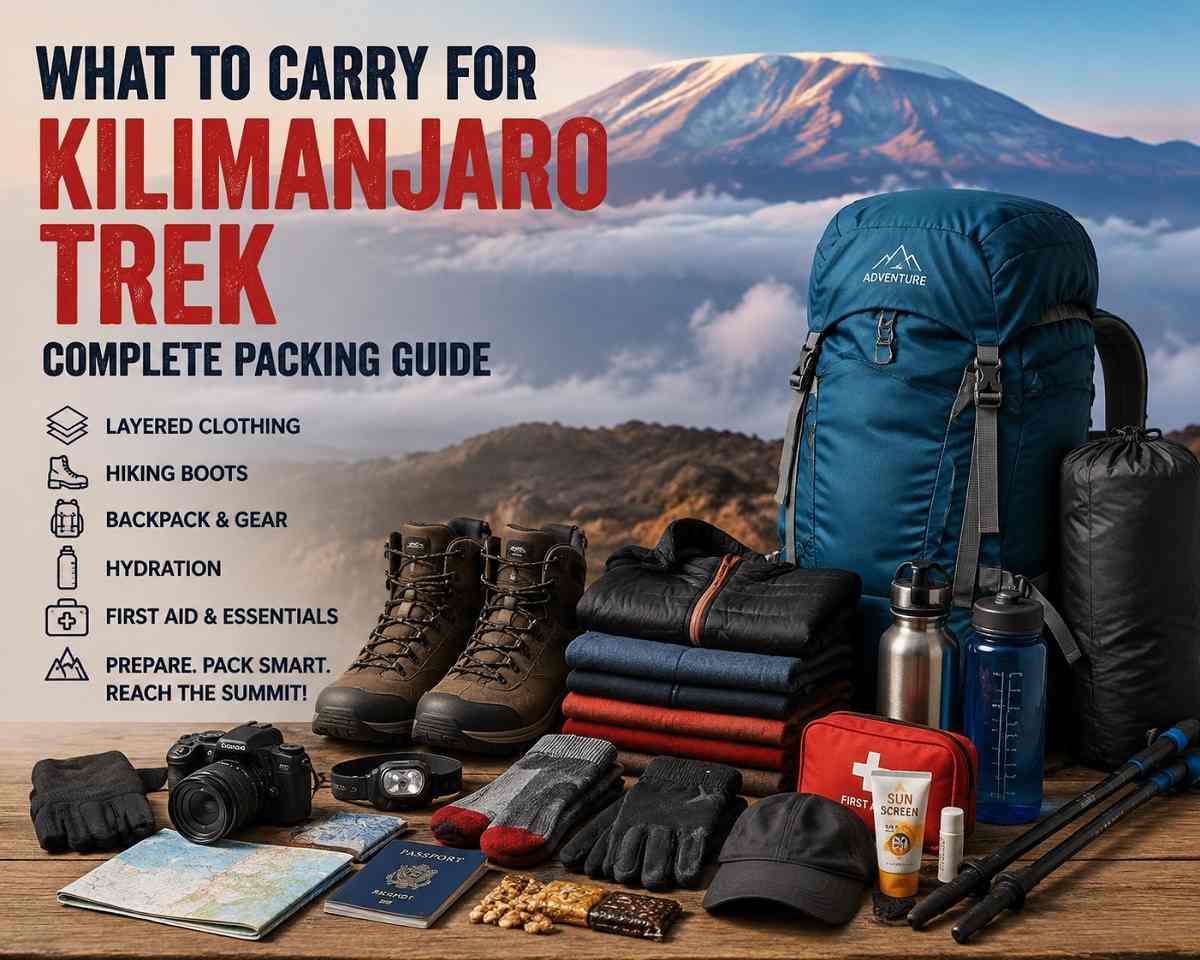
What to Carry for Kilimanjaro Trek: Complete Packing Guide
If you are wondering what to carry for a Kilimanjaro trek, the honest answer is: fewer fancy items than you think, but every one of them has to work across five climates in nine days.
Most first-timers pack like they’re going on a cold-weather holiday. Kilimanjaro isn’t that. You start in warm, humid farmland and rainforest, and finish on an arctic summit where night temperatures fall well below freezing. Your gear has to carry you through both extremes, sometimes on the same day.
This complete Kilimanjaro packing list lays out exactly what our expedition team asks every climber to carry, why each item matters, and what happens on the mountain if you skip it.
Quick Answer
|
Why Kilimanjaro Packing Is Different From a Himalayan Trek
Most first-time climbers over-pack heavy woollens and under-pack proper layering. Kilimanjaro has five ecological zones — cultivation, rainforest, heath/moorland, alpine desert and arctic summit — so your kit gets tested against heat, rain, wind and frost within a single week.
Near Moshi, at the base, daytime temperatures typically range from 18°C to 30°C depending on season. By the time you reach Uhuru Peak (5,895 m), night temperatures generally fall between -7°C and -20°C, occasionally colder on extreme nights with wind chill. This is why a generic hill-station packing list won’t work here — you need true expedition-grade layering, not a single thick jacket.
- Cultivation zone (800m–1,800m): Farmland and villages, warm and humid.
- Rainforest zone (1,800m–2,800m): Lush, wet, frequent afternoon showers.
- Heath/moorland zone (2,800m–4,000m): Cooler, drier, strong UV by day.
- Alpine desert zone (4,000m–5,000m): Near-freezing nights, barren terrain.
- Arctic/summit zone (5,000m+): Sub-zero, windy, roughly half the oxygen of sea level.
This is why a proper Kilimanjaro packing checklist is built around zones and layers, not a fixed list of jackets — the same rucksack has to work in humid heat on day one and in arctic wind on summit night.
- Must Read on: How to Prepare for Your First Mount Kilimanjaro Trek
Route Snapshot: Distance, Camps and Gates
Knowing the distance and camps on your route helps you plan gear for each day rather than the trek as a whole.
| Route | Distance | Key Camps/Gates Passed |
|---|---|---|
| Machame | ~62 km (37 mi) | Machame Gate → Machame Camp → Shira Camp → Barranco Camp → Karanga Camp → Barafu Camp → Uhuru Peak → Mweka Gate |
| Marangu | ~72 km (45 mi) | Marangu Gate → Mandara Hut → Horombo Hut → Kibo Hut → Uhuru Peak → Marangu Gate |
Complete Kilimanjaro Packing List by Category
What most people don’t realise is that Kilimanjaro packing lists are not about buying the most expensive gear — they are about covering every layer, every extremity, and every failure point. Here is the full list our team hands out before every departure.
Headwear and Eye Protection
- Warm woollen hat or beanie (covers ears)
- Balaclava or neck gaiter/buff for summit night
- Wide-brim sun hat or cap for lower altitude sun
- UV-protective sunglasses (category 3–4, glacier-style preferred)
- Head torch/headlamp with spare batteries — summit day starts around midnight
Upper Body Layers
- Thermal base layers, top and bottom — carry at least 3 sets
- Mid-layer fleece jacket
- Insulated down jacket (rated for sub-zero nights)
- Waterproof and windproof outer jacket (breathable shell)
- Lightweight poncho for sudden rainforest showers
Lower Body and Hands
- Hiking trousers, quick-dry, with reinforced knees
- Waterproof trousers/overpants
- Inner glove liners (for dexterity at camp)
- Waterproof insulated outer gloves (for summit night)
Footwear
- Broken-in, waterproof hiking boots with ankle support
- Hiking socks — 4 pairs minimum, wool or synthetic blend, no cotton
- Gaiters to keep scree and snow out of boots
- Comfortable camp shoes/sandals for evenings
- Microspikes (optional): rarely needed, but useful in icy conditions near the summit in colder months
Sleep, Water and Pack Essentials
- Sleeping bag rated to at least -15°C to -20°C
- Sleeping bag liner for extra warmth and hygiene
- Trekking poles/walking stick — protects knees on steep descents
- Water bottles, 2 litres total, plus a hydration bladder (camelback)
- Rucksack (daypack) with rain cover, 30-35 litres
- Large duffel bag for porter-carried gear (soft-sided, no wheels)
Health and Personal Items
- High-SPF sunscreen and lip balm with sun protection
- Personal prescription medication and a basic first-aid kit
- Altitude sickness medication if prescribed by your doctor (Diamox is commonly used, but people with a sulfa-drug allergy should discuss alternatives with their doctor beforehand)
- Blister kit: moleskin or Leukotape, plus antiseptic and bandages
- Basic over-the-counter medicines: rehydration salts (ORS), pain relief, and anti-diarrheal tablets
- Hand sanitiser, wet wipes, and toilet paper
- Power bank for charging headlamp batteries and phone
Kilimanjaro Packing Checklist Table (Quick Reference)
Use this quick-reference things-to-carry table for Kilimanjaro climb preparation alongside the detailed category lists above — it’s designed to be scanned in under a minute before you zip up your duffel.
| Item | Quantity | Why It Matters |
|---|---|---|
| Down jacket | 1 | Core insulation for summit night (-7°C to -29°C) |
| Waterproof/windproof shell | 1 | Blocks rain in rainforest zone, wind above 4,000m |
| Thermal base layers | 3 sets | Rotate for hygiene and warmth across 9 days |
| Hiking boots (broken-in) | 1 pair | Prevents blisters on 60+ km of trail |
| Hiking socks | 4 pairs | Wool/synthetic only — cotton stays wet |
| Sleeping bag (-15°C to -20°C rated) | 1 | Camp temperatures fall well below freezing |
| Headlamp + spare batteries | 1 + spares | Summit push starts around midnight |
| Trekking poles | 1 pair | Protects knees on the long summit-day descent |
| Water bottles/bladder | 2-3 litres | Dehydration worsens altitude sickness risk |
| Duffel bag (soft-sided) | 1, under 15 kg | Porter-carried; wheels and hard shells don’t work |
Money, Tipping and Electronics You’ll Need on the Mountain
Beyond clothing and camping gear, a few practical items get overlooked until the last day of packing.
- Cash for tipping: Guides, cooks and porters are tipped in cash (USD or Tanzanian Shillings) at the end of the climb — carry small denomination notes, since change is hard to arrange on the mountain.
- Travel adapter: Tanzania uses Type D and Type G sockets at 230V, 50Hz. Type G (UK-style, three rectangular pins) is the most common in hotels, so a universal adapter covering both is the safest bet.
- Power bank: There is no charging point on the mountain itself, so a fully charged power bank (10,000mAh or higher) keeps your headlamp, phone and camera running for the full climb.
- Cash and cards: ATMs are available in Moshi town, but not on the mountain — withdraw and exchange what you need for tips and personal expenses before you start trekking.
- Ziplock or dry bags: Useful for keeping cash, passport copies, and electronics dry through the rainforest zone.
What NOT to Carry: Drones and Restricted Items
Drones are a common question from photography enthusiasts. Flying one on Kilimanjaro legally requires advance written permits from the Tanzania National Parks Authority (TANAPA) and the Tanzania Civil Aviation Authority (TCAA); recreational or personal-use drone flights are not normally approved. Unless you have secured these permits weeks in advance, it’s simplest — and safest for your gear budget — to leave the drone at home and let your guide’s summit photos do the job.
Daily Life on the Mountain: Water, Food, Toilets and Network
Beyond your packing list, it helps to know what daily life on Kilimanjaro actually looks like.
- Water: Aim for 3-4 litres a day. Your crew boils or filters stream water, but carrying purification tablets or a filter bottle as backup is a smart habit.
- Food: Three cooked meals a day are provided on the mountain, with vegetarian options available on request — let Shikhar Travels know your dietary needs when booking.
- Snacks: Pack your own energy bars, electrolytes, glucose tablets, and dry snacks for the trail between meals, especially for summit night.
- Toilets: Camps have basic long-drop or portable toilets; a personal roll of toilet paper and hand sanitiser go a long way.
- Network and WiFi: Mobile signal is patchy above the rainforest zone and unreliable near the summit — download offline maps and let family know you may be unreachable for a day or two.
- Laundry: There’s no laundry service on the mountain, so pack enough base layers and socks to avoid re-wearing damp clothing.
Who Can Climb: Fitness, Age and Beginner Questions
Kilimanjaro is a non-technical trek — no ropes or climbing skills required — which is why it attracts a wide range of first-time high-altitude trekkers each year.
- Beginners: Yes, beginners can climb Kilimanjaro with good fitness, proper acclimatization, and an experienced guide. Prior trekking experience helps but isn’t mandatory.
- Children: Most operators, including Shikhar Travels, set a minimum age of around 10-12 years, since altitude and long trekking days are demanding for younger children.
- Senior trekkers: There’s no strict upper age limit — fitness and a doctor’s clearance matter more than age itself.
- Altitude sickness: Watch for headache, nausea, dizziness and breathlessness (mild AMS). Severe symptoms like confusion or a persistent cough can signal HAPE or HACE, both medical emergencies requiring immediate descent — this is why a guide with oxygen and evacuation protocols matters.
From Practical Experience: What Actually Fails on the Mountain
On the ground, our guides see the same three gear failures every season.
- Cotton socks that stay wet and cause blisters by day three.
- Gloves that are warm but not waterproof, and turn to ice on summit night.
- Boots bought two weeks before departure that are never broken in, causing blisters exactly when climbers need their feet most.
The Barranco Wall and Barafu Camp sections are where cold and fatigue hit hardest. Most experienced trekkers layer up before they feel cold, not after — once your core temperature drops at 4,700m, it’s hard to recover on the move. Treat your packing list as a safety checklist, not a shopping list.
Step-by-Step: How to Pack Your Kilimanjaro Duffel and Daypack
- Separate your gear into two bags: a duffel for the porter and a daypack you carry yourself.
- Pack heavier, less-used items (spare clothing, sleeping bag) at the bottom of the duffel.
- Keep summit-night gear (down jacket, gloves, balaclava) near the top so it is quick to find at Barafu or Kibo camp.
- Weigh your duffel before departure — keep it under 15 kg so it stays within porter-friendly limits.
- In your daypack, carry only what you need during the day’s walk: water, rain shell, sunscreen, snacks, camera, and a basic first-aid kit.
- Line both bags with a dry-bag or heavy plastic liner — rainforest days can be genuinely wet.
- Do a full trial pack at home and walk around your neighbourhood with the loaded daypack before you fly out.
| ⚠ Booking Note
September to December and January-February slots fill up fast during the dry season. Advance booking is recommended, especially for the December Christmas and New Year departures. |
Common Packing Mistakes to Avoid
- Buying brand-new boots days before the trek instead of breaking them in over weeks
- Packing cotton clothing, which stays wet and cools the body dangerously fast
- Carrying only one pair of gloves instead of a liner-plus-outer combination
- Skipping a proper rain cover and assuming a poncho alone is enough
- Overloading the daypack, which tires you out well before summit night
- Forgetting spare batteries for the headlamp — summit day starts around midnight
- Not testing gear before departure, so fit and comfort issues surface for the first time on the mountain
Pro Tips From Our Expedition Team
- Dress in layers you can remove and add quickly without taking off your backpack.
- Keep your water bottle inside your jacket at night before summit push — it can freeze otherwise.
- Carry hand and toe warmers as backup for summit night, especially if you feel the cold easily.
- Pack a lightweight power bank; batteries drain faster in cold, high-altitude conditions.
- Rent bulky gear like sleeping bags and down jackets locally if you are travelling from India, to save on luggage weight and cost.
Why Choose Shikhar Travels for Your Kilimanjaro Climb
Shikhar Travels India Pvt. Ltd. has been organising guided mountaineering and trekking expeditions since 1979, and was India’s first company to offer fully-guided mountaineering expeditions. The company is recognised by the Ministry of Tourism, Government of India, as an Inbound and Adventure Tour Operator, and is registered with the Indian Mountaineering Foundation.
- Over 90% claimed summit success rate through expert route planning and acclimatization strategy
- Professional, English-speaking guides with high-altitude experience
- Comprehensive medical kits and oxygen support carried on every climb
- Fair wages and ethical treatment for porters, in line with responsible tourism practice
- Pre-departure training and physical preparation guidance provided from India
- 45+ years of Himalayan and international expedition experience, 400+ expeditions handled
Call: +91 9717891151 Email: tours@shikhar.com
Frequently Asked Questions
What is the most important item to carry for a Kilimanjaro trek?
A good waterproof, insulated down jacket and a sleeping bag rated to at least -15°C matter most, since summit night temperatures fall well below freezing.
How many layers of clothing do I need for Kilimanjaro?
You need a five-layer system: base thermal layer, mid fleece layer, insulating down layer, waterproof-windproof shell, and accessories like gloves and a balaclava for summit night.
How cold does it get on Kilimanjaro summit night?
Temperatures at Uhuru Peak typically range from -7°C to -20°C, occasionally colder with wind chill — pack a spare pair of glove liners as backup.
Are hiking poles really necessary for Kilimanjaro?
Yes. Trekking poles reduce knee strain on the long summit-day descent and help with balance on loose scree sections.
How many pairs of socks should I pack?
Pack at least four pairs of moisture-wicking wool or synthetic hiking socks. Avoid cotton, since it stays damp and increases blister risk.
What is the porter weight limit for my duffel bag on Kilimanjaro?
Park regulations cap porters at 20 kg of client gear, separate from their own kit. Keep your duffel bag close to 15 kg for a safe margin.
Should I carry my own daypack or let the porter carry everything?
Carry a daypack yourself with water, rain gear, sunscreen and snacks for the day’s walk. Porters carry your main duffel, tents and camping equipment.
What footwear works best for Kilimanjaro?
Broken-in, waterproof hiking boots with good ankle support are essential. New or untested boots are a common cause of blisters on the mountain.
Do I need altitude sickness medication?
Many climbers carry Diamox after consulting their doctor, since Kilimanjaro’s rapid altitude gain raises acute mountain sickness risk. It isn’t suitable for people with a sulfa-drug allergy.
Which route should I choose, Marangu or Machame?
Marangu offers hut accommodation and a gentler pace, suited to first-timers. Machame involves tent camping and a more varied altitude profile many find helps acclimatization.
What is the best time of year to climb Kilimanjaro?
January-February and June-October are the driest, most reliable months. December suits Christmas/New Year departures, while November brings short rains.
How much does a Kilimanjaro trek with Shikhar Travels cost?
The 2026 price for the 9 Days/8 Nights Machame Route is USD 2,778 per person. Marangu Route pricing is available on request.
What travel documents and insurance do I need?
A Tanzania e-visa (USD 50 for most nationalities, including Indian travellers) is required, and travel insurance covering high-altitude evacuation is strongly recommended.
Do I need to carry cash for tipping on Kilimanjaro?
Yes. Guides, cooks and porters are tipped in cash — USD or Tanzanian Shillings — at the end of the climb, so carry small denomination notes.
Can I wear cotton clothes or jeans on Kilimanjaro?
No. Cotton and jeans stay wet once damp and drain body heat fast at altitude. Stick to wool or synthetic moisture-wicking fabrics throughout.
Do I need crampons to climb Kilimanjaro?
No, standard treks don’t require crampons. Lightweight microspikes are occasionally useful in icy conditions near the summit in colder months.
Can I drink tap water on Kilimanjaro?
No. Your crew boils or filters water on the mountain, and it’s wise to carry purification tablets or a filter bottle as backup, especially at lower camps.
Is WiFi or mobile network available on the mountain?
Signal is patchy above the rainforest zone and unreliable near the summit. Download offline maps and inform family you may be unreachable for a day or two.
How much water should I drink daily while climbing?
Aim for 3-4 litres a day. Staying well-hydrated significantly lowers your risk of altitude sickness on the ascent.
Can beginners climb Kilimanjaro?
Yes. Kilimanjaro is a non-technical trek, so beginners with good fitness, proper acclimatization, and an experienced guide can complete it successfully.
Final Word: Pack for the Mountain, Not the Postcard
Knowing what to carry for a Kilimanjaro trek comes down to respecting five climate zones, not packing the heaviest jacket you own. Get your layering, footwear, sleeping bag and duffel weight right, and the gear stops being a worry — leaving you free to focus on the climb itself.
If you are planning this seriously, our team at Shikhar Travels can share the full expedition kit list, rental options, and training guidance specific to your chosen route and departure month.
Ready to plan your Kilimanjaro climb? Call +91 9717891151 or email tours@shikhar.com to check 2026 departure dates and book your slot.