Kilimanjaro Weather Guide 2026: Packing Guide by Zone
You can start a Kilimanjaro climb sweating in a T-shirt and end the same day shivering in three layers. That’s not bad luck — it’s how the mountain works. Kilimanjaro doesn’t have “seasons” the way most trekking destinations do. It has altitude, and altitude decides everything.
This Kilimanjaro weather guide breaks down Mount Kilimanjaro’s climate zones and temperatures month by month, and tells you exactly what to pack for each stretch of the climb — not a generic “bring warm clothes” list, but the real gear that gets used on summit night versus the gear that just adds weight to your duffel.
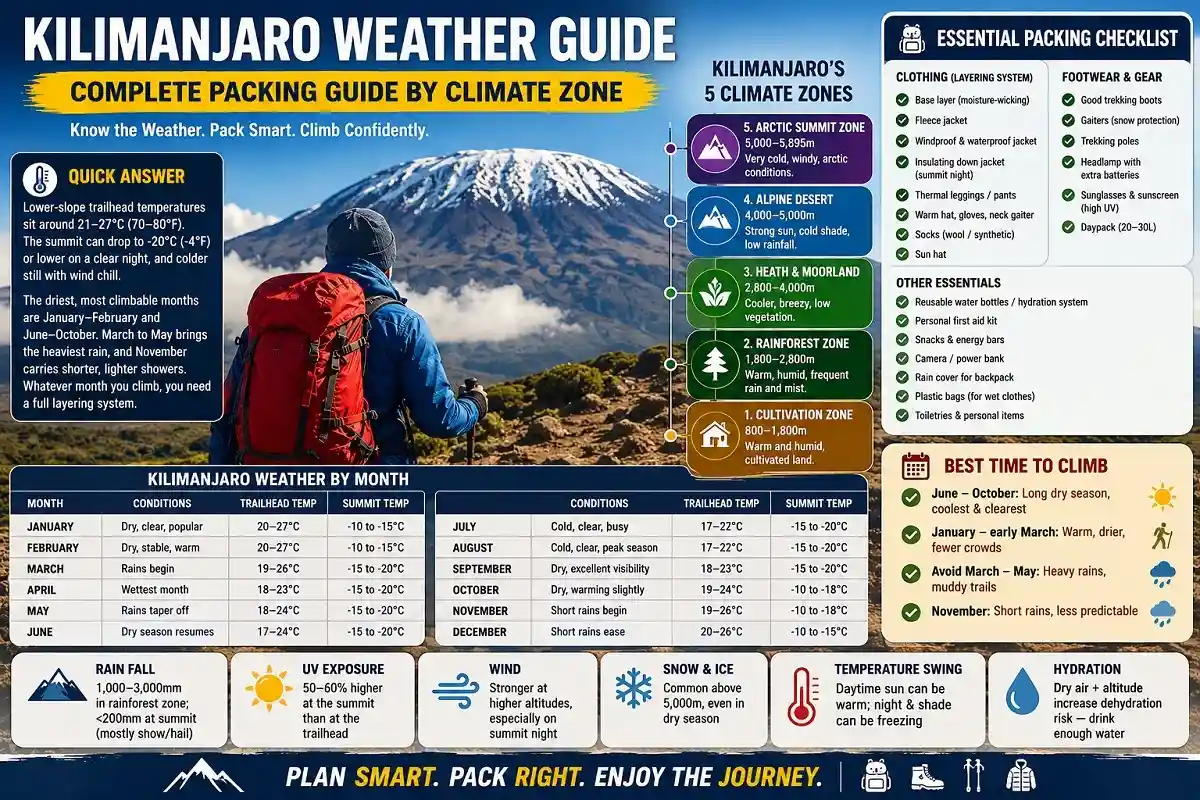
Quick Answer:
Lower-slope trailhead temperatures sit around 21–27°C (70–80°F). The summit can drop to -20°C (-4°F) or lower on a clear night, and colder still with wind chill.
The driest, most climbable months are January–February and June–October. March to May brings the heaviest rain, and November carries shorter, lighter showers. Whatever month you climb, you need a full layering system, because you’ll pass through nearly every one of Kilimanjaro’s climate zones in under a week.
Kilimanjaro’s Five Climate Zones, Explained
Kilimanjaro rises from tropical farmland to arctic ice in under 5,000 vertical metres. Each zone has its own weather, and your pack needs to work in all five.
The elevation bands below are approximate — exact boundaries shift slightly by route and by source, so treat them as general guidance rather than fixed markers.
1. Cultivation Zone (approx. 800–1,800m)
Warm, humid, and green — this is where most routes begin. Daytime temperatures generally run 21–27°C. Light trekking clothes are enough here.
2. Rainforest Zone (approx. 1,800–2,800m)
Humid and prone to sudden showers, even in the dry season. This zone is Kilimanjaro’s wettest, receiving roughly 1,000–3,000mm of rain a year depending on the slope. Mist rolls in fast, so your rain jacket earns its place in the daypack, not the duffel.
3. Heath and Moorland (approx. 2,800–4,000m)
Vegetation thins out, air cools noticeably, and UV exposure climbs sharply. Expect a layering rhythm of stripping down while climbing and adding a fleece the moment you stop.
4. Alpine Desert (approx. 4,000–5,000m)
Warm sun, freezing shade, thin air. Daytime swings of 20°C or more between sun and shadow are normal. Rainfall drops to a few hundred millimetres a year here, mostly as snow or hail. Sunglasses and a windproof layer matter as much as warmth.
5. Arctic Summit Zone (5,000–5,895m)
This is where the real cold lives. Air temperature on summit night typically falls between -10°C and -20°C, but wind chill regularly drags the felt temperature down to -25°C to -30°C on exposed ridges. Every serious piece of cold-weather gear you own gets used in these final hours.
Kilimanjaro Weather by Month: Best Time to Climb
Kilimanjaro is climbable year-round, but two dry windows offer the most predictable conditions:
- June to October — the long dry season, coolest and clearest, most popular with climbers.
- January to early March — warmer, drier, with fewer crowds than July–August.
- March to May — the long rains; trails turn muddy and summit visibility drops.
- November — short rains; lighter and less predictable than the March–May season.
For a closer look, here’s how each month generally shapes up:
| Month | Conditions | Trailhead Temp | Summit Temp |
|---|---|---|---|
| January | Dry, clear, popular | 20–27°C | -10 to -15°C |
| February | Dry, stable, warm | 20–27°C | -10 to -15°C |
| March | Rains begin | 19–26°C | -15 to -20°C |
| April | Wettest month | 18–23°C | -15 to -20°C |
| May | Rains taper off | 18–24°C | -15 to -20°C |
| June | Dry season resumes | 17–24°C | -15 to -20°C |
| July | Cold, clear, busy | 17–22°C | -15 to -20°C |
| August | Cold, clear, peak season | 17–22°C | -15 to -20°C |
| September | Dry, excellent visibility | 18–23°C | -15 to -20°C |
| October | Dry, warming slightly | 19–24°C | -10 to -18°C |
| November | Short rains begin | 19–26°C | -10 to -18°C |
| December | Short rains ease | 20–26°C | -10 to -15°C |
Rainfall, Wind, UV and Snow: The Numbers Behind the Zones
Temperature isn’t the only thing that changes with altitude on Kilimanjaro. Rainfall, wind, and sun exposure shift just as sharply.
- Rainfall: the rainforest zone gets 1,000–3,000mm a year, while the summit zone sees under 200mm, mostly as snow or hail.
- UV exposure: radiation increases by roughly 50–60% from the trailhead to the summit, even on cool or cloudy days.
- Wind: exposed ridges above 4,000m see the strongest gusts, especially on the final summit push before dawn.
- Snow: light summit snow is possible in most months, but it rarely settles below the alpine desert zone.
Does Weather Differ by Route?
Yes, slightly. Southern and eastern routes — Machame, Marangu, Umbwe — sit on the windward side and catch more rain. Northern routes like Rongai sit in a rain shadow and stay noticeably drier, which is useful during the wetter months.
Kilimanjaro’s Glaciers: A Fast-Changing Climate Story
Kilimanjaro’s ice fields have shrunk by more than 80% since 1912, and scientists expect most of the remaining glaciers to disappear within the next few decades. Short-term snowfall can occasionally add ice back temporarily, but it hasn’t reversed the long-term retreat.
For climbers, this mainly affects the view from the summit rather than trail conditions — the glaciers are a shrinking backdrop, not a hazard on the standard trekking routes.
What Climbers Actually Feel on the Mountain
On paper, the numbers look manageable. In real life, wind chill changes the story completely.
A guide leading groups on the Lemosho and Machame routes will tell you the same thing every season: climbers who pack “for the temperature” without accounting for wind and time-of-day swings are the ones who struggle most on summit night.
What most people don’t realize is that the discomfort isn’t usually the cold at the summit. It’s the two hours before sunrise, standing still at a rest point, when sweat from the climb turns cold against the skin. That’s why moisture-wicking base layers matter more than a single “big warm jacket.”
One mistake many people make is buying a heavy down jacket and assuming it replaces the whole layering system. It doesn’t. A single thick layer traps sweat and leaves you cold once you stop moving. Three thinner layers you can add or remove work better than one bulky one.
Best Weather for Photography and Clear Summit Views
If clear views matter to you, aim for July to October or January to February. Skies are driest then, and cloud cover below the summit is thinnest in the early morning before it builds through the afternoon.
The Complete Kilimanjaro Packing List
This is where the layering system pays off. Build your kit around these five categories.
Quick Reference: What to Wear at Each Temperature
| Temperature | What You’ll Likely Need |
|---|---|
| 20°C+ | Base layer or light trekking shirt |
| 10°C | Base layer + fleece mid layer |
| 0°C | Base + fleece + windproof shell |
| -10°C | Full layering + insulated gloves and hat |
| -20°C and below | Every layer, including down jacket and balaclava |
Base Layers (worn daily, every zone)
- 2–3 moisture-wicking base tops (merino wool or synthetic — avoid cotton)
- 2 thermal base-layer bottoms
- 4–5 pairs of quick-dry trekking socks + liner socks to prevent blisters
Mid Layers (heath, moorland, alpine desert)
- Fleece jacket or lightweight insulated jacket
- Softshell or insulated trekking trousers
- Warm hat covering the ears
Outer / Summit Layers (arctic zone, summit night)
- Waterproof, windproof shell jacket with a hood (look for at least a 10,000mm waterproof rating)
- Waterproof shell trousers
- Insulated down or synthetic jacket rated for sub-zero temperatures — down is warmer for its weight, synthetic insulates better when damp
- Insulated waterproof gloves + thin liner gloves
- Balaclava or neck gaiter for summit night wind
Sleep System (packed in the duffel)
- Four-season sleeping bag rated to at least -10°C to -15°C — camp temperatures above 4,000m drop well below freezing
- Sleeping bag liner for extra warmth and hygiene
- Inflatable sleeping pad or extra padding, if not provided by your operator
Footwear
- Broken-in waterproof hiking boots with ankle support
- Camp shoes or sandals for evenings at camp
- Gaiters, useful in muddy or scree sections
Daypack Essentials (carried every day, 25–35L pack)
- 2–3 litres water capacity (bottles or hydration bladder)
- Rain cover for the daypack
- Headlamp with spare batteries for the pre-dawn summit push
- High-SPF sunscreen and lip balm (UV is strong above the cloud line)
- Sunglasses rated for high-altitude glare
- Basic first-aid kit and any altitude medication prescribed by your doctor
- Trekking poles for knee support on steep and descending sections
- High-energy snacks — trail mix, energy bars, dried fruit
How to Pack: A Step-by-Step Approach
- Start with the layering system, not individual items — build base, mid, and outer layers first, then fill gaps.
- Pack your duffel (carried by porters) with camp clothing, sleeping bag, and spares — the Kilimanjaro Porters Assistance Project (KPAP) caps total porter load at 20kg, and since porters carry 5–7kg of their own gear, most responsible operators cap your client duffel at 15kg to stay within that limit.
- Pack your daypack with anything you’ll need without accessing the duffel: water, rain gear, snacks, camera, sun protection.
- Carry critical items — boots, base layers, medication — in your flight carry-on in case checked luggage is delayed.
- Do a full trial hike wearing your boots and carrying your loaded daypack before you fly out.
Must Reads on:
Common Packing Mistakes to Avoid
- Buying boots and not breaking them in — a guaranteed cause of blisters by day two.
- Packing cotton clothing — it holds sweat and chills you fast once you stop moving.
- Underestimating summit-night cold because base-camp weather felt warm.
- Skipping the rain cover for the daypack, assuming the dry season means no rain at all.
- Overpacking the duffel beyond your operator’s 15kg client limit, which causes delays when bags are weighed at the park gate.
Weather-Related Safety: Hypothermia and Cold Exposure
Altitude sickness, not weather, is the leading safety concern on Kilimanjaro — but cold exposure on summit night is the main weather-related risk, and it’s almost always preventable with the right gear. Guides are trained to watch for shivering that won’t stop, confusion, slurred speech, or slowed reactions, and will add a layer or turn a climber back if needed.
Staying dry matters more than staying bundled up. Wet clothing loses insulation fast, so change out of sweat-soaked base layers at camp and keep a spare dry set reserved only for sleeping. Eating enough on summit night also helps — your body needs fuel to generate its own heat in sub-zero wind chill.
Tell your guide immediately if you or a teammate feels persistent shivering, confusion, or unusual clumsiness — cold exposure escalates faster on Kilimanjaro than most first-time climbers expect.
A few other cold- and sun-related issues worth knowing about:
- Frostnip and frostbite: numbness or white patches on fingers, toes, nose, or ears — cover exposed skin fully on summit night.
- Sunburn: UV is far stronger at altitude even in cold weather, so sunscreen matters on every zone, not just the hot lower slopes.
- Snow blindness: glare off snow and ice can burn the eyes — wear glacier-rated sunglasses above the tree line.
Frequently Asked Questions
1. What is the coldest month to climb Kilimanjaro?
July and August tend to bring the coldest, clearest conditions, with summit night temperatures regularly falling to -15°C to -20°C.
2. Do I need a four-season sleeping bag?
Yes. Camp temperatures drop well below freezing above 4,000m, so a sleeping bag rated for at least -15°C is standard advice from most operators.
3. Can I climb Kilimanjaro during the rainy season?
Yes, but trails get muddy and summit visibility drops. If you climb in March–May or November, prioritize waterproof gear over extra warm layers.
4. How cold does it get on summit night?
Air temperature typically runs -10°C to -20°C, but wind chill can push the felt temperature to -25°C to -30°C. This is the coldest stretch of the entire climb.
5. What shoes are best for Kilimanjaro?
Waterproof hiking boots with ankle support, broken in over several weeks before the trip. Trail shoes are not warm or supportive enough for summit night.
6. How much should my daypack weigh?
Many climbers carry roughly 5–7kg — enough for water, snacks, rain gear, and layers — though this varies by operator and personal packing style.
7. Is a down jacket necessary?
Yes, for summit night specifically. A sub-zero rated down or synthetic insulated jacket is one of the few non-negotiable items on the list.
8. What’s the porter weight limit for my duffel bag?
KPAP caps total porter load at 20kg, so most responsible operators cap your client duffel at 15kg (porters carry the rest as their own gear). Bags are usually weighed before or at the park gate.
9. Do I need gloves and a hat even in the dry season?
Yes. Dry season affects rainfall, not summit temperature. Insulated gloves and a warm hat are needed on every route, every month.
10. What’s the biggest packing mistake first-time climbers make?
Relying on one heavy jacket instead of a full layering system. Layers you can add and remove handle Kilimanjaro’s swings far better than a single bulky piece of gear.
Final Word
This Kilimanjaro weather guide comes down to one idea: it’s not really about the calendar, it’s about altitude. You’ll move through five Mount Kilimanjaro climate zones in under a week, and your gear needs to keep pace with every one of them. Build your kit around layering, pack a properly rated sleeping bag, break in your boots early, and treat summit night as the coldest, windiest stretch you’ll face, regardless of which month you climb.
If you’re finalizing your dates and route, check current seasonal conditions with your operator before you fly, and pack according to the zone-by-zone breakdown above — not just the weather forecast for your arrival day.
- Suggested Tour: Mount Kilimanjaro Trekking Expedition