How to Plan a Denali Climbing Expedition
Climbing Denali takes more than motivation. A Denali climbing expedition means National Park Service permits, months of load-carrying training, and a solid West Buttress route plan — plus enough spare days to sit out Alaska Range storms.
North America’s highest peak stands at 20,310 feet, and most climbers who struggle here didn’t fail on summit day. They failed months earlier, in planning. Here’s what actually goes into getting it right.
Quick Answer
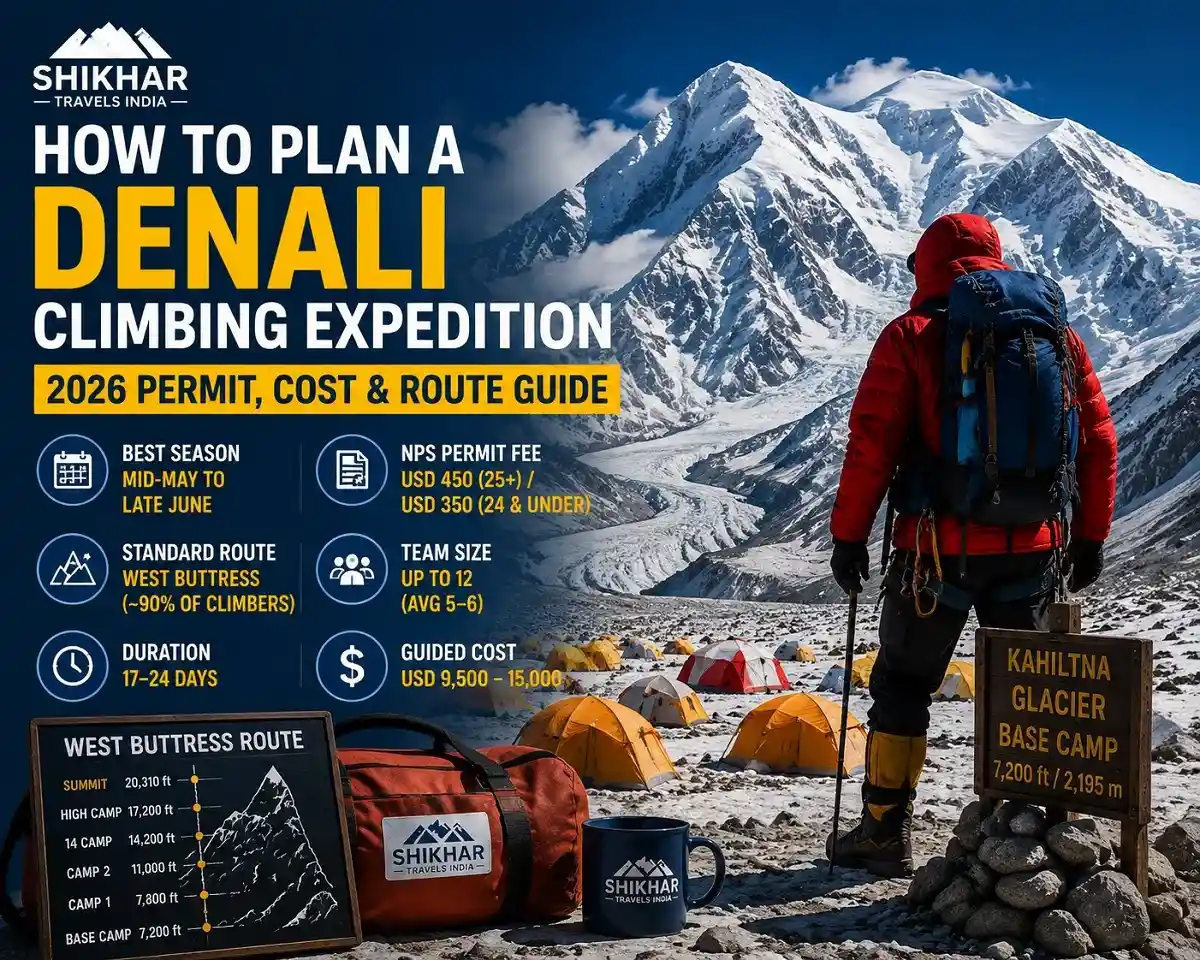
Best season: mid-May to late June. Route: West Buttress (~90% of climbers). Permit: NPS fee USD 450 (25+) / USD 350 (24 & under), register 60+ days ahead via Pay.gov. Team size: up to 12, average 5–6. Duration: 17–24 days. Guided cost: USD 9,500–15,000. Source: NPS Mountaineering, Pay.gov.
Denali Key Facts at a Glance
| Fact | Detail |
|---|---|
| Elevation | 20,310 ft / 6,190 m |
| Location | Denali National Park, Alaska |
| Standard route | West Buttress (~90% of climbers) |
| Best season | Mid-May to late June |
| Permit fee (2026) | USD 450 (25+) / USD 350 (24 & under) |
| Duration | 17–24 days |
| Guided cost | USD 9,500 – 15,000 |
| Success rate | ~50% long-term average (31%–70% by season) |
What Is a Denali Climbing Expedition?
A Denali climbing expedition is a multi-week, self-supported climb up North America’s highest peak inside Denali National Park, Alaska. It suits climbers with prior glacier travel and crevasse rescue experience, not first-timers.
The mountain’s official NPS name is Denali, though a January 2025 executive order reverted the federal name to Mount McKinley. Alaska state agencies and most guide services still use Denali. Naming can change again, so always confirm the current term on nps.gov.
Best Time to Climb Denali
NPS keeps the climbing season open roughly May 1 to July 15, but the best time to climb Denali is mid-May to late June, when snow bridges over crevasses are firmest and weather is most stable.
Late-season climbs face softer glaciers and rising crevasse risk, which is why most guided departures cluster into that six-week window.
Denali Climbing Permit Cost and Registration
| Fee Type | Amount |
|---|---|
| Special Use Fee — age 25+ | USD 450 |
| Special Use Fee — age 24 & under | USD 350 |
| Park entrance fee | USD 15 (waived with Interagency or Denali Annual Pass) |
Every climber needs an NPS Mountaineering Special Use Permit, paid via Pay.gov, plus a signed application submitted at least 60 days before your climb date. Teams max out at 12 climbers (average 5–6), and NPS caps total season registrations at 1,500.
You’ll also attend a mandatory briefing at the Walter Harper Talkeetna Ranger Station before flying to Base Camp. (Source: NPS Mountaineering, Pay.gov.)
The West Buttress Route: Camps, Distance and Fixed Lines
The West Buttress, first climbed in 1951, is the standard line for a Denali ascent. It starts with a 30-minute ski-plane flight from Talkeetna to Kahiltna Glacier Base Camp.
| Camp | Elevation | Distance from Previous Camp |
|---|---|---|
| Base Camp | 7,200 ft | Fly in from Talkeetna |
| Camp 1 | 7,800 ft | ~5.5 miles |
| Camp 2 | 11,000 ft | ~4 miles (Ski Hill) |
| 14 Camp | 14,200 ft | ~3.5 miles via Windy Corner |
| High Camp | 17,200 ft | ~2 miles via the Headwall |
| Summit | 20,310 ft | ~3 miles; 8–14 hr round trip |
The Headwall’s fixed lines sit roughly between 15,500 and 16,100 ft on a 50-degree slope — the route’s one genuinely technical stretch. Total glacier travel runs about 20 km one-way from Base Camp to the summit.
Getting There: Anchorage, Talkeetna and Air Taxi
Anchorage is the entry point. A shuttle to Talkeetna takes roughly 2 hours (about USD 85 per person). From Talkeetna, ski-planes fly climbers to Kahiltna Glacier Base Camp — a 30-minute flight run by Talkeetna Air Taxi or K2 Aviation, the two established glacier air services.
Gear allowance typically runs 125 lbs per climber, with extra weight billed around USD 2/lb, so pack deliberately.
Training, Documents and Insurance You Need
- Prior glacier travel and crevasse rescue experience, expected by nearly every operator
- Load-carrying training (30–40 kg) for 6+ months — cardio alone won’t get you up this mountain
- A passport valid 6+ months, plus a US B1/B2 visa for most nationalities including Indian climbers
- Emergency medical evacuation and repatriation insurance — NPS rescue is discretionary, not guaranteed
- Trip cancellation cover is worth adding, since most operator fees are non-refundable
Choosing a Denali Guide Service
Only NPS-authorised concessioners can legally guide commercial Denali climbers; anyone else is subcontracting through one of these.
| Operator | Duration | Starting Price (2026) |
|---|---|---|
| Alaska Mountaineering School (AMS) | 22 days | ~USD 12,700 |
| Alpine Ascents International | 21 days | ~USD 11,900+ |
| IMG Denali LLC (Shikhar’s partner) | 19 days | USD 14,950 |
| Mountain Trip Alaska LLC | 20–22 days | ~USD 9,800–12,900 |
| Rainier Mountaineering Inc (RMI) | 21 days | ~USD 10,800+ |
Total Expedition Budget
| Option | Typical Cost (2026) |
|---|---|
| Guided expedition | USD 9,500 – 15,000 |
| Independent / unsupported climb | USD 4,000 – 6,000 |
| NPS permit + entrance fee | USD 365 – 465 per person |
Guided prices usually include guides, group gear, ski-plane flights and camp food — not flights to Anchorage, personal gear, or insurance. Always confirm exact inclusions before booking.
Gear, Communication and Safety Essentials
- Expedition down suit and a sleeping bag rated to -40°F, plus double or triple mountaineering boots
- A Clean Mountain Can (mandatory human-waste system) and a satellite communicator — cell signal doesn’t reach the glacier
- Watch for acute mountain sickness above 10,000 ft: headache, nausea and poor sleep mean stop ascending, not push through
- Frostbite is Denali’s most common serious injury; wear true expedition mitts, not gloves, above 14 Camp
- NPS rescue is discretionary — a helicopter evacuation ends your climb immediately, with no refund
Common Mistakes and Pro Tips
- Registering with NPS less than 60 days before departure
- Skipping scheduled acclimatisation days at 14 Camp to save time
- Packing regular gloves instead of true expedition mitts for summit day
- Not building weather-buffer days into flights home
- Pro tip: add 3–4 contingency days beyond the base itinerary — Denali weather rarely cooperates on schedule
- Pro tip: rehearse crevasse rescue with your actual rope team before flying onto the glacier
Why Plan Your Expedition With Shikhar
Denali is one of the Seven Summits, and for Indian climbers, the hardest part of a Denali climbing expedition is often logistics, not altitude. Shikhar coordinates permits, guiding through IMG Denali LLC — an NPS-authorised concessioner — visas, insurance and your wider Seven Summits plan, as a government-recognised, IMF-registered operator with transparent pricing.
FAQs: Denali Expedition Planning
Q: How much does it cost to climb Denali?
A: Guided expeditions run USD 9,500–15,000, plus NPS permits, flights and insurance.
Q: How long does a Denali expedition take?
A: Most run 17–24 days, including built-in weather buffers.
Q: What is the best time to climb Denali?
A: Mid-May to late June, for firmer snow bridges and calmer weather.
Q: How much is the Denali climbing permit?
A: USD 450 (25+) or USD 350 (24 & under), plus a USD 15 entrance fee.
Q: Do I need prior climbing experience?
A: Yes — glacier travel and crevasse rescue skills are expected by every reputable operator.
Q: Is Denali harder than Everest?
A: Not technically, but it demands more self-sufficiency and colder sustained conditions.
Q: Is Denali still called Mount McKinley?
A: Both names are used; the federal name reverted to Mount McKinley in 2025, though NPS and climbers commonly say Denali.
Q: What is Denali’s summit success rate?
A: Around 50% long-term, ranging from 31% to 70% depending on the season.
Q: How cold does it get on Denali?
A: Near -40°C at High Camp, with wind chill below -60°F.
Q: Can beginners climb Denali?
A: No — prior mountaineering and glacier experience is required.
Q: Do I need travel insurance to climb Denali?
A: Yes, evacuation and repatriation coverage is essentially mandatory.
Q: How many climbers can be on a Denali team?
A: Up to 12, with an average team size of 5–6.
Q: How do I get to Denali Base Camp?
A: A ski-plane flight from Talkeetna, run by Talkeetna Air Taxi or K2 Aviation.
Q: What is the Headwall fixed-line section like?
A: Fixed lines run roughly 15,500–16,100 ft on a 50-degree slope — the route’s technical crux.
Q: How do I plan a Denali climbing expedition step by step?
A: Build experience, register with NPS 60+ days ahead, train for 6 months, and sort visa, insurance and gear early.
Q: How do I book a Denali expedition with Shikhar?
A: Contact Shikhar’s travel consultants via WhatsApp or the website for dates and inclusions.
Final Word
A well-planned Denali climbing expedition comes down to timing, training and paperwork, not luck. Register early, train for load-carrying rather than just cardio, and build weather buffers into every stage.
Whether you call it Denali or Mount McKinley, reaching North America’s highest point starts months before you land in Anchorage. Talk to Shikhar’s consultants to lock in your 2026 or 2027 departure dates.