Apricot Blossom in Ladakh – Season, Villages, & Festival
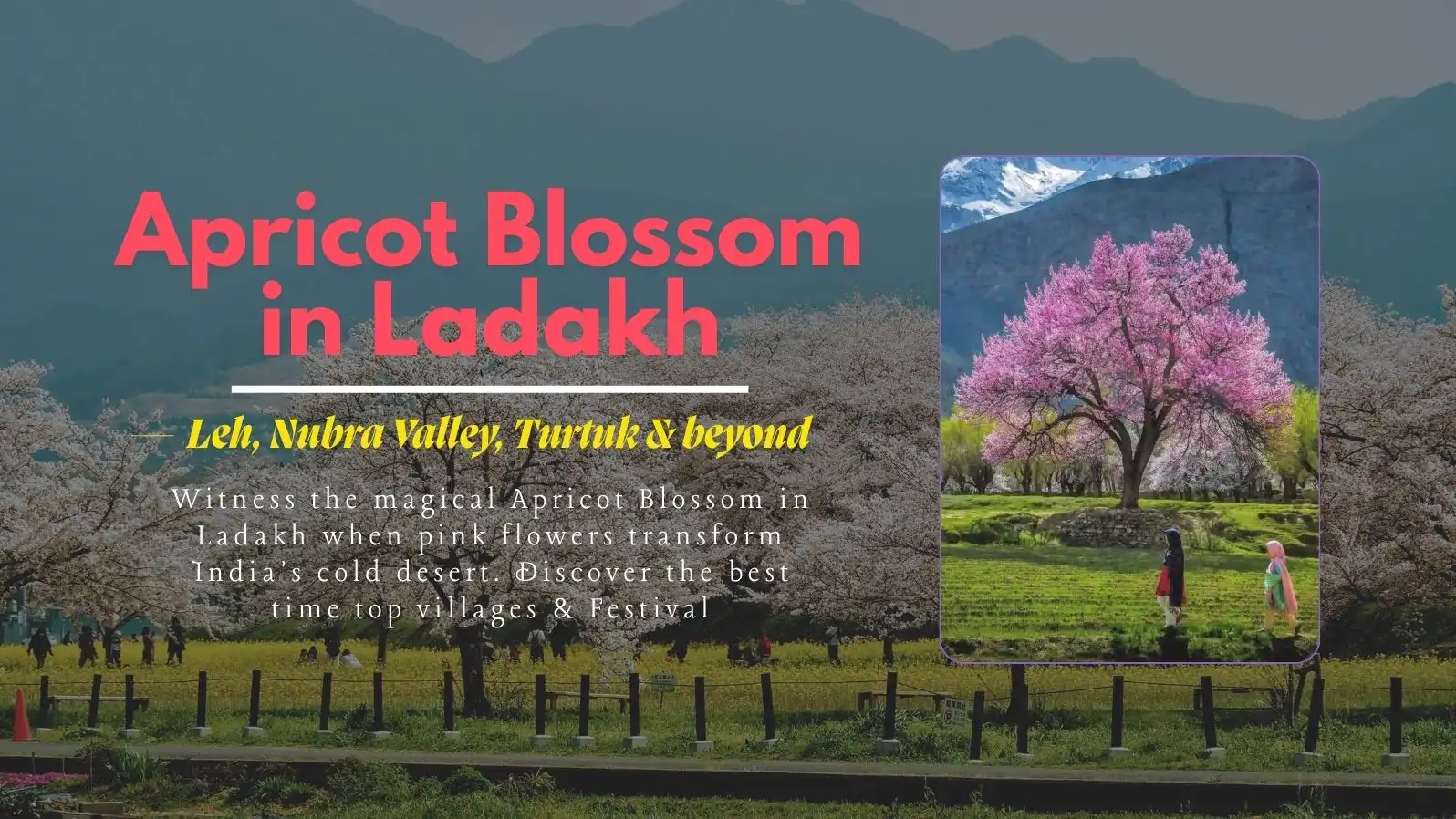
Close your eyes for a moment and picture Ladakh. Chances are you see a stark, dramatic landscape towering snow capped peaks, rust colored cliffs, and a vast expanse of cold desert stretching to the horizon. Monasteries perched on rocky outcrops. Prayer flags snapping in a biting wind. A place of extraordinary beauty, yes but not one you would typically associate with flowers.
Now open your eyes to a different Ladakh. It is mid March. The long Himalayan winter is loosening its grip, and almost overnight, something miraculous happens. Thousands of apricot trees that line the stone walls of ancient villages, terraced farms, and valley floors erupt in spectacular blooms of pale pink and ivory white. The contrast is almost otherworldly delicate blossoms set against snow dusted peaks and cobalt blue skies.
What if we told you that India’s most stunning blossom season is not in Kashmir, not in Himachal Pradesh, but in Ladakh the land of high passes and cold desert? Welcome to one of travel’s best kept secrets: the Apricot Blossom Season in Ladakh, a fleeting but unforgettable spectacle that is slowly but surely capturing the imagination of photographers, nature lovers, and adventure travelers from across the world.
In this guide, we cover everything you need to know when the blossoms peak, the most beautiful villages to visit, the cultural significance of the apricot tree to Ladakhi life, photography tips, and how to plan the perfect spring trip to witness this remarkable natural event.
What Is the Apricot Blossom Season in Ladakh?
Ladakh sits in the rain shadow of the Himalayas, making it one of the coldest and driest inhabited regions on Earth. Given this, the apricot tree’s ability to thrive here and bloom with such abundance is nothing short of extraordinary.
Apricot trees (Prunus armeniaca) have been cultivated in Ladakh for centuries. They are deeply embedded in the culture, diet, and economy of the local Ladakhi people. Every spring, before the leaves appear, these trees produce an explosion of blossoms that carpets entire valleys in shades of blush pink and creamy white.
a
The season is often compared to Japan’s iconic Sakura (cherry blossom) season and with good reason. Like Sakura, the Ladakh apricot bloom is short lived, lasting only two to three weeks, and its ephemeral quality only adds to its magic. Unlike the global crowds that descend on Japan during cherry blossom season, Ladakh’s spring bloom remains beautifully uncrowded, intimate, and authentic.
What makes Ladakh’s blossom season especially unique is the dramatic visual juxtaposition: soft, romantic pink blossoms framed by the raw, rugged geometry of the Himalayan landscape. It is a collision of delicacy and grandeur that is almost impossible to capture adequately in a photograph though photographers certainly try.
When Do Apricots Bloom in Ladakh? Season & Timing Guide
Peak Bloom: Mid March to Mid April
The exact timing varies by altitude and location. Lower altitude villages in Nubra Valley bloom first (early to mid March), while higher altitude settlements near Leh peak in early April. The entire blossom season across Ladakh spans roughly five to six weeks
Month by Month Breakdown
• Nubra Valley & lower villages (2,600 – 3,000 m elevation) begin to bloom first. Turtuk and Hunder are usually the earliest spots. Early to Mid March
• The bloom spreads toward Leh and mid altitude villages. This is when the valley wide pink carpet effect is most dramatic. Late March
• Peak bloom around Leh city, Basgo, Nimmu, and Alchi. Ideal time for most travelers to visit. Early April
• Higher altitude villages see their final blooms. By late April, petals begin to fall and green leaves emerge.Mid to Late April
What Affects the Timing?
The blossom date varies year to year depending on winter snowfall, spring temperatures, and elevation. A warmer than average winter can push blooms two weeks earlier, while a late snowfall can delay them. It is always advisable to check with local guesthouses or the Ladakh tourism department before finalizing your travel dates.
Best Places to See Apricot Blossoms in Ladakh
Ladakh is dotted with villages where apricot orchards create breathtaking scenery during spring. Here are the very best spots to add to your itinerary:
1. Nubra Valley
Nubra Valley, accessible via the famous Khardung La pass, is widely considered the most spectacular location for apricot blossoms in all of Ladakh. The valley is home to thousands of apricot trees that line the banks of the Shyok and Nubra rivers. The visual contrast of pink blossoms against sand dunes, the river, and snow capped mountains is absolutely extraordinary. Nubra is typically the first area to bloom, making it ideal for early-season visitors in early to mid March.
2. Turtuk Village
Located near the Line of Actual Control with Pakistan, Turtuk is one of Ladakh’s most remote and beautiful villages and one of the least visited during blossom season. The village has an almost Central Asian character, with flat roofed mud brick homes and terraced orchards that come alive in spring. Because of its lower elevation and southern exposure, Turtuk blooms early and the blossoms last longer. For photographers and travelers seeking an authentic, off the beaten path experience, Turtuk during apricot season is paradise.
3. Hunder
Hunder is famous for its cold desert sand dunes and Bactrian camels but during spring, the apricot orchards surrounding the village add a stunning layer of beauty that most tourists never get to see. The combination of pink blossoms, golden sand dunes, and distant snowy peaks is one of the most surreal and photogenic scenes in all of Ladakh.
4. Leh Town & Surroundings
For travelers based in Leh city, there is no need to travel far. The valleys and villages immediately surrounding Leh including Spituk, Phyang, and Choglamsar are lined with apricot orchards that bloom beautifully in early April. This is the most accessible blossom experience, perfect for a morning or afternoon excursion combined with monastery visits.
5. Basgo & Nimmu
The villages of Basgo and Nimmu, situated along the Indus River about 30 40 km west of Leh, are lesser known blossom destinations. With ancient mud brick fortresses, working monasteries, and extensive apricot orchards, these villages offer a deeply immersive blossom experience away from tourist crowds. The combination of historical architecture and spring blooms makes for extraordinary photography.
6. Dah Beama (Aryan Valley)
The Dah Beama or Aryan Valley is home to the Brokpa people, believed to be descendants of Alexander the Great’s army. The valley’s unique culture, combined with extensive apricot orchards, makes it one of the most culturally and visually rich blossom destinations. The villages of Dah, Hanu, and Biama have orchards that bloom in a profusion of pink against towering Himalayan cliffs.
Apricot Blossom Festival in Ladakh
The Apricot Blossom Festival is one of Ladakh’s most joyful and colorful events. Organized to celebrate the arrival of spring and the blooming of the apricot orchards, the festival offers visitors a rare window into authentic Ladakhi culture and community life.
Festival highlights typically include traditional Ladakhi folk music and Cham dances performed in traditional attire, demonstrations of local crafts including Thangka painting and wood carving, a local food market featuring traditional Ladakhi dishes prepared with apricots, guided walks through blossoming orchards, and photography workshops and competitions.
Planning your visit to coincide with the festival is highly recommended it transforms an already beautiful natural experience into a rich cultural immersion. Check the official Ladakh Tourism website or contact local guesthouses for confirmed festival dates before booking your trip.
Why the Apricot Tree Is Sacred to Ladakhi Culture
To truly appreciate the apricot blossom season, it helps to understand how central the apricot tree is to Ladakhi life. This is not merely a scenic phenomenon it is a deeply cultural event.
For centuries, apricots have been the lifeblood of Ladakhi agriculture. The fruit is eaten fresh in summer, dried and stored for the long winter months, and pressed into apricot oil a precious commodity used in cooking, skincare, and traditional medicine. In a region where the growing season is brutally short and the winters are unforgiving, the apricot harvest is a matter of survival as much as sustenance.
Every apricot tree in a Ladakhi village is carefully tended across generations, often planted by great-grandparents and passed down through families. The blooming of the apricot trees in spring is therefore not just a visual spectacle it is the signal of renewal, of the end of a long isolation, of warmth and abundance returning to the valley. Families emerge from their winter homes to tend their orchards, children play among fallen petals, and the entire community participates in the age-old rituals of the new agricultural season.
Apricot oil from Ladakh, particularly from Nubra Valley, has gained recognition as a premium cold-pressed cosmetic oil and is exported across India and internationally. The blossom season thus marks not just the beginning of spring but the promise of an economic lifeline for thousands of Ladakhi farming families.
Photography Guide: How to Capture the Apricot Blossoms
The apricot blossom season in Ladakh is a photographer’s dream but getting the perfect shot requires some knowledge of timing, light, and composition.
Best Lighting Conditions
• The warm, soft light of the first and last hour of the day turns blossoms luminous gold pink. Arrive at your chosen orchard well before sunrise. Golden Hour (sunrise & sunset)
• Diffused cloud cover eliminates harsh shadows and reveals the true, delicate colors of the blossoms. Some of the most beautiful blossom photographs are taken on slightly overcast spring mornings. Overcast days
• The strong midday light bleaches the delicate pink tones and creates unflattering, high-contrast shadows. Avoid harsh midday sun
Composition Tips
• Alchi, Spituk, and Basgo monasteries provide stunning architectural backdrops for blossom photography. Frame blossoms against monasteries
• Position yourself to frame pink blossoms against the snow capped peaks for the ultimate Ladakh spring shot. Use the mountains as a backdrop
• The reflection of blossoming trees in the Indus River adds a magical, layered quality to images. Incorporate the Indus River
• Get close to individual blossoms to capture the extraordinary detail and translucency of the petals. Macro shots
• A Ladakhi farmer tending their orchard, a child playing among fallen petals human presence adds scale, emotion, and story to blossom photographs. Include people
Technical Settings
Use a wide aperture (f/1.8 to f/2.8) for dreamy, bokeh-rich blossom portraits. Switch to a narrower aperture (f/8 to f/11) for wide landscape shots where you want the mountains and blossoms both in sharp focus. Burst mode is your friend when there is a breeze flowers in motion create beautiful, soft images but require multiple shots to get the perfect frozen moment.
How to Plan Your Apricot Blossom Trip to Ladakh
How to Reach Ladakh in Spring
Getting to Ladakh during blossom season requires some planning. The Manali-Leh highway is typically still closed in March and early April due to snow on the Rohtang and Baralacha passes. The Srinagar Leh highway may be open but conditions are variable.
The most reliable and comfortable way to reach Ladakh in spring is by direct flight to Leh Kushok Bakula Rimpochhe Airport. Multiple daily flights operate from Delhi, Mumbai, and Srinagar throughout the year. Book well in advance as spring flights fill up quickly.
Where to Stay
• The widest range of accommodation from budget guesthouses to mid-range hotels. Most hotels reopen for the spring season in mid March. Leh city hotels
• Staying with a Ladakhi family in Nubra Valley, Turtuk, or Basgo is the most immersive way to experience blossom season. Many families open their homes to guests in spring. Village homestays
• Several seasonal camps in the Nubra Valley open for the blossom season, offering a glamping experience surrounded by orchards.Eco camps in Nubra Valley
Frequently Asked Questions (FAQs)
The following questions are among the most commonly searched queries related to the Apricot Blossom season in Ladakh:
Q1. When is the best time to visit Ladakh for Apricot Blossom?
The best time is between mid March and mid April. For the earliest blooms in Nubra Valley and Turtuk, aim for late March. For the most accessible experience around Leh city, target the first two weeks of April. Check with local contacts closer to your travel date for the most accurate bloom forecast.
Q2. Which is the most beautiful village for apricot blossoms in Ladakh?
Nubra Valley and particularly the villages of Hunder and Diskit is widely considered the most visually spectacular location, offering the iconic combination of pink blossoms against sand dunes and snow capped mountains. Turtuk is the top choice for a more intimate, off the beaten path experience.
Q3. Is it cold in Ladakh during apricot blossom season?
Yes, it can be quite cold, especially at night. Daytime temperatures in March and April range from 5°C to 15°C, but nights regularly drop to -5°C or lower. Pack thermal base layers, a warm fleece, a waterproof jacket, and gloves. Mornings and evenings coincidentally the best times for blossom photography are particularly chilly.
Q4. Can I drive to Ladakh during blossom season?
The Manali Leh Highway is typically closed until mid May due to snow on the high passes. The Srinagar Leh Highway (NH-1) may be open from late March, but road conditions are variable and can change rapidly due to snowfall. Flying to Leh is the most reliable and recommended option for blossom season visitors.
Q5. How long does the apricot blossom last in Ladakh?
Each individual location’s bloom lasts approximately 10-15 days. Because different villages bloom at different elevations and times, the overall blossom season across Ladakh spans five to six weeks, from early March in Nubra Valley to late April at higher altitudes. Plan for at least 5 – 7 days in Ladakh to catch the bloom at multiple locations.
Q6. Is there an Apricot Blossom Festival in Ladakh?
Yes! The Apricot Blossom Festival is organized annually in Ladakh to celebrate the spring bloom. It features traditional Ladakhi music, folk dances, local food, craft demonstrations, and guided orchard walks. Exact dates vary by year check the Ladakh Tourism Department website for current year announcements.
Q7. Do I need a permit to visit Nubra Valley during blossom season?
Yes. Nubra Valley and Turtuk require a Protected Area Permit (PAP), also known as an Inner Line Permit (ILP). These are easily obtainable in Leh through the District Commissioner’s office or via registered travel agents. The permit process is straightforward and can usually be completed within a few hours.
Conclusion: Go Before the Secret Gets Out
The Apricot Blossom season in Ladakh is one of those rare travel experiences that exceeds every expectation. It is visually stunning, culturally rich, and for now beautifully uncrowded. While cherry blossom tourism in Japan has become a logistical challenge of crowds, queues, and packed accommodation, Ladakh’s pink spring remains intimate, authentic, and deeply moving.
Whether you are a photographer chasing that perfect shot of blossoms against the Himalayas, a nature lover seeking a soulful spring experience, or a cultural traveler wanting to witness the joy with which Ladakhis celebrate the arrival of warmth and life this is a trip that will stay with you long after the petals have fallen.
The blossom season is short. The window is narrow. But for those who make it, the Apricot Blossom season in Ladakh is nothing less than one of the most beautiful things this country has to offer.