Best Time to Climb Kilimanjaro: A Month-by-Month Guide
There’s no single best time to climb Kilimanjaro. There’s a best time for you.
Some months give you the clearest skies but the biggest crowds. Others give you near-empty trails but muddier ground. The right choice depends on what you’re optimizing for — weather, cost, solitude, or a safari add-on.
This guide breaks the year into its real seasons, not just “dry” and “wet,” and shows what each month actually delivers so you can pick dates that match your priorities.
Quick Overview
Kilimanjaro has two dry windows: January to early March, and June to October. Both offer the clearest skies and the highest summit success rates.
June to October is the busiest and most popular stretch. January and February are nearly as reliable with noticeably fewer people on the trail.
2026 note: recent operator reporting shows both dry windows holding to this same pattern, with no major shift reported so far this year.
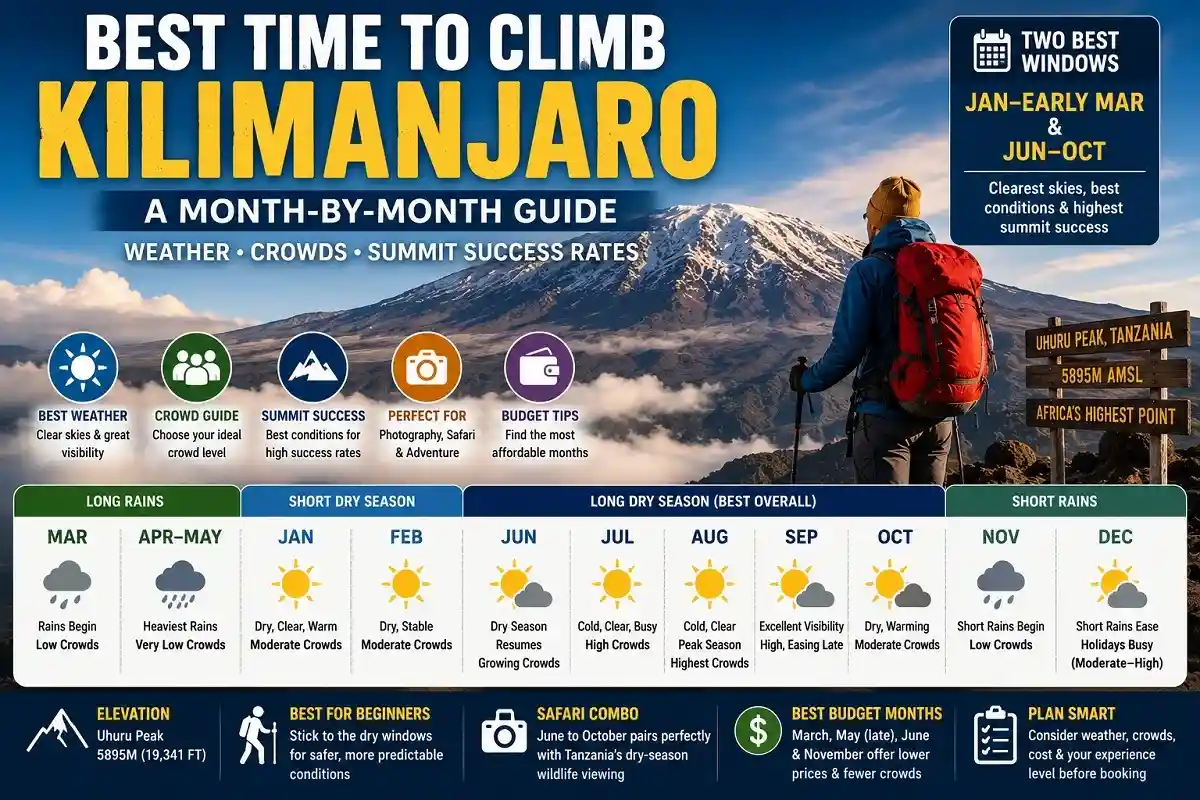
The Two Dry Seasons, Compared
Kilimanjaro doesn’t follow a spring-summer-fall-winter calendar. Its seasons are driven by the Intertropical Convergence Zone (ITCZ), a band of low pressure that shifts north and south across East Africa through the year, dragging rain with it.
That movement is what creates two distinct dry seasons rather than one long one.
| Factor | Short Dry Season (Jan–Mar) | Long Dry Season (Jun–Oct) |
|---|---|---|
| Weather | Clear, cool mornings, brief afternoon cloud | Clear, cooler air, most stable skies |
| Crowds | Moderate | Heaviest, especially Jul–Aug |
| Cost | Often slightly lower | Often at peak-season rates |
| Best for | Photography, fewer crowds | Safari combos, reliable conditions |
- Must Reads on: What to Carry for Kilimanjaro Trek: Complete Packing Guide
Kilimanjaro Weather and Crowds by Month
Here’s how each month generally compares. Treat these as general patterns rather than guarantees — Kilimanjaro’s weather can still surprise you in any given year.
| Month | Conditions | Crowd Level | Good For |
|---|---|---|---|
| January | Dry, clear, warm | Moderate | Clear skies, fewer people |
| February | Dry, stable | Moderate | Photography, snow-capped views |
| March | Rains begin | Low | Solitude, budget climbs |
| April | Heaviest rain | Very low | Experienced trekkers only |
| May | Rains ease late month | Low | Late-month budget climbs |
| June | Dry season resumes | Growing | Early peak-season conditions |
| July | Cold, clear, busy | High | Safari combos, reliable weather |
| August | Cold, clear, peak season | Highest | Reliable summit conditions |
| September | Dry, excellent visibility | High, easing late-month | Best overall balance |
| October | Dry, warming, quieter | Moderate | Good weather, fewer crowds |
| November | Short rains begin | Low | Quiet trails, lower cost |
| December | Short rains ease, holidays busy | Moderate–high (late Dec) | Festive-season climbs |
Best Time to Climb Kilimanjaro by Priority
Different climbers care about different things. Match your priority to a season below.
Best for Clear Skies and Photography
January, February, and September consistently offer the clearest visibility and the least cloud cover for summit-day photos.
When to Climb Kilimanjaro to Avoid Crowds
March, June, October, and November see noticeably lighter trail traffic than July–August, without the harshest rains of April and May.
Best for Combining With a Safari
June to October overlaps with Tanzania’s dry-season game viewing, making it easy to pair a climb with the Serengeti or Ngorongoro Crater.
Best Month to Climb Kilimanjaro for Beginners
Stick to the dry windows — January to early March or June to October. Predictable weather removes one major variable while you’re still learning to manage altitude and pacing.
Best for Budget Climbers
Shoulder months — March, June, and November — often come with lower operator rates than the peak weeks of July, August, and December, since demand is lower.
Is It Worth Climbing During the Rainy Season?
Sometimes, yes. April and May bring the heaviest rain and the muddiest trails, and most guides steer first-timers away from this window.
November’s short rains are lighter and less disruptive. If you want a quieter mountain and don’t mind a rain jacket, late November can work well.
Whatever month you choose, prioritize waterproof gear over extra warm layers if you’re climbing in a wetter window.
Should You Time Your Climb to a Full Moon?
Many climbers try to schedule their summit night around a full moon. Clear moonlight lights up the trail during the pre-dawn push, and it makes the glaciers and the final approach to Uhuru Peak especially striking.
It’s a genuine bonus, not a requirement — a good headlamp does the same job on any night. Full moon dates shift every year and vary by source, so confirm the exact date for your target month directly with your operator before booking.
Full moon weeks are popular and can mean busier camps, so book early if this matters to you.
Does Your Route Choice Affect the Best Time to Climb?
A little. Southern and eastern routes catch more rain, so they’re most comfortable in the driest weeks of each dry season.
Northern routes like Rongai sit in a rain shadow and stay drier for longer, which makes them a reasonable option even close to the edges of the rainy seasons.
What Experienced Guides Actually Recommend
Ask a guide which month is “best,” and most won’t give you a single answer.
What they’ll usually say is that September offers the best overall balance — dry trails, thinning July–August crowds, and consistently strong summit conditions. First-time climbers who want the safest bet are usually pointed toward this window or the January–February stretch.
What most people don’t realize is that summit night is cold in every single month. Picking a good weather month improves your odds, but it doesn’t remove the need for full cold-weather gear.
Do El Niño and La Niña Affect Kilimanjaro’s Climbing Season?
Yes, to some degree. El Niño years tend to bring heavier-than-usual rainfall to East Africa, while La Niña years often mean drier conditions — on top of Kilimanjaro’s normal wet and dry pattern.
This doesn’t flip the seasons around, but it can make a normally dry month wetter than expected, or a normally wet month milder. Check current-year conditions with your operator a few weeks before departure rather than relying only on the general seasonal pattern.
A Practical Note on Flights and Arrival Timing
Most climbers fly into Kilimanjaro International Airport (JRO), near Moshi and Arusha. During July, August, and December, flights and nearby hotels fill up alongside the mountain itself, so book both together.
Plan to arrive at least a day before your trek starts. It gives you a buffer for delayed flights and a little time to adjust before you’re climbing, regardless of which month you choose.
Common Mistakes When Choosing Climb Dates
- Booking April or May without knowing it’s the wettest stretch of the year.
- Assuming any dry-season date guarantees good weather — Kilimanjaro can still surprise you.
- Ignoring crowd levels and ending up on a packed trail during peak July–August weeks.
- Booking too close to your travel date during popular full-moon or holiday weeks, when camps fill up fast.
- Choosing a date based on weather alone without checking route-specific conditions.
Pro Tips for Picking Your Dates
- Book 6–12 months ahead for July, August, or full-moon weeks — these fill up first.
- If solitude matters more than perfect weather, look at March, June, or November.
- Pair your climb with a safari by choosing June–October, when both align.
- Ask your operator for their honest read on current-season conditions — they track it in real time.
- Confirm your operator is TANAPA-registered and that park permits are included in your quote — this is required for every climb, in every season.
A Quick Safety Note on Timing
Whatever month you choose, altitude sickness remains the primary safety concern on Kilimanjaro, not the season.
Good acclimatization, a sensible ascent pace, and a longer route with built-in rest days matter more to your summit chances than picking the “perfect” month.
If you do climb during the rainy months, ask your guide about afternoon thunderstorm patterns. Exposed ridges are best crossed earlier in the day when storms are less likely.
Frequently Asked Questions
1. What is the best time to climb Kilimanjaro overall?
January to early March and June to October are the two most reliable windows, with September often cited as the best overall balance.
2. What is the best month to climb Kilimanjaro for good weather?
August and September typically offer the clearest, most stable conditions of the year.
3. When should I avoid climbing Kilimanjaro?
April and May, the long rains, bring the muddiest trails and lowest summit visibility of the year.
4. Is Kilimanjaro busier in July and August?
Yes. These months align with Northern Hemisphere summer holidays and safari season, so trails and camps are at their busiest.
5. When should I climb Kilimanjaro to avoid crowds?
March, June, October, and November offer good conditions with noticeably fewer climbers than the July–August peak.
6. Is November a bad time to climb Kilimanjaro?
Not necessarily. The short rains are lighter than the long rains, and trails are much quieter than during peak season.
7. Does the best time to climb change by route?
Slightly. Northern routes like Rongai stay drier for longer, while southern routes are best kept to the driest weeks of each dry season.
8. Is it cheaper to climb Kilimanjaro in the off-season?
Often, yes. Shoulder months like March, June, and November tend to see lower demand and sometimes lower operator rates than peak weeks.
9. What’s the best month for beginners to climb Kilimanjaro?
Stick to the dry windows — January to early March or June to October — for the most predictable conditions while you’re still learning to manage the climb.
10. Should I plan my climb around a full moon?
It’s a nice bonus for visibility and scenery, but not essential. Confirm exact full moon dates with your operator, since they shift yearly.
11. Is Kilimanjaro summit night cold no matter the month?
Yes. Summit night regularly drops to -10°C to -20°C or colder year-round, so proper gear matters regardless of season.
12. What month has the highest Kilimanjaro summit success rate?
August and September tend to see some of the strongest reported success rates, thanks to stable weather and well-established acclimatization schedules.
13. Can I combine Kilimanjaro with a safari?
Yes — climbing June to October lines up well with Tanzania’s dry-season safari circuits like the Serengeti and Ngorongoro Crater.
14. How far in advance should I book for peak season?
Six to twelve months ahead is common for July, August, and full-moon weeks, since permits and camps fill up early.
15. Is climbing Kilimanjaro in the rainy season ever a good idea?
It can be, if you’re an experienced trekker who prioritizes solitude and lower cost over dry trails and clear views.
This guide draws on seasonal patterns reported by Tanzania-based operators and current 2026 field updates. Confirm exact dates, permits, and conditions with your chosen operator before booking.
Final Word
There’s no universally perfect month — only the ideal climbing window for what you actually want out of the trip.
Want the clearest skies and don’t mind company? Aim for July to September. Want fewer people and can handle a bit more unpredictability? Look at March, June, or November. Either way, pick a dry-season window, book early, and let good acclimatization — not the calendar alone — carry you to the summit.
Suggested Tour: Mount Kilimanjaro Trek