When is the Best Time to Climb Mount Denali?
Choosing the best time to climb Denali matters more than on almost any other major peak, since North America’s highest mountain sits far enough north that weather, wind, and snow conditions shift dramatically across its short climbing window. At 6,190 m, Denali rises from a base only around 700 m — one of the largest base-to-summit rises of any mountain on Earth, a key reason its weather feels far more severe than its altitude alone suggests. This guide covers Denali weather by season, wind, camp, and route, helping you plan a successful Mount Denali Expedition.
Quick Answer
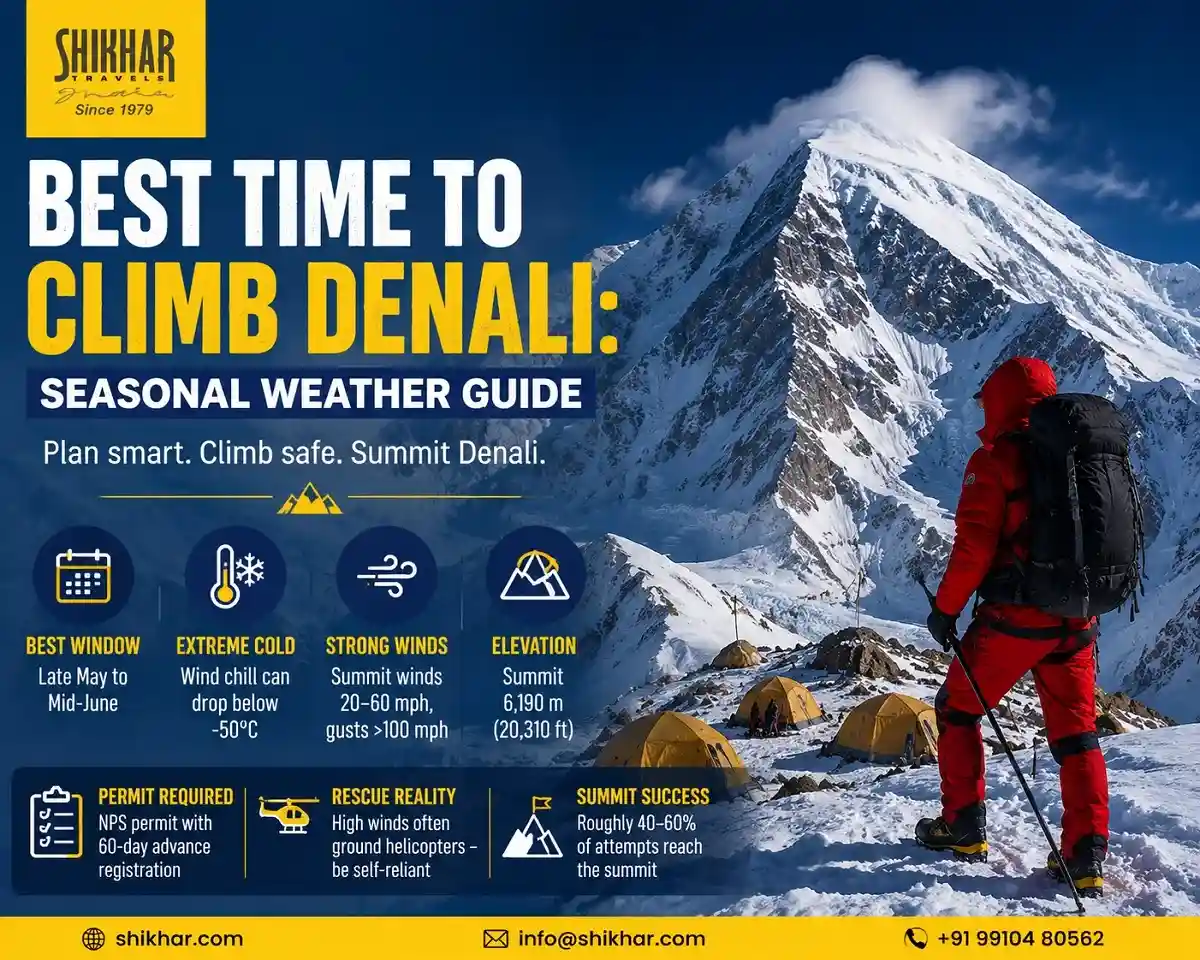
| The best time to climb Denali is generally late May to mid-June, balancing firmer snowpack with milder temperatures than early season. Most expeditions run early May through mid-July. Early May is colder but safer underfoot; late June brings warmer weather but can carry higher avalanche and crevasse risk depending on that season’s snowfall. |
Denali Climbing Season Overview
Most guided expeditions operate from early May to mid-July, though independent teams sometimes climb slightly outside this window depending on permits and conditions. The National Park Service requires registration at least 60 days before your climb — apply early, since popular guided slots fill up well ahead of the season.
Roughly 1,000–1,200 climbers attempt Denali annually, with summit success typically ranging from 40–60% depending on that season’s weather. Denali’s near-Arctic latitude also puts it directly under the polar jet stream, which drives the sudden, violent storms the mountain is known for — a factor that matters more here than on most other major peaks.
Denali Weather by Month
| Month | Snowpack | High Camp Temp | Trade-Offs |
| Late April | Firm, winter-like | -30 to -40°C at night | Coldest; best footing, fewest crowds |
| May | Firm to stable | -20 to -30°C | Classic early window; still brutally cold |
| June | Softening late month | -10 to -20°C | Often cited as the best time to climb Denali |
| July (to mid) | Soft, higher risk | Warmest; can feel hot lower down | Comfortable temps, higher objective hazard |
Wind, not temperature, is Denali’s biggest weather challenge: summit winds average 20–60 mph with gusts exceeding 100 mph during storms, and whiteouts can cut visibility to a few metres, making GPS and route markers essential rather than optional.
- Suggested Package: Climbing the Seven Summits
When NOT to Climb Denali
Outside the main season, conditions turn genuinely dangerous. Avoid climbing before late April or after mid-to-late July, when storms grow more frequent, glacier snow bridges weaken, and daylight-driven warming increases rockfall and avalanche risk on steeper sections. Postpone a summit push entirely if forecasts show sustained high wind, incoming low-pressure systems, or poor visibility near Denali Pass.
Route Options: West Buttress vs Muldrow Glacier
About 90% of climbers use the West Buttress, flown onto the Kahiltna Glacier from Talkeetna. The Karstens Ridge/Muldrow Glacier route is a quieter, similarly difficult alternative approached on foot from Wonder Lake, typically adding about a week and more exposure to unpredictable lower-elevation weather before the technical climbing begins.
Weather & Distance by Camp
| Camp | Elevation | From Previous Camp | Typical Conditions (May–Jun) |
| Kahiltna Base | 2,195 m | Fly-in from Talkeetna | Cold nights, strong sun glare |
| Camp 3 (11,000 ft) | 3,353 m | ~9 km, ~1,150 m gain | Colder, more wind exposure |
| 14 Camp | 4,328 m | ~4 km, ~975 m gain | Main acclimatisation camp |
| High Camp (17,200 ft) | 5,243 m | ~2.5 km, ~915 m gain | Severe cold; -50°F not uncommon in May |
| Summit | 6,190 m | ~3 km, ~950 m gain | Extreme cold and wind |
Extreme Cold, Wind & Altitude Risk
Wind chill above 14 Camp can plunge past -50°C even in the warmer part of the season. In a well-documented 1989 incident, a team caught near Denali Pass in a sudden windstorm recorded wind-chill readings below -50°C — a reminder that summit-day weather calls should never be rushed, even during a brief lull.
At 6,190 m, altitude illness is a genuine risk, worsened by the cold. Watch for AMS symptoms — headache, nausea, poor appetite — and treat them as a signal to stop ascending. Standard itineraries build in rotation days between camps for acclimatisation, and glacier glasses are essential given intense UV and over 18–20 hours of daylight through May and June.
Costs, Permits & Logistics
Budget for the NPS climbing permit (around $450 for adults, 60-day advance registration), an air taxi charge from Talkeetna to Kahiltna Base Camp, and separately a guide service fee if climbing with an operator — costs vary by season, so confirm current rates directly with your operator. All climbers must carry a Clean Mountain Can for human waste above 14 Camp, per NPS regulations.
Weather Monitoring & the Reality of Rescue
Check the Talkeetna Ranger Station’s current conditions and NPS mountaineering reports before and during your climb. Rescue on Denali typically involves NPS mountaineering rangers and, in severe cases, the Alaska Air National Guard — but high wind and cold frequently ground helicopters for days, so expeditions should be prepared for genuine self-rescue rather than assuming rapid evacuation.
Weather-Related Safety Tips
- Check ranger weather updates before every camp move, not just at the start of the trip.
- Never push above 14 Camp in deteriorating visibility — whiteouts near Denali Pass have caused serious accidents.
- Build at least 3–5 reserve days into your itinerary for weather delays.
- Carry a satellite communicator, since standard mobile coverage doesn’t exist on the mountain.
- Avoid a late-June/July summit push without checking that season’s avalanche and crevasse conditions first.
What to Pack for Denali Weather
- Expedition-weight down suit or separate heavyweight down jacket and pants for high camp
- Layered base and mid layers plus a windproof, waterproof shell
- Double or triple mountaineering boots rated for extreme cold
- Glacier glasses and goggles for whiteout and high-UV glare conditions
- A 4-season expedition tent capable of handling sustained high winds
Denali Expeditions: Experience Requirements
Denali is not a suitable introductory expedition for student groups — it demands prior glacier travel, crevasse rescue, and cold-weather camping experience, ideally including a prior climb above 5,000–6,000 m with rope-team and ice-axe skills. Shikhar Educational Tours recommends Denali only for climbers who already meet this experience bar.
Travel Notes for Indian Climbers
Most climbers fly into Anchorage via connections from Delhi, Mumbai, or Bengaluru, then travel to Talkeetna. India isn’t part of the US Visa Waiver Program, so a B1/B2 visa is required — apply well ahead, since interview wait times vary, and check that your passport meets the airline’s minimum validity requirement before booking flights.
Best Time to Climb Denali: FAQs
What is the best time to climb Denali?
Late May to mid-June, balancing stable snow with milder temperatures.
How cold does it get on Denali’s summit?
Wind chill can drop past -50°C even in the warmer climbing months.
When does the Denali climbing season run?
Most expeditions operate from early May to mid-July.
Is early May a good time to climb Denali?
It’s colder but offers firmer, often stronger snow bridges over crevasses.
Is late June too late to climb Denali?
It’s warmer but can carry higher avalanche and crevasse risk that season.
When should I avoid climbing Denali?
Before late April or after mid-to-late July, when risk rises sharply.
How long does a Denali expedition take?
Most trips run 17–21 days, including acclimatisation and weather buffers.
What percentage of climbers summit Denali?
Roughly 40–60% of annual attempts, depending on that season’s weather.
Do I need a permit to climb Denali?
Yes, an NPS permit with 60-day advance registration is required.
How windy does it get on Denali?
Summit winds average 20–60 mph, with storm gusts exceeding 100 mph.
Can beginners attempt Denali?
No, prior glacier travel and crevasse rescue experience are essential.
Can Indian climbers attempt Denali?
Yes, with a US B1/B2 visa and sufficient mountaineering experience.
Is altitude sickness a risk on Denali?
Yes, AMS is a real risk at 6,190 m, worsened by extreme cold.
Can rescue helicopters reach climbers quickly on Denali?
Not always — high wind often grounds them, so self-rescue capability matters.
Roughly how much does a Denali expedition cost?
Budget for permit, air taxi, and guide fees, which vary by operator and season.
What should I pack for Denali weather?
An expedition down suit, double boots, glacier glasses, and a storm-rated tent.
Picking the best time to climb Denali comes down to weighing early-season cold against late-season risk — most successful expeditions choose a late-May to mid-June window. Respect the mountain’s extreme weather, build in reserve days, and prepare for genuine self-sufficiency, and this demanding peak becomes an achievable expedition.
Suggested to Read: