Best Time to Climb Mount Elbrus: A Month-by-Month Guide
The best time to climb Mount Elbrus is mid-June through mid-September, with July and August offering the most stable weather of the year. Europe’s highest peak, at 5,642 metres, is technically climbable in almost any month, but the Mount Elbrus climbing season only opens a safe, predictable window for a few months a year. Pick the wrong month and you’re managing deep snow, whiteouts, or a summit night near -20°C. Pick the right one, and the South Route becomes one of the more approachable ways to ascend Elbrus above 5,000 metres.
Quick Facts
- Altitude: 5,642 m / 18,510 ft — Europe’s highest peak
- Location: Caucasus range, Kabardino-Balkaria, Russia
- Standard route: South Route via Azau–Terskol
- Nearest airport: Mineralnye Vody (MRV)
- Best climbing season: June–September
- South Route summit success rate: roughly 80–90%
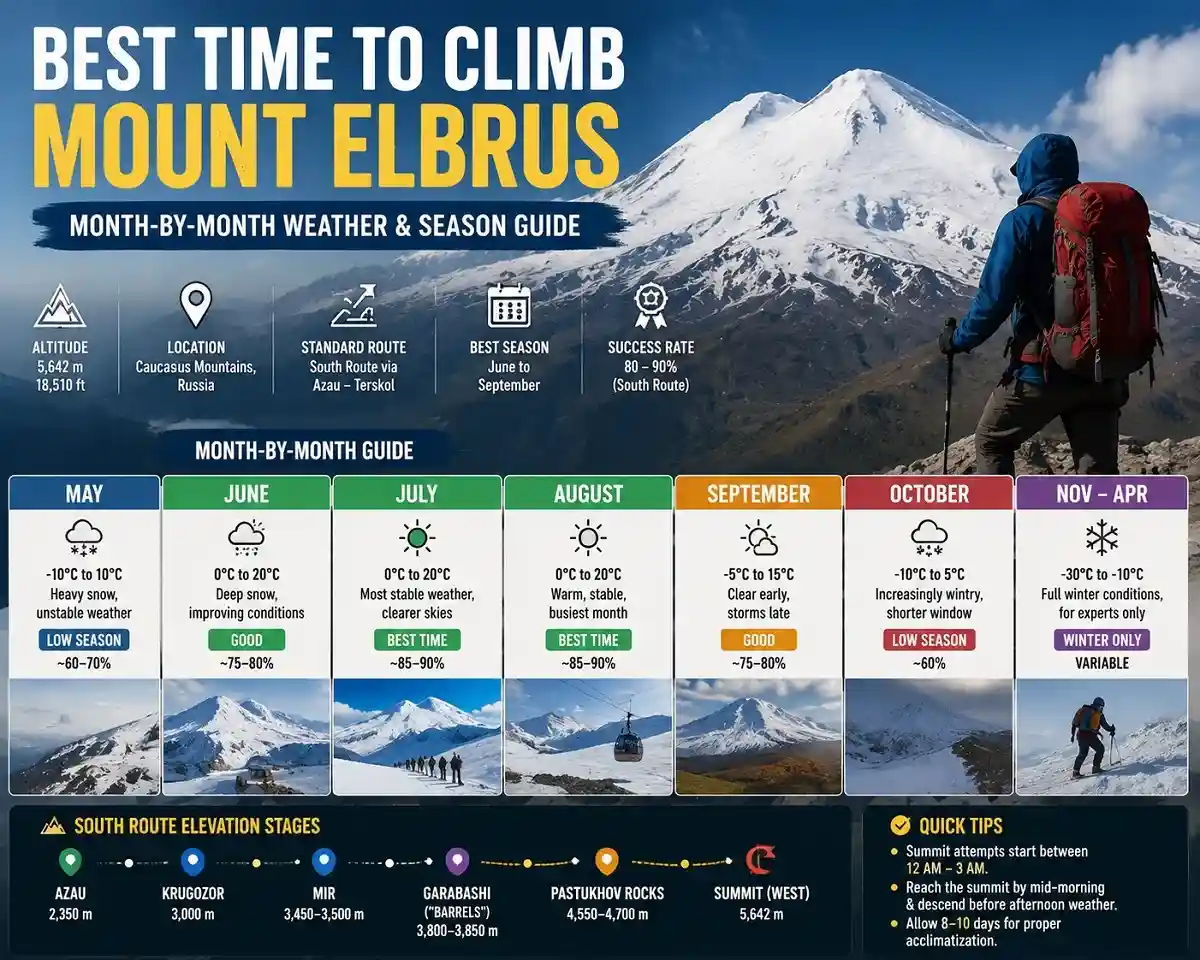
Understanding the Mount Elbrus Climbing Season
Elbrus sits in the Caucasus range, on the Russia–Georgia border in Kabardino-Balkaria. Summer (June–August) is the main season; winter (November–April) is for experienced mountaineers only. Even in the “good” months, summit-night temperatures can fall to around -20°C, and fog can roll in within minutes — timing improves your odds, but it doesn’t remove the mountain’s unpredictability.
June — Fewer Crowds, More Snow
Base temperatures run 10–20°C, dropping to 0 to -10°C higher up. Snow cover is still heavy from winter, so climbing days are slower and more physically demanding. If you want a quieter mountain, June delivers.
July–August — The Peak Window
These two months bring the most stable weather and the longest daylight of the year, which matters hugely on summit day. Some guides slightly prefer July over August, since afternoon storms build less often and there’s less snow melt. August stays the busiest month, with fuller huts and cable car queues.
September — The Underrated Option
Crowds thin out and skies are often crisper. Daytime conditions stay climbable through most of the month, but early snowstorms can arrive with little warning as September closes, shortening the safe summit window.
October — A Narrowing Window
Some operators still run expeditions into early October, when weather can still cooperate. But conditions turn quickly — colder nights, higher wind, and a real chance of an early winter storm closing the route. Late-season bookings need a flexible schedule and a guide willing to call off a summit attempt.
Winter (November–April) — For Specialists Only
December–January average -20°C to -30°C; February–March stay nearly as harsh at -15°C to -25°C. Deep snow, higher avalanche risk, and short daylight make winter Elbrus a far more technical undertaking than its summer version.
Suggested Package
Weather and Success Rate by Month
| Month | Temp Range | Conditions | Crowd Level | Approx. Success Rate |
| May | -10 to 10°C | Heavy leftover snow, unstable | Low | ~60–70% |
| June | 0 to 20°C | Deep snowpack, improving | Medium | ~75–80% |
| July | 0 to 20°C | Most stable of the year | High (peak) | ~85–90% |
| August | 0 to 20°C | Warm, stable, busiest | Highest | ~85–90% |
| September | -5 to 15°C | Clear early, storms late | Medium | ~75–80% |
| October | -10 to 5°C | Increasingly wintry | Low | ~60% |
| Nov–Apr | -30 to -10°C | Full winter conditions | Very low | Variable, experts only |
Success rates are approximate and weather-dependent. South Route averages are generally cited at 80–90% in peak season, versus roughly 50% on the more technical North Route.
Elevation, Distance, and Timings on the Route
Most climbers follow the South Route from Terskol/Azau. Here’s how the stages break down:
| Stage | Elevation | Notes |
| Azau | 2,350 m | Start of the cable car system |
| Krugozor | 3,000 m | First cable car stop |
| Mir | 3,450–3,500 m | Cafés, shops, change point |
| Garabashi (“Barrels”) | 3,800–3,850 m | Where most climbers sleep before summit day |
| Pastukhov Rocks | 4,550–4,700 m | Acclimatization point, snowcat pickup option |
| Summit (West) | 5,642 m | Highest of Elbrus’s twin peaks |
Cable cars generally run 9:00 a.m.–4:00 p.m. (last car down around 4:30 p.m.), so time your descent carefully. Summit pushes typically start between midnight and 3:00 a.m., aiming to reach the top by mid-morning and descend before afternoon weather turns.
Cost and Permit Basics
Guided South Route climbs typically run 8–10 days door-to-door — counting international arrival to departure, not just days on the mountain.
Budget trips start around $900; standard guided packages run $1,300–$2,000; premium expeditions can exceed $3,000. Prices vary by operator and route logistics.
| Season | Guided Cost (USD) | Typical Group Size |
| Summer (Jun–Sep) | $900 budget – $2,000 standard | 6–10 climbers |
| Shoulder (May/Oct) | Similar, fewer fixed departures | Smaller/private groups |
| Winter (Nov–Apr) | $1,800–$2,000+ | Small expert teams only |
No special border permit is required for the standard South Route; you’ll need a low-cost Prielbrusie National Park entry pass instead, checked at the lift stations. Restricted zones nearer the Georgian border, such as upper Cheget, need separate FSB clearance.
Fitness, Acclimatization, and Altitude Readiness
Elbrus isn’t technical, but altitude makes it demanding. Most itineraries include 1–2 acclimatization days before the summit push, moving gradually from Garabashi toward Pastukhov Rocks.
Cardio fitness matters more than technical skill — expect 10–14 hours of continuous movement on summit day. Get medical clearance first if you have an underlying heart or lung condition.
What to Pack
Most technical gear can be rented locally in Terskol or Azau, but plan around these essentials:
- Mountaineering boots rated for high altitude
- Crampons and an ice axe
- Down jacket and insulated mid-layers
- Glacier glasses, headlamp, gaiters, and trekking poles
South Route vs North Route
The South Route, supported by cable cars and snowcats, is easier and faster, with a summit success rate around 80–90%. The North Route is quieter and more remote, but tougher — a longer summit day and no snowcat support drop success rates to roughly 50%. East and West routes see only a handful of ascents a year and suit specialists only.
From Practical Experience: What the Weather Actually Feels Like
Base-camp weather and summit weather are two different worlds. The Baksan Valley can hit 25°C in July while summit night sits near -20°C.
A common mistake is packing for the valley instead of the summit. Build in at least one buffer day too — groups that skip acclimatization to save time are the ones most likely to turn back below the top.
Step-by-Step: Planning Your Climb Around the Best Season
- Pick July or August for your first high-altitude climb; June or September to avoid crowds.
- Book 2–3 months ahead for peak season.
- Build in 1–2 acclimatization days before summit day.
- Confirm your National Park pass and any border-zone requirements for your route.
- Pack for -20°C summit-night cold regardless of month.
- Leave 1–2 spare days in your itinerary for weather delays.
Common Mistakes to Avoid
- Choosing October or later without winter mountaineering experience.
- Skipping acclimatization days to compress the schedule.
- Underestimating summit-night cold because the valley felt warm.
- Booking July/August slots at the last minute.
- Ignoring daily guide weather briefings.
Pro Tips
- Go early June or late September if crowds bother you more than cold.
- Use cable cars and snowcats to save energy for summit day.
- Check short-range mountain forecasts, not just Terskol city weather, in the final 72 hours.
- Ask any operator for their season-by-season summit success rate before booking.
Guided vs Independent Climbs
Most first-timers use a local guiding outfit, which handles the park pass, hut bookings, and the call on whether a day is safe for a summit push. Experienced mountaineers do climb independently, but weather judgment matters more than paperwork.
Frequently Asked Questions
1. What is the best time to climb Mount Elbrus?
July and August, for the most stable weather and longest daylight of the year.
2. Can beginners climb Mount Elbrus?
Yes, via the South Route with a guide, provided you’re reasonably fit.
3. Is June safe for climbing Elbrus?
Yes, though expect deeper snow and slightly less predictable weather than peak summer.
4. How cold does it get on summit night?
Around -20°C even in peak summer, colder with wind chill.
5. Is a permit required to climb Elbrus?
No border permit for the standard South Route — just a low-cost National Park entry pass.
6. How much does climbing Mount Elbrus cost?
Roughly $900 for budget trips, $1,300–$2,000 for standard guided climbs, and $3,000+ for premium expeditions.
7. Is October too late to climb?
Some expeditions still run in early October, but weather turns quickly and less predictably.
8. Which route has a higher success rate, North or South?
South Route, at roughly 80–90%, versus about 50% on the North Route.
9. How fit do I need to be?
Very fit — expect 10–14 hours of continuous movement on summit day.
10. What time does the summit push start?
Usually between midnight and 3:00 a.m., to reach the summit by mid-morning.
11. What are the cable car operating hours?
Roughly 9:00 a.m. to 4:00 p.m., with the last car down around 4:30 p.m.
12. Is September too late to climb Elbrus?
Not usually — early-to-mid September often has some of the clearest skies of the year.
Final Word
If you remember one thing, make it this: the best time to climb Mount Elbrus is July or August if stable weather matters most, and June or September if you’d rather trade some risk for fewer crowds. Respect summit-night cold, build in acclimatization time, and treat the forecast as a living document. Elbrus rewards climbers — and anyone planning to ascend Elbrus — who plan around its weather instead of their travel dates.
Suggested Package