Educational Tour Benefits: Why Educational Tours Are Essential for Better Learning
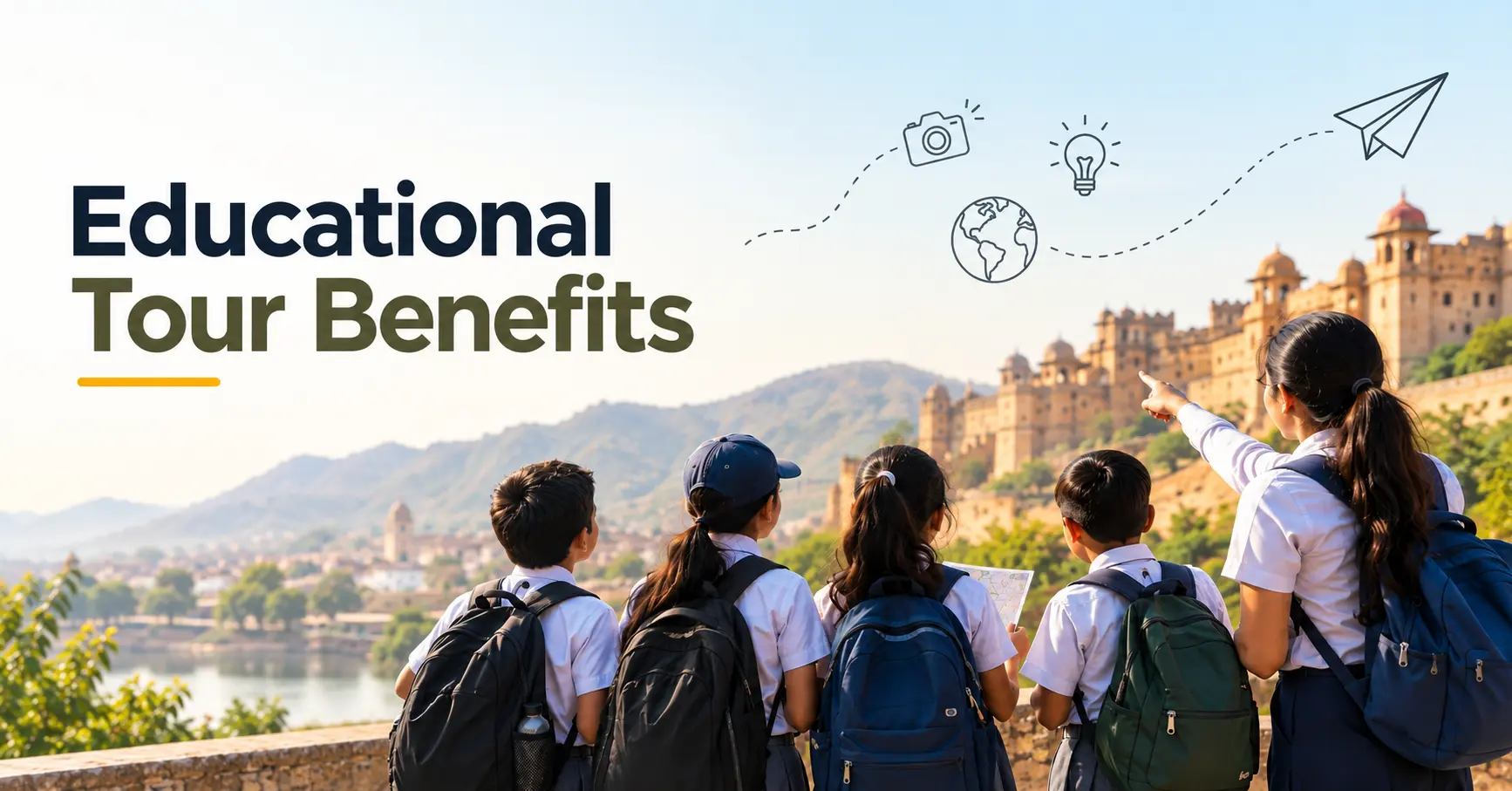 Education is no longer limited to classrooms, textbooks, homework, and examinations. Students learn more effectively when they can connect academic concepts with real places, real people, practical experiences, and the world around them. This is where educational tours become an important part of modern school education. From visiting historical monuments and science museums to exploring wildlife sanctuaries, industries, cultural destinations, research centres, and geographical landscapes, educational trips give students opportunities to learn beyond conventional classroom boundaries. Understanding the educational tour benefits can help school principals, teachers, coordinators, and parents recognise why carefully planned school trips are much more than recreational outings.
A well-designed educational tour can support academic learning, improve communication and teamwork, develop independence, strengthen observation skills, and give students experiences that remain memorable long after they return to school.
For students, an educational tour can turn a chapter from a textbook into something they can actually see and experience. For teachers, it provides a practical environment to reinforce classroom concepts. For principals and school management, educational tours can become an effective way to support experiential learning, student development, and a more engaging school experience.
Why Educational Tour?
An educational tour is a planned school trip designed to provide students with learning experiences outside the traditional classroom. Depending on the age group and academic objectives, schools may organise visits to museums, historical sites, laboratories, universities, factories, farms, wildlife parks, art galleries, cultural centres, geographical locations, or other educational destinations.
The primary purpose is not simply to take students somewhere new. The destination, activities, interactions, and itinerary should be connected with learning objectives. Students should have opportunities to observe, ask questions, participate in activities, collect information, understand real-world applications, and discuss what they have learned.
A successful educational tour therefore combines learning with experience. Instead of only reading about a historical event, students can visit the location where it happened. Instead of studying biodiversity exclusively through diagrams, they can observe ecosystems in the field. Instead of learning about industrial production from a textbook, they can see how products are actually manufactured.
Why Educational Tours Matter in Modern School Education
Modern education increasingly focuses on developing students beyond academic scores. Schools are expected to help children become confident, curious, responsible, creative, collaborative, and capable of applying knowledge in real situations.
Educational tours support this broader approach because they introduce learning environments that are difficult to reproduce inside a classroom. Students encounter unfamiliar surroundings, interact with different people, solve small practical problems, follow schedules, work with classmates, and observe things directly.
The educational tour benefits become especially valuable when trips are planned around clear learning outcomes. A history trip can strengthen historical understanding, a science visit can demonstrate scientific principles, and an environmental tour can develop awareness of conservation and sustainability.
For school leadership, this means educational tours should not be treated as an optional recreational activity. When properly designed, they can become an extension of the school’s academic programme.
Educational Tour Benefits for Students
1. Makes Classroom Learning More Practical
One of the most important educational tour benefits is the ability to connect theoretical knowledge with practical experience.
Students may understand a concept while reading a textbook, but seeing that concept in the real world can make it much easier to remember. A science student visiting a research laboratory, for example, can observe equipment and processes that may otherwise exist only as illustrations in a textbook.
Similarly, students studying architecture can examine historical buildings, geography students can observe different landscapes, and commerce students can understand business operations through carefully planned industry visits.
This connection between theory and practice helps students understand not only what they are learning but also where and why that knowledge is used.
2. Improves Observation and Critical Thinking Skills
Educational tours encourage students to look carefully at their surroundings. Instead of simply receiving information from a teacher, they have to observe, compare, question, interpret, and sometimes reach their own conclusions.
A visit to a museum, for example, may encourage students to compare historical objects and understand how societies changed over time. A visit to a manufacturing facility may lead students to think about automation, supply chains, quality control, and employment.
These experiences encourage students to become active learners rather than passive recipients of information.
3. Encourages Curiosity and Questioning
Curiosity is one of the foundations of effective learning. Students naturally ask more questions when they encounter something unfamiliar or interesting.
An educational tour creates countless opportunities for such questions. Why was a particular monument built? How does a power plant generate electricity? How are medicines tested? Why do certain animals live in particular habitats?
Teachers can use these questions as starting points for deeper discussions both during and after the trip.
4. Develops Communication Skills
Students interact with classmates, teachers, guides, professionals, local communities, and other people during educational tours.
These interactions can help students develop communication skills in natural situations. They may need to ask questions, participate in group discussions, present observations, communicate with team members, or explain what they have learned.
For students who are shy inside the classroom, a different environment can sometimes provide a more comfortable opportunity to participate.
5. Builds Teamwork and Collaboration
Many educational activities require students to work together.
They may be divided into groups for observation activities, assignments, photography projects, questionnaires, research tasks, or presentations. Working together teaches students how to divide responsibilities, listen to others, make decisions, manage disagreements, and achieve a shared objective.
These teamwork skills are valuable not only for school but also for higher education and future professional environments.
6. Develops Independence and Responsibility
Travelling with a school group gives students opportunities to take responsibility for themselves and their belongings while following established rules and schedules.
Students learn to manage personal items, arrive at designated locations on time, follow instructions, respect public spaces, and behave responsibly around others.
For older students, educational tours can provide an even greater opportunity to develop independence and decision-making skills under appropriate teacher supervision.
7. Creates Stronger Memory Through Experiences
People often remember experiences more strongly than information they simply read or hear.
A student may forget a paragraph from a textbook, but may remember standing inside a historical monument, seeing a scientific experiment, watching an animal in its natural environment, or speaking with a professional.
This is another important aspect of the educational tour benefits: experiences can provide powerful memory anchors for academic concepts.
When students return to the classroom, teachers can refer to the experience while explaining related topics, making revision more meaningful.
8. Supports Social and Emotional Development
Educational tours allow students to spend time with classmates in a different environment.
They learn how to cooperate, adjust to group situations, respect different personalities, and manage unfamiliar circumstances. These experiences can strengthen relationships between students and help create a stronger sense of belonging within the school community.
At the same time, teachers get opportunities to understand students in situations that differ from ordinary classroom interactions.
Educational Tour Benefits for Teachers
Educational tours are not only beneficial for students. Teachers can also use them as powerful extensions of their teaching methods.
1. Provides a New Teaching Environment
A teacher can explain many concepts in a classroom, but certain subjects become easier to teach when students can see them directly.
During an educational trip, teachers can point out real examples, ask students questions, encourage observation, and connect the experience with their syllabus.
This creates a more dynamic teaching environment.
2. Helps Teachers Understand Student Interests
Students may demonstrate different interests during a tour than they do in regular classroom activities.
One student may become fascinated by technology, another by history, another by wildlife, and another by entrepreneurship. Teachers can observe these interests and potentially use them to guide future projects, activities, and career discussions.
3. Encourages Experiential Teaching Methods
Educational tours naturally support experiential learning.
Teachers can design pre-tour assignments, observation tasks, questionnaires, group projects, reflection activities, and post-tour presentations. In this way, the tour becomes part of a larger learning cycle rather than an isolated event.
4. Strengthens Teacher-Student Relationships
Spending time together outside the regular classroom can create opportunities for more informal and meaningful interaction.
Students may feel more comfortable discussing their interests, asking questions, or sharing their observations. Teachers can also better understand students’ personalities, strengths, and areas where additional support may be useful.
Educational Tour Benefits for School Principals and Management
For principals and school administrators, educational tours can contribute to both academic quality and the overall student experience.
1. Supports Experiential and Activity-Based Learning
Schools are increasingly expected to provide learning experiences that extend beyond textbook-based instruction.
Educational tours provide a practical way to introduce experiential learning into the school calendar. With appropriate planning, tours can complement classroom teaching and support multiple learning objectives.
2. Strengthens the School’s Educational Approach
A thoughtfully designed educational-tour programme demonstrates that a school values practical learning, curiosity, creativity, collaboration, and student development.
Instead of focusing exclusively on examinations, schools can demonstrate a broader educational philosophy where students are encouraged to explore and understand the world around them.
3. Creates Meaningful Student Experiences
Parents increasingly look for schools that provide children with opportunities to learn through activities and experiences.
Educational tours can therefore contribute to a richer overall school experience when they are safe, academically relevant, age-appropriate, and well organised.
4. Encourages Interdisciplinary Learning
One of the strongest educational tour benefits for schools is the opportunity to combine different subjects in one experience.
For example, a visit to Rajasthan can combine history, geography, architecture, culture, art, economics, and environmental studies. Similarly, a trip to a major city can combine science, technology, business, history, civic awareness, and cultural learning.
This interdisciplinary approach can help students understand that real-world problems are rarely limited to a single academic subject.
How Educational Tours Improve Academic Learning
The effectiveness of a school trip depends heavily on how it is connected with the curriculum.
A successful educational tour generally involves three stages: preparation before the trip, active learning during the trip, and reflection after returning to school.
Before the tour, teachers can introduce the destination and explain what students should observe. During the trip, students can participate in guided activities, ask questions, record observations, and collect information. After the tour, teachers can use presentations, reports, discussions, projects, quizzes, or classroom activities to reinforce what students experienced.
This approach transforms a simple trip into a structured learning experience.
Educational Tour Benefits Across Different Subjects
History and Social Science
Historical monuments, museums, archaeological sites, memorials, and cultural centres can bring history to life.
Students can observe architecture, artefacts, inscriptions, artworks, and other evidence of the past. This makes historical learning more tangible and encourages students to understand events within their geographical and cultural context.
Science
Science-related educational tours can include planetariums, laboratories, research centres, science museums, technology parks, manufacturing facilities, and environmental sites.
Students can observe scientific principles in practical settings and better understand how classroom knowledge is applied.
Geography and Environmental Studies
Visits to mountains, forests, wetlands, farms, rivers, national parks, and other natural environments can help students understand ecosystems, landforms, climate, biodiversity, conservation, and human interaction with nature.
Such experiences can also encourage greater environmental responsibility.
Commerce and Economics
Industry visits, business centres, markets, banks, production facilities, and entrepreneurship-focused destinations can demonstrate how businesses operate.
Students can gain introductory exposure to areas such as production, marketing, logistics, finance, customer service, technology, and management.
Art and Culture
Museums, art galleries, craft villages, cultural centres, theatres, and heritage destinations provide opportunities for students to understand creative traditions and cultural diversity.
This can encourage appreciation for different forms of artistic expression and cultural heritage.
Educational Tour Benefits for Different Age Groups
Educational tours should be designed according to the age, academic level, interests, and maturity of students.
For primary students, tours should generally focus on discovery, observation, simple activities, nature, science, culture, and interactive experiences.
For middle-school students, trips can introduce more structured academic tasks, research activities, environmental awareness, history, science, and social learning.
For senior-school students, educational tours can become more specialised. Industry visits, universities, research centres, professional institutions, historical research locations, entrepreneurship programmes, and career-oriented experiences can help students understand possible academic and professional pathways.
The destination alone does not determine the educational value. The learning design surrounding the destination is what makes the experience meaningful.
How Schools Can Plan a Successful Educational Tour
Planning is one of the most important factors behind a successful school tour. Schools should begin by identifying the academic purpose of the trip and selecting a destination that supports that objective.
Safety, transportation, accommodation where required, student supervision, emergency planning, food arrangements, accessibility, communication systems, permissions, and appropriate student-to-teacher ratios should all be considered carefully.
Teachers should also create a clear itinerary that balances academic activities with reasonable rest and recreation. Students are more likely to benefit when the programme is engaging without becoming excessively tiring.
Parents should receive clear information about the destination, schedule, transport, accommodation where applicable, emergency contacts, inclusions, exclusions, and required student preparations.
The Role of Teachers During an Educational Tour
Teachers play a critical role in converting travel into learning.
Instead of simply accompanying students, teachers can encourage them to observe details, ask questions, record information, participate in activities, and connect their observations with classroom topics.
Simple questions such as What did you notice? Why do you think this works this way? How is this connected to what we studied? can turn ordinary sightseeing into active learning.
Teachers can also encourage students to maintain journals or observation sheets during the trip. These can later become the foundation for classroom discussions or projects.
Safety Should Be a Core Part of Every School Tour
No discussion of the educational tour benefits is complete without considering student safety.
Schools should conduct appropriate planning and risk assessment before travelling. Transportation providers, accommodation, destinations, food arrangements, emergency contacts, medical support requirements, supervision procedures, student attendance systems, and communication protocols should be carefully reviewed.
Students should receive clear instructions regarding group movement, personal safety, appropriate behaviour, emergency procedures, and communication with teachers.
A memorable educational experience should always be built on a strong foundation of responsible planning and student welfare.
Educational Tours Should Include More Than Sightseeing
One common mistake is to treat an educational tour as a sightseeing programme with a school label.
Simply visiting multiple destinations does not automatically create meaningful learning.
Schools can increase the value of a tour by including guided activities, expert interactions, workshops, demonstrations, field observations, student assignments, cultural activities, group challenges, reflection sessions, and presentations.
The goal should be to create a balanced experience where students see, experience, question, discuss, and reflect.
How Parents Can Support Educational Tours
Parents play an important role in helping students make the most of educational trips.
They can encourage children to remain curious, follow school instructions, respect local communities and cultural sites, maintain personal responsibility, and actively participate in learning activities.
Parents should also understand that the value of a school tour cannot always be measured simply by the number of places visited. The deeper value comes from what students learn and how those experiences contribute to their academic, social, and personal development.
Measuring the Success of an Educational Tour
Schools can evaluate educational tours just as they evaluate other learning activities.
Teachers can collect student feedback, review assignments, conduct discussions, evaluate presentations, and compare learning outcomes with the objectives established before the trip.
Questions such as these can help:
- Did students understand the intended academic concepts?
- Were students actively participating?
- What new skills did they develop?
- What surprised or interested them?
- What did they remember after returning?
- How can the experience be connected to future classroom learning?
Such evaluation helps schools improve future tours and ensures that educational travel continues to deliver meaningful value.
Common Mistakes Schools Should Avoid
A poorly planned tour can reduce the educational value of the experience. Overloading the itinerary with too many destinations can leave students exhausted and reduce their ability to absorb information.
Another common problem is selecting destinations without considering curriculum relevance. Schools should avoid choosing a destination simply because it is popular. The academic objectives, age group, travel time, safety, accessibility, and overall learning experience should be considered together.
Schools should also avoid treating the tour as completely separate from classroom education. Pre-tour preparation and post-tour activities are essential for turning experiences into lasting knowledge.
Why Educational Tours Create Long-Term Value for Students
The impact of an educational tour can continue long after students return home.
A historical visit may inspire a student to read more about a particular period. A science-centre visit may encourage curiosity about technology. An industry visit may introduce students to a career they had never considered. A nature trip may create greater appreciation for environmental conservation.
This is why the educational tour benefits extend beyond immediate academic learning. The right experience can influence curiosity, confidence, interests, relationships, career awareness, and the way students understand the world.
Educational Tours and Career Awareness
For senior students, educational travel can also support career exploration.
Visits to universities, research institutions, industries, technology companies, hospitals, laboratories, media organisations, financial institutions, or other professional environments can give students a realistic glimpse into different fields.
Students can see how professionals work, what skills are required, what technologies are used, and what educational pathways may lead to particular careers.
Such exposure can help students make more informed decisions about subjects, higher education, and future career options.
Educational Tours as a Tool for Holistic Development
The strongest argument for educational tours is that they contribute to multiple areas of student development simultaneously.
A single well-planned trip can involve academic learning, communication, teamwork, leadership, independence, cultural awareness, observation, problem-solving, creativity, and social development.
This makes educational tours particularly valuable for schools that want to provide holistic education rather than focusing exclusively on academic performance.
Follow Us & Travel With Us
Get travel inspiration, exciting destinations, tour updates & special offers.
Final Thoughts on Educational Tour Benefits
The classroom will always remain a central part of education, but learning does not have to stop when students leave it. Educational tours provide schools with an opportunity to take learning into museums, laboratories, historical sites, natural environments, industries, cultural centres, universities, and communities.
For students, these experiences can make knowledge practical and memorable. For teachers, they create new opportunities for experiential and interdisciplinary teaching. For principals and school management, they can support a more engaging and holistic educational environment.
Ultimately, the greatest educational tour benefits come when a school approaches every trip with a clear purpose: to help students explore, experience, understand, and grow.
A thoughtfully planned educational tour is therefore not simply a break from the classroom. It is a classroom without walls—one where students can observe the world directly, ask better questions, build meaningful skills, and turn academic knowledge into real-life understanding.