Mt Kosciuszko Packing List: What to Bring for Every Season
A solid Mt Kosciuszko packing list matters more than most people expect. Australia’s highest peak is a straightforward walk on paper — a formed track, clear signposts, and under normal summer conditions no technical mountaineering experience needed — but the alpine weather above the treeline can shift from sunburn to sleet in under an hour. On a late-January climb, hikers regularly report a sunny morning at the trailhead turning windy and cold soon after Rawson Pass. Whichever route you take, what’s in your pack decides whether that shift is a minor inconvenience or a real problem.
Quick Facts
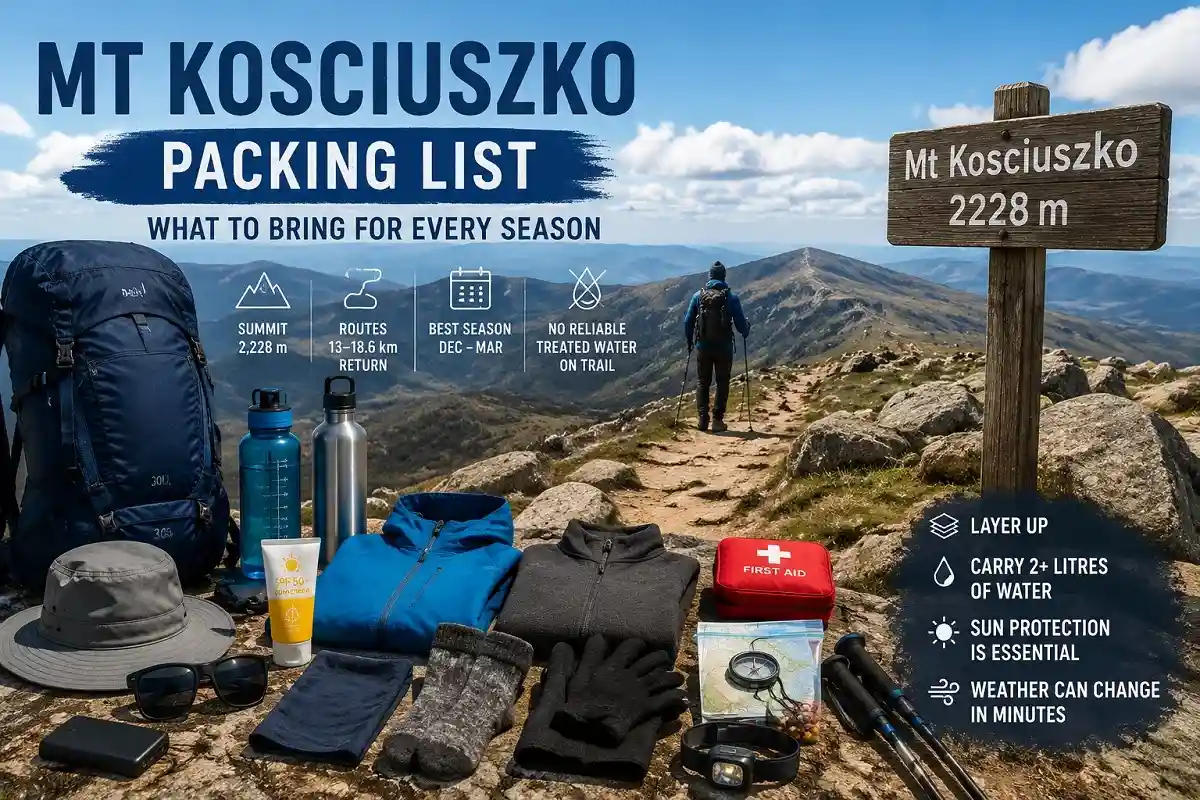
- Summit: 2,228 m — Australia’s highest peak
- Main routes: Thredbo (13 km return) or Charlotte Pass (18.6 km return)
- Best season: December–March, after the snow melts
- Recommended day pack: 20–30L; winter trips often need 30–40L
- No reliable treated drinking water on the standard summit trail
Why the Packing List Matters Here
Kosciuszko doesn’t look like a mountain that demands respect — the summit sits only 2,228 m up, and the Thredbo route gains just 300 m of that on foot thanks to the chairlift. But it’s fully exposed alpine terrain above the treeline, with no shelter and no water taps.
NSW National Parks (NPWS) and the Bureau of Meteorology both flag rapid weather changes as the main risk on this walk, not the distance or elevation — check the BOM forecast for Thredbo Top Station or Charlotte Pass no earlier than a week out, since conditions shift fast.
Suggested Package:
Route Options, Distance, and Getting There
Your packing needs shift a little depending on route, mostly around water, food, and how much elevation you’re gaining on foot rather than by chairlift. Note that the distances below are return trips, not one-way:
| Route | Return Distance | Notes |
| Thredbo (via chairlift) | 13 km, 4–6 hrs | Easiest; ~300 m elevation gain thanks to the chairlift |
| Charlotte Pass | 18.6 km, 6–8 hrs | Longer, gentle old-road grade, more elevation gain on foot |
| Main Range Loop | ~22 km loop | Toughest option; undulating, less developed sections |
Entry fees apply to Kosciuszko National Park and can change — check the current rate on the official NPWS website before you go. The Kosciuszko Express Chairlift generally runs through the hiking season, but weather and maintenance can affect its schedule, so confirm operating hours with Thredbo Resort the same week. Aim to start hiking by 7–8 a.m. in summer, and earlier still in winter, to avoid being caught by afternoon storms.
Weather by Season
| Season | Temp Range | Wind & Snow | UV |
| Summer (Dec–Mar) | 5–25°C, can drop fast | Gusty; rare summer snow flurries | Very high |
| Shoulder (Apr–May, Nov) | -5 to 15°C | Increasingly windy; early/late snow possible | High |
| Winter (Jun–Oct) | -10 to 5°C | Winds 100+ km/h possible; sustained snow cover | High (reflective snow) |
Who This Hike Suits
- Beginners: yes, on the Thredbo route in summer, with proper gear and an early start
- Families, kids, and seniors: manageable at a relaxed pace on the Thredbo route
- Not wheelchair or stroller accessible beyond the boardwalk sections near Eagles Nest
Backpack Size and Pack Weight
- Summer day hike: a 20–30L pack is enough for water, food, and layers
- Winter or shoulder season: 30–40L to fit extra insulation, snowshoes, and emergency gear
- Typical loaded pack weight: roughly 5–8 kg in summer, 8–12 kg in winter
Summer Packing List (December–March)
This is when most people climb Kosciuszko, and while it’s the easiest season, “easy” still means alpine-ready. Core items:
- Sturdy trail shoes or light hiking boots — the track includes rocky and uneven sections
- Moisture-wicking base layer plus a light fleece or insulated mid-layer
- A packable rain and wind jacket — pack it even if the forecast looks clear
- Wide-brim hat, UV-rated sunglasses, and SPF 50+ sunscreen with an SPF lip balm
- At least 2 litres of water per person on the Thredbo route, more for Charlotte Pass or the Main Range
Food and Hydration Strategy
- Protein bars, trail mix, and dried fruit for steady energy
- A sandwich or wrap for the longer Charlotte Pass walk, plus electrolyte tablets in summer heat
- A hydration bladder or bottles — whichever you find easier to sip from without stopping
Winter and Shoulder-Season Packing List (April–November)
Snow can settle on Kosciuszko from as early as April, and the main summit track typically holds snow cover between June and October, though this varies with each year’s snowfall. Winds over 100 km/h and whiteouts are genuinely possible, so this isn’t a season for underdressing:
- Waterproof, insulated hiking boots, with microspikes if the track is icy
- Full thermal base layers, an insulated mid-layer, and a windproof/waterproof outer shell
- Snowshoes and trekking poles for safe movement through deep or drifted snow
- Beanie, neck gaiter, insulated gloves, and snow goggles for whiteout conditions
- A GPS device or offline smartphone maps, with spare batteries — cold drains battery life fast, and there are no snow poles marking the route in winter
Navigation, Safety, and Emergency Gear
Even on the well-marked summer track, carry backup navigation, basic first aid, and a few emergency items most people skip:
- Offline maps app plus a printed paper map as backup
- A basic first aid kit, headlamp, power bank, and an emergency whistle
- A personal locator beacon (PLB) for winter or Main Range trips, where mobile signal is unreliable
- Know the signs of dehydration, heat exhaustion, and hypothermia, and turn back if weather closes in — the summit isn’t worth a lightning strike or a whiteout
Small Extras People Forget
- Spare socks, a buff, zip-lock bags, and a waterproof phone pouch
- Hand sanitiser, a small trash bag, personal medications, and insect repellent in summer
Full Packing Checklist by Season
| Category | Summer (Dec–Mar) | Shoulder/Winter (Apr–Nov) |
| Footwear | Sturdy trail shoes or light hiking boots | Waterproof hiking boots; microspikes if icy |
| Legs | Hiking trousers or shorts | Thermal base layer + waterproof overpants |
| Torso | Moisture-wicking tee + light fleece | Thermal base layer, insulated mid-layer, down jacket |
| Outer shell | Packable rain/wind jacket | Waterproof, windproof shell jacket and pants |
| Head & hands | Wide-brim hat, sunglasses | Beanie, neck gaiter, insulated gloves, goggles |
| Extra gear | Trekking poles (optional) | Snowshoes, trekking poles, gaiters |
| Water & food | 2+ litres, high-energy snacks | 2+ litres (insulated bottle), extra calories |
What You Don’t Need
It’s easy to overpack once you start reading general alpine-climbing gear lists. In summer, on the Thredbo or Charlotte Pass routes, you don’t need crampons, an ice axe, a rope, or a heavy DSLR kit — this is a day walk on a formed track, not a technical ascent. Cotton clothing, flip-flops, and glass bottles are all worth leaving at home too.
Common Mistakes to Avoid
- Trusting a clear morning forecast and leaving the rain shell in the car.
- Underestimating UV exposure — sunburn is one of the most common issues on this walk.
- Carrying too little water, assuming you’ll find a tap or café along the way.
Pro Tips
- Layer rather than bulk up in one heavy jacket; alpine weather swings mean you’ll be adding and removing layers all day.
- If riding a bike to Rawson Pass, remember the final 1.4 km to the summit is walk-only.
Buying or Renting Gear Locally
Thredbo and nearby Jindabyne both have outdoor stores stocking rain shells, thermal layers, and poles. Snowshoe and ski gear rental is widely available around Thredbo and Perisher during the snow season.
Frequently Asked Questions
1. Do I need hiking boots for Mt Kosciuszko?
Sturdy trail shoes are enough in summer on the Thredbo route; waterproof boots are recommended for Charlotte Pass and essential in winter.
2. Is there water available on the Kosciuszko walk?
No treated drinking water on the trail — carry at least 2 litres per person.
3. Is Mt Kosciuszko suitable for beginners?
Yes, the Thredbo route in summer suits most fitness levels with the right gear.
4. Are there toilets on the walk?
Yes, at the Thredbo chairlift base and top, and at Rawson Pass.
5. Can I bring my dog?
No, dogs aren’t permitted on Kosciuszko National Park walking tracks.
6. Is there mobile phone signal on the trail?
Coverage is patchy at best; don’t rely on it, and carry offline maps or a PLB for remote sections.
7. What happens if bad weather rolls in?
Turn back — rapid weather changes are the main hazard here, and the summit will still be there another day.
8. What backpack size should I use?
A 20–30L pack for a summer day hike; 30–40L if you’re carrying winter layers and gear.
9. Is camping allowed near the summit?
Only in designated areas with a permit; check current NPWS rules before planning an overnight trip.
10. Is drone flying allowed?
Drone use is restricted in Kosciuszko National Park and generally requires prior NPWS approval.
Final Word
A good Mt Kosciu szko packing list isn’t about carrying a mountaineer’s kit up Australia’s easiest big peak — it’s about respecting how fast alpine weather changes above the treeline. Pack layers, water, and sun protection for summer; add real winter gear the rest of the year; and you’ll turn a straightforward ascent into a comfortable one, whichever route up you choose.
Suggested Package