Mount Aconcagua Expedition Itinerary (20 Days)
Day 1: Arrival in Mendoza (760 m / 2,508 ft)
Arrive in Mendoza, the gateway city for the Mount Aconcagua Expedition. Meet your expedition team, complete gear checks, attend the briefing session, and prepare for the adventure ahead.
Day 2: Mendoza to Penitentes (2,725 m / 8,992 ft)
Travel through the stunning Andes Mountains to Penitentes. Enjoy spectacular views of the surrounding peaks while preparing for your ascent of Mount Aconcagua.
Day 3: Penitentes to Confluencia Camp (3,300 m / 10,890 ft)
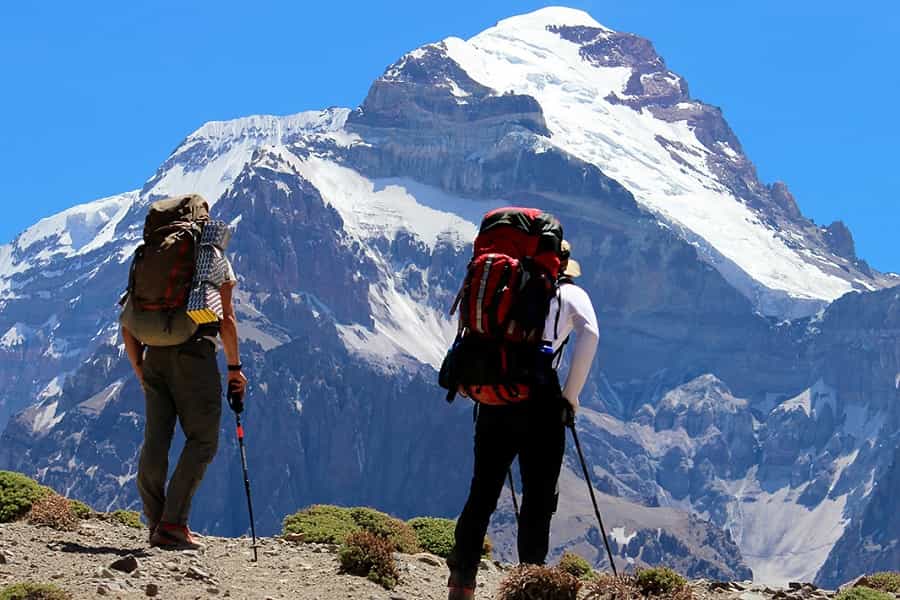
Begin trekking into Aconcagua Provincial Park and reach Confluencia Camp. Experience your first close-up views of Mount Aconcagua and settle into camp.
Day 4: Acclimatization Hike to Plaza Francia (4,000 m / 13,200 ft)
Hike to Plaza Francia, located at the base of the impressive South Face of Mount Aconcagua. Return to Confluencia Camp after an important acclimatization day.
Day 5: Confluencia to Plaza de Mulas Base Camp (4,260 m / 14,058 ft)
Trek to Plaza de Mulas, the main base camp of Mount Aconcagua. Enjoy breathtaking views of the Andes and prepare for higher altitude acclimatization.
Day 6: Acclimatization Day at Plaza de Mulas
Rest and acclimatize at Plaza de Mulas. Explore the base camp surroundings and monitor your adaptation to the altitude before advancing higher on Mount Aconcagua.
Day 7: Acclimatization Climb to Mount Bonete (5,091 m / 16,702 ft)
Climb Mount Bonete for acclimatization and enjoy panoramic views of Mount Aconcagua and the surrounding Andean peaks. Return to Plaza de Mulas for the night.
Day 8: Carry Load to Camp 1 Canadá (5,000 m / 16,400 ft)
Carry equipment and supplies to Camp Canadá, the first high camp on the normal route of Mount Aconcagua. Return to Plaza de Mulas.
Day 9: Rest Day at Plaza de Mulas
A full rest and recovery day at Mount Aconcagua Base Camp. Final preparations are made for moving to higher camps.
Day 10: Plaza de Mulas to Camp 1 Canadá (5,000 m / 16,400 ft)
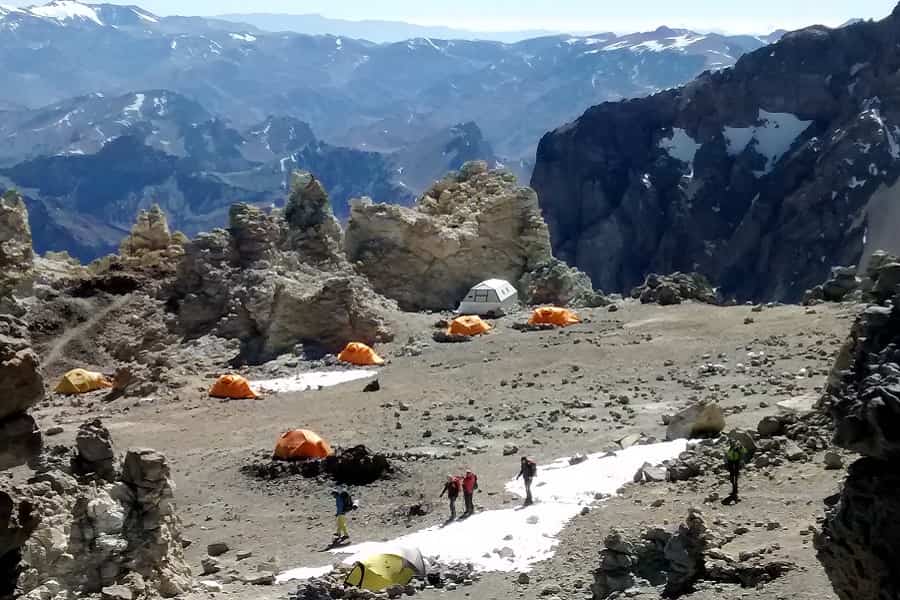
Leave base camp and move permanently to Camp Canadá. Experience your first night at a high-altitude camp on Mount Aconcagua.
Day 11: Camp Canadá to Nido de Cóndores (5,500 m / 18,000 ft)
Ascend to Nido de Cóndores, one of the most important camps on Mount Aconcagua. Enjoy expansive views of the Andes from this spectacular location.
Day 12: Acclimatization Day at Nido de Cóndores
Rest and acclimatize at Nido de Cóndores. Hydration and recovery are essential for a successful Mount Aconcagua summit attempt.
Day 13: Carry to Camp 3 Cólera (5,970 m / 19,585 ft)
Carry summit equipment to Camp Cólera, the final high camp on Mount Aconcagua. Return to Nido de Cóndores for the night.
Day 14: Nido de Cóndores to Camp 3 Cólera (5,970 m / 19,585 ft)
Move to Camp Cólera and prepare for the summit push. Review weather conditions and finalize plans for summit day.
Day 15: Mount Aconcagua Summit Day (6,962 m / 22,834 ft)
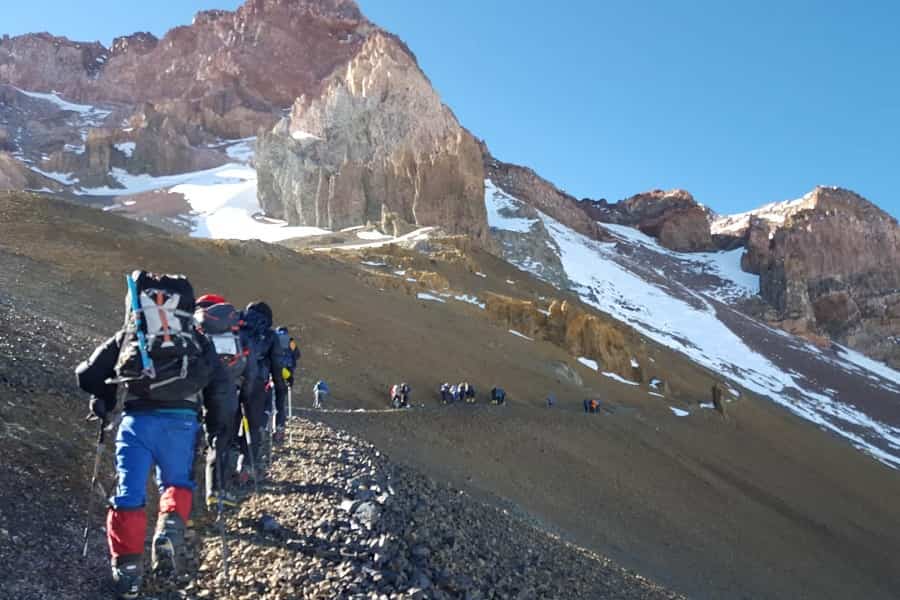
Begin the summit ascent of Mount Aconcagua, the highest mountain in South America and the highest peak outside Asia. Reach the summit at 6,962 meters and enjoy unforgettable views before descending to Camp Cólera.
Day 16: Camp Cólera to Plaza de Mulas (4,260 m / 14,058 ft)
Descend from the high camps back to Plaza de Mulas Base Camp. Celebrate your successful Mount Aconcagua summit climb.
Day 17: Plaza de Mulas to Penitentes
Trek out of Aconcagua Provincial Park and return to Penitentes, concluding the mountain phase of the expedition.
Day 18: Penitentes to Mendoza
Transfer back to Mendoza. Enjoy a farewell dinner and share memories from your Mount Aconcagua Expedition.
Day 19: Extra Summit Weather Day
Reserved as an additional contingency day for weather, acclimatization, or summit flexibility during the Mount Aconcagua Expedition.
Day 20: Extra Summit Weather Day
Second contingency day to maximize the chances of a successful Mount Aconcagua summit and safe expedition completion.
FAQ related Mount Aconcagua
Q. How hard is it to climb Mount Aconcagua?
The Normal Route requires no technical climbing skills and involves no ice or rock climbing experience. However, the ascent is physically demanding due to high altitude, long trekking days, and load carrying between camps. A well paced acclimatization schedule is essential for a safe and successful summit.
Q. How much does an Aconcagua expedition cost?
Shikhar's 20 day Mount Aconcagua Normal Route expedition is priced at USD 6,532 for international tourists, covering guided ascent, base camp services, mules, porters for high-altitude camps, meals on the mountain, and a 2 day weather buffer. Park permits, rescue insurance, and personal equipment are not included.
Q. What is the best time to climb Mount Aconcagua?
The prime climbing season is December to February, when weather is most stable and temperatures are highest. November and March are shoulder months with fewer climbers but colder summit conditions. Shikhar's fixed departures run from November through February to align with this window.
Q. What is the difference between the Normal Route and the Polish Glacier Route on Aconcagua?
The Normal Route is non technical and suitable for fit trekkers with no prior climbing experience. The Polish Traverse offers a more gradual, scenic ascent with a similar difficulty level. The Polish Glacier Route requires technical ice and glacier skills and is recommended only for experienced climbers.
Q. Do I need prior mountaineering experience to climb Aconcagua?
No technical mountaineering experience is required for the Normal Route. Strong cardiovascular fitness, leg endurance, and prior high-altitude trekking experience above 4,000 metres are recommended to improve acclimatization and summit success.
Q. How many days does the Aconcagua expedition take?
Shikhar's Aconcagua expedition runs 20 days and 19 nights, including travel to and from Mendoza, a structured acclimatization schedule across multiple camps, the summit push, and 2 contingency days for weather.