Mount Kosciuszko Expedition Weather Guide
Mount Kosciuszko weather swings between Australia’s mild alpine summer and its snow-bound winter, even though the mountain itself is a gentle, non-technical walk. At 2,228 m, it’s the highest peak on the Australian mainland, inside Kosciuszko National Park in the Snowy Mountains. This guide covers Kosciuszko’s climate by season, route distances, timing, safety, and what the weather means for your packing list, helping you prepare for a successful Mount Kosciuszko Climbing Expedition.
Quick Answer
| The best Mount Kosciuszko weather is generally found between December and March, Australia’s summer, when daytime temperatures reach 14–25°C and trails are usually snow-free. Winter (June–October) brings snow, sub-zero temperatures near -4°C to 4°C, and blizzard risk. Wind chill can make it feel colder than the thermometer shows, so pack layers regardless of season and check the forecast before you set out. |
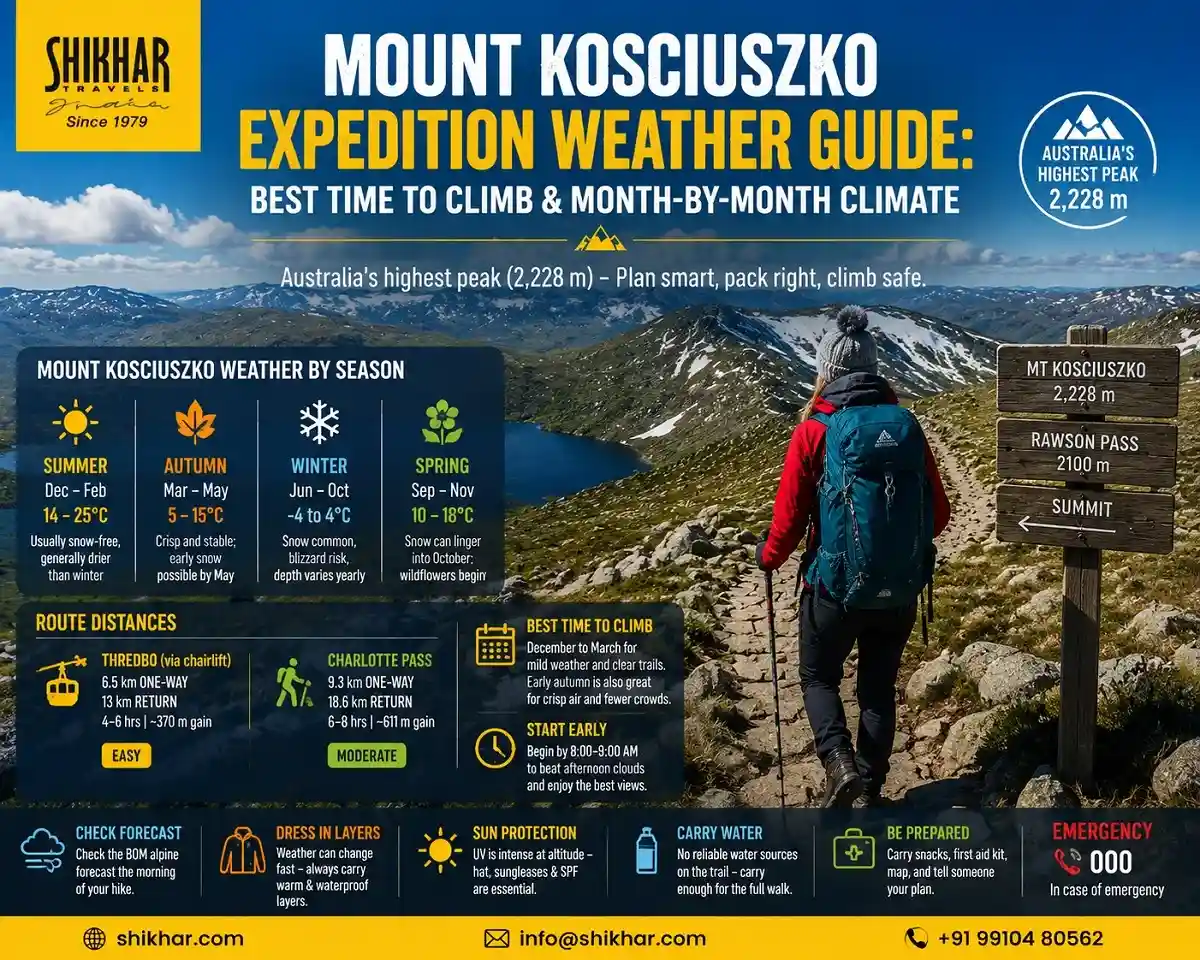
Mount Kosciuszko Weather by Season
Because Kosciuszko sits in the Southern Hemisphere, summer falls in December–February. Conditions below are typical ranges — actual weather varies year to year, so always check a live forecast before you hike.
| Season | Months | Day Temp | Wind & Rain | Conditions |
| Summer | Dec–Feb | 14–25°C | Moderate; afternoon storms possible | Usually snow-free, generally drier than winter |
| Autumn | Mar–May | 5–15°C | Calmer, occasional frost | Crisp and stable; early snow possible by May |
| Winter | Jun–Oct | -4 to 4°C | Strong; wind chill adds further cold | Snow common, blizzard risk, depth varies yearly |
| Spring | Sep–Nov | 10–18°C | Variable, gusty | Snow can linger into October; wildflowers begin |
Valley temperatures at Thredbo often run a few degrees warmer than the exposed summit, and even January nights can dip near freezing at altitude, so warm layers matter in every season.
- Suggested Package: Climbing the Seven Summits
Best Time to Climb Mount Kosciuszko
December to March is generally the best time to climb Mount Kosciuszko, with the mildest weather and mostly clear trails. Early autumn is a good alternative for crisp weather and thinner crowds. Mornings usually offer the calmest, clearest conditions before afternoon cloud builds, so an early start also means better summit views.
| Quick tip: weekday hikes in December or March combine good weather with quieter trails, avoiding January school-holiday crowds. |
Route Distances: Thredbo vs Charlotte Pass
Route choice affects both weather exposure and how far you’re committing to walk. Note that the Charlotte Pass route is 18.6 km return (about 9.3 km one-way), not a short 9 km round trip.
| Route | One-Way | Return | Duration | Elev. Gain | Difficulty |
| Thredbo (via chairlift) | 6.5 km | 13 km | 4–6 hrs | ~370 m | Easy |
| Charlotte Pass | 9.3 km | 18.6 km | 6–8 hrs | ~611 m | Moderate |
The Charlotte Pass route is closed during winter and is fully exposed to wind and weather throughout, with fewer facilities than the Thredbo side. Both routes meet near Rawson Pass.
Chairlift, Fees & Trail Logistics
The Kosciuszko Express chairlift takes about 15 minutes; operating hours vary seasonally and by weather, so confirm the day’s schedule before travelling rather than relying on a fixed time.
- A NSW National Parks vehicle entry fee applies, with rates that vary by season — verify current pricing on the NPWS website before you go
- The chairlift ticket is a separate cost from the park entry fee
- Toilets are generally available at Thredbo Village, Eagles Nest, Seamans Hut, and Rawson Pass, though availability can change — check locally on arrival
- Mobile signal is patchy beyond Eagles Nest; download offline maps and carry a paper backup
- Water refill points are limited — carry enough drinking water for the full walk rather than relying on taps
Expedition Day Timing
A Kosciuszko summit is typically a single long day hike, so timing revolves around daylight and afternoon weather risk. Start from Thredbo by 8:00–9:00 AM for a good weather buffer, and begin descending by early afternoon. Actual pace varies — fit hikers often finish faster, while families, photographers, or beginners should budget extra time and check the last chairlift departure before setting out.
Winter Weather & Snow Season
From June to October, Kosciuszko becomes a backcountry snow environment aligned with the Thredbo and Perisher ski season. Expect sub-zero temperatures, whiteouts, and real blizzard and hypothermia risk; snow depth varies year to year, and marked trails are often buried. Winter attempts need snowshoes or skis, navigation skills, and cold-weather experience — Shikhar Educational Tours does not recommend winter attempts for student or first-time groups without a certified guide.
Weather-Related Safety Tips
- Check the Bureau of Meteorology alpine forecast the morning of your hike, not the night before.
- Carry a waterproof shell even in summer — rain, wind, and lightning can arrive with little warning near the exposed Main Range.
- Watch for hypothermia signs; windy summits can chill you fast even on a mild day.
- UV exposure is intense at altitude — sunburn is common even on cool, cloudy days.
- In genuine emergencies call 000; Seamans Hut offers emergency shelter, and a personal locator beacon (PLB) is a smart addition for remote-route hikers.
- Tell someone your planned route and expected return time before you set out.
What to Pack for Mount Kosciuszko Weather
- Waterproof, windproof jacket and a warm mid-layer, even in summer
- Sturdy walking shoes or light hiking boots with good grip
- Sun hat, sunglasses, and high-SPF sunscreen for intense alpine UV
- Extra warm layer and gloves for the exposed summit ridge
- Water, snacks, and a basic first-aid kit for the return walk
Nearby Landmarks Along the Route
Both routes pass notable alpine features worth knowing before you go: Seamans Hut and the Snowy River on the Charlotte Pass side, and views toward Mount Townsend, Blue Lake, and the Ramshead Range from the Main Range. Adventurous hikers sometimes extend the trip via Merritts Nature Track or toward Dead Horse Gap, though these add distance and demand more fitness.
Weather Planning for Student & Educational Expeditions
Kosciuszko’s gentle gradient suits school and college expedition groups, but weather planning still matters. Group leaders should build a weather contingency into the itinerary, check the forecast the morning of departure, and carry spare layers for students who underestimate the cold.
Travel Notes for Indian Travellers
Most visitors fly into Sydney or Canberra. Thredbo is roughly 5–6 hours’ drive from Sydney but only about 2.5 hours from Canberra, the faster gateway if your itinerary allows it; Snowy Mountains Airport near Cooma is about an hour away. Indian passport holders need a valid Australian visa arranged well before travel — confirm the current visa category with the Australian High Commission or your tour operator.
Mount Kosciuszko Weather FAQs
What is the best time to climb Mount Kosciuszko?
December to March, for mild, mostly snow-free weather.
How cold does it get on Mount Kosciuszko?
Winter days average -4°C to 4°C; wind chill can feel colder.
Is Mount Kosciuszko covered in snow in winter?
Yes, usually from June through September or October, though depth varies yearly.
Is Mount Kosciuszko weather predictable?
No, alpine weather can shift quickly even in summer.
Can I hike Mount Kosciuszko after rain?
Yes, but expect slippery sections; check trail conditions first.
Can you hike Mount Kosciuszko in fog?
It’s possible but visibility drops fast — consider postponing if fog is heavy.
Can children hike Mount Kosciuszko?
Yes, the Thredbo route is family-friendly in good summer weather.
Are dogs allowed on the Mount Kosciuszko trail?
No, dogs aren’t permitted within Kosciuszko National Park’s walking tracks.
Is camping allowed near the summit?
Limited backcountry camping is allowed away from water catchments; check NPWS rules first.
Does weather ever cancel the chairlift?
Yes, high wind or maintenance can close it — always check before relying on it.
Is snow guaranteed on Mount Kosciuszko in winter?
No, snowfall and depth vary each year and aren’t guaranteed.
Is there ice risk in October?
Yes, frost and icy patches are still possible in early spring.
What should I pack for Mount Kosciuszko weather?
A waterproof shell, warm layer, sun protection, and sturdy shoes.
How long is the Charlotte Pass route?
18.6 km return, about 9.3 km one-way, taking 6–8 hours.
Is Mount Kosciuszko technically difficult to climb?
No, it’s a non-technical walk with no mountaineering gear needed in summer.
What time should I start a Kosciuszko summit hike?
By 8:00–9:00 AM, to finish before afternoon weather risk increases.
Mount Kosciuszko weather rewards good timing: aim for December–March, start early, check the forecast on the morning of your hike, and pack layers regardless of season. Respect the alpine climate, and Australia’s highest peak makes for a rewarding, manageable climb.
Must Reads on: