Aconcagua Mountain Climbing Expedition: The Complete 2026 Guide
An Aconcagua climbing expedition takes you to 6,961 metres in Argentina’s Andes — the highest point in the Western Hemisphere and one of the more approachable entries into the Aconcagua Seven Summits climb category. The Normal Route itself is non-technical: no fixed ropes or crevasse travel are involved, though routes like the Polish Glacier are genuine technical alpine climbs. What actually defeats most climbers is thin air, brutal wind, and cold, not steep rock. This guide covers the real numbers you need: cost, permits, weather, and a realistic itinerary.
Quick Answer: What You Need to Know
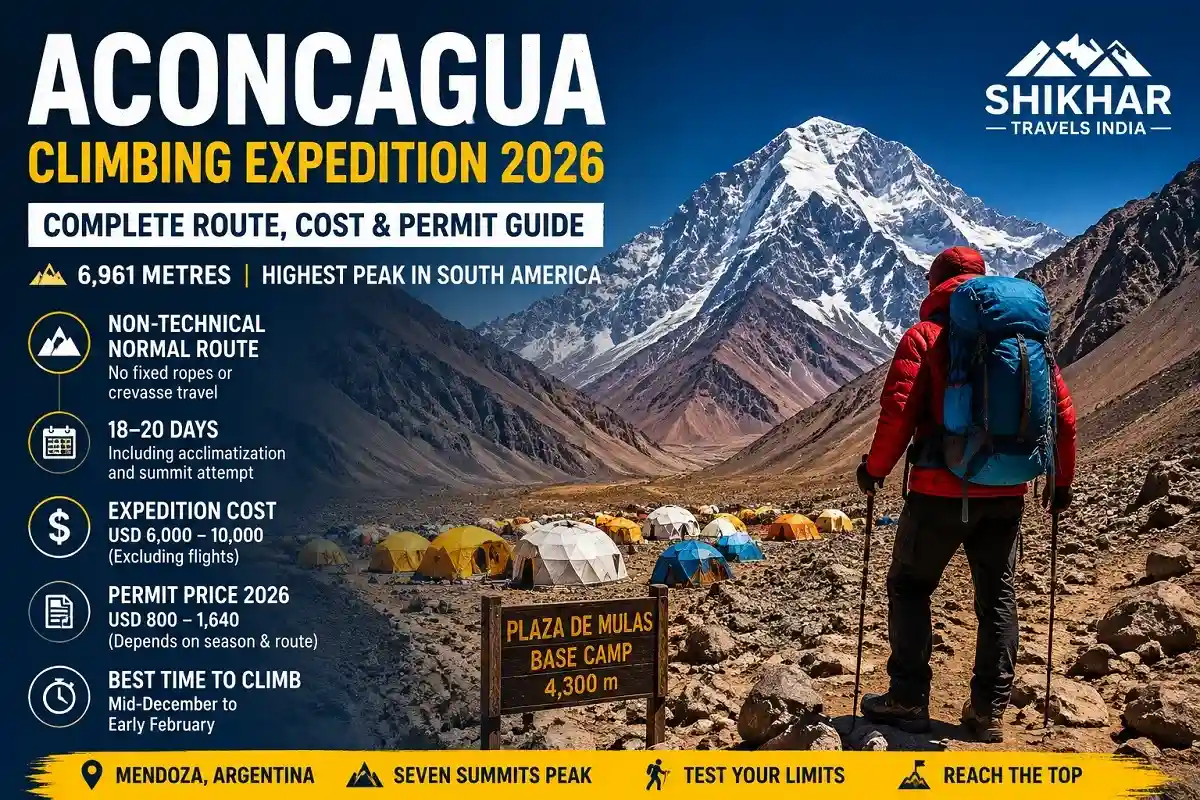
Aconcagua (6,961m) is climbed mainly via the non-technical Normal Route from Horcones, over 18–20 days including acclimatization. The best time to climb Aconcagua is mid-December to early February. A guided expedition typically costs USD 6,000–10,000 excluding flights, and the Aconcagua permit price runs USD 800–1,640 depending on season and route. Summit success rates vary widely by season and operator and shouldn’t be treated as a fixed number.
What Is Aconcagua and Why Climbers Choose It
Aconcagua sits in Mendoza Province, Argentina, about 15km from the Chilean border, and is the highest peak in South America and the Western Hemisphere. It’s one of the Seven Summits — the highest point on each continent. An Aconcagua climbing expedition attracts trekkers rather than technical alpinists because the standard route needs no fixed ropes or crevasse travel — though that applies specifically to the Normal Route, since the Polish Glacier route is a genuine technical alpine climb. Most climbers use this Aconcagua ascent as a training ground for Denali or Everest.
Aconcagua Routes: Which One Should You Climb
Normal Route (Horcones)
The route roughly seven in ten climbers choose for their Aconcagua climbing expedition. It runs through Confluencia and Plaza de Mulas base camp (4,300m) to three high camps before the summit push. It’s non-technical — no glacier travel or fixed ropes — though crampons and an ice axe are often carried for the final ridge, depending on snow conditions that season.
360° Route (Vacas Valley)
A longer, quieter approach through the Vacas and Relinchos valleys, adding two to three days but easing acclimatization pacing — a good pick if you want to climb Aconcagua Argentina away from the Horcones crowds.
Polish Glacier and False Polish Traverse
The true Polish Glacier route is a technical alpine climb requiring rope and ice skills. Most operators instead run the False Polish Traverse — approaching via the Vacas Valley but summiting via the non-technical Normal Route side.
Best Time to Climb Aconcagua
The park season runs mid-November to late February. High season (mid-December to January) has the most stable weather but the biggest crowds; many guides prefer February for quieter trails with comparable conditions. Expect big daily swings: 20–30°C by day at Confluencia (3,368m), dropping to around -10°C at night at Plaza de Mulas (4,300m), and -20°C to -30°C at the high camps and summit (6,961m) once wind chill is factored in. Gusts above 5,000m can exceed 100 km/h — locals call the dangerous westerly squalls viento blanco. Treat every forecast as provisional and build in spare days.
How Difficult Is an Aconcagua Climbing Expedition
On the Normal Route, the real challenge isn’t technical climbing — it’s carrying a loaded pack above 5,500m in extreme wind and cold. Summit success rates vary significantly by season, route, and operator, commonly cited between 25% and 65%, so treat any single figure as indicative rather than guaranteed. It suits climbers with prior multi-day trekking or peak experience (Kilimanjaro, Elbrus, or similar), solid cardiovascular fitness, and at least one night already spent above 4,000m.
Health, Safety and Practical Essentials
Altitude sickness is the biggest real risk on Aconcagua, not the terrain. Drink 4–5 litres of water daily, ascend gradually, and talk to your doctor before departure about preventive medication such as acetazolamide (Diamox). Sun exposure at this altitude is intense — SPF 50+ and glacier glasses are non-negotiable even on cloudy days.
High-altitude rescue insurance is mandatory for your permit, though minimum coverage requirements can vary by operator, so confirm the figure before buying a policy. Helicopter evacuation is possible in emergencies but is arranged, and billed, through your insurer and the park rescue service, not guaranteed on demand. Mobile signal and Wi-Fi are unreliable above Confluencia — most operators carry a satellite phone for emergencies, worth budgeting for if you’re climbing independently.
Getting There, Staying and What It Costs
Fly into Mendoza’s El Plumerillo Airport (MDZ), then it’s a roughly 3-hour, 182km road transfer to Penitentes (2,580m), the logistics base before the Horcones park entrance. Most itineraries include 2–3 nights in a Mendoza hotel for permit processing, one night in Penitentes, and tented or dormitory-style camps from Plaza de Mulas upward.
Indian passport holders should check Argentina’s current visa rules well ahead of booking: under 2025 policy changes, some Indian travellers can enter visa-free only if they already hold a valid US visa or green card; otherwise a standard visa or AVE is still required. Rules change, so confirm with the Argentine embassy before booking flights.
Budget for four separate cost buckets, since none are bundled by default:
| Cost Item | Typical Range (USD) | Notes |
|---|---|---|
| Park Permit (Horcones, high season) | $1,170 – $1,640 | Lower with authorised local assistance |
| Park Permit (Vacas/360° Route) | $1,450 – $2,000 | Higher due to longer route |
| Guided Operator Package | $5,850 – $9,950 | Varies by group size, season, inclusions |
| Gear (rent vs buy) | $600 – $3,000 | Renting in Mendoza cuts cost significantly |
| Flights + Mendoza transfers | $1,200 – $3,500 | Book 4–6 months ahead |
| Tips & incidentals | $300 – $500 | Guides, base camp staff, muleteers |
Permit fees are paid in person at the Mendoza tourism office — bring your passport and allow half a day for processing. Prices above reflect the latest officially published season (2025/26); Mendoza Province typically confirms updated rates closer to each year’s opening, so reconfirm with your operator before booking.
Step-by-Step: Aconcagua Normal Route Itinerary
- Day 1–2: Arrive Mendoza (760m), permit processing, gear check
- Day 3: Drive to Penitentes (2,580m), trek to Confluencia (3,368m)
- Day 4: Acclimatization hike to Plaza Francia viewpoint
- Day 5–6: Trek roughly 20km to Plaza de Mulas base camp (4,300m)
- Day 7–8: Rest and acclimatize at base camp
- Day 9–11: Move to Camp Cañada (4,910m) and Nido de Cóndores (5,560m)
- Day 12–14: Move to Camp Cólera (5,970–6,100m); watch for a weather window
- Day 15–16: Summit attempt (6,961m), typically an 8–12 hour round trip, then descend to base camp
- Day 17–19: Weather buffer days, descend to Penitentes/Mendoza
- Day 20: Departure
Common Mistakes Climbers Make
- Skipping acclimatization hikes to ‘save time’ — the top cause of forced retreats
- Under-budgeting by forgetting the permit is separate from the operator fee
- Booking December departures without buffer days for wind delays
- Confirming rescue insurance and visa requirements too late to fix issues
Safety Note: Viento blanco can force summit-day retreats even with clear skies elsewhere on the mountain — always keep at least two spare summit-attempt days in your itinerary.
Pro Tips From the Ground
- Choose February if you want a quieter mountain with comparable weather odds
- Hire a personal porter for the Nido de Cóndores–Cólera carry to save summit-day energy
- Train with a loaded pack (18–22kg) on stairs or hills for at least 8 weeks before departure
- Get the permit done on day one in Mendoza to avoid a wasted acclimatization day later
Why Climb With Shikhar Travels
Shikhar Travels India has built its expedition track record across Seven Summits peaks including Kilimanjaro and Elbrus, with the same principle applied to every Aconcagua climbing expedition we run: transparent pricing, realistic acclimatization schedules, and no shortcuts on safety days. We’re a govt-registered operator offering custom departures, 24×7 climb support, and clear cost breakdowns — no hidden permit surprises after you’ve paid.
Frequently Asked Questions
How difficult is the Aconcagua Normal Route?
It’s non-technical but physically demanding — the difficulty comes from altitude, wind, and cold rather than climbing skill.
How much does it cost to climb Aconcagua?
Budget USD 9,000–15,000 all-in once you add the permit, guided operator fee, flights, and gear on top of the base package price.
What is the best time to climb Aconcagua?
December and January offer the most stable weather, while February often has similar conditions with far fewer climbers on the mountain.
What is the Aconcagua climbing permit cost for 2026?
Foreign climbers currently pay roughly USD 1,170–1,640 on the Horcones route and USD 1,450–2,000 on the Vacas/360° route; confirm final 2026/27 rates before booking.
Can beginners join an Aconcagua climbing expedition?
Not as a first mountain — prior multi-day trekking or a lower-altitude peak like Kilimanjaro or Elbrus is strongly recommended first.
Final Word: Is Aconcagua Right for You
An Aconcagua climbing expedition rewards patience over raw athleticism — climbers who summit are usually the ones who respected the acclimatization schedule, not the fastest ones on day one. If you have prior high-altitude trekking behind you, a realistic 18–20 day window, and a budget around USD 9,000–15,000 all-in, this Aconcagua ascent is one of the most achievable non-technical summits on the Seven Summits list.
Ready to plan your climb? Contact Shikhar Travels for a custom itinerary, transparent cost breakdown, and confirmed December–February departure dates.