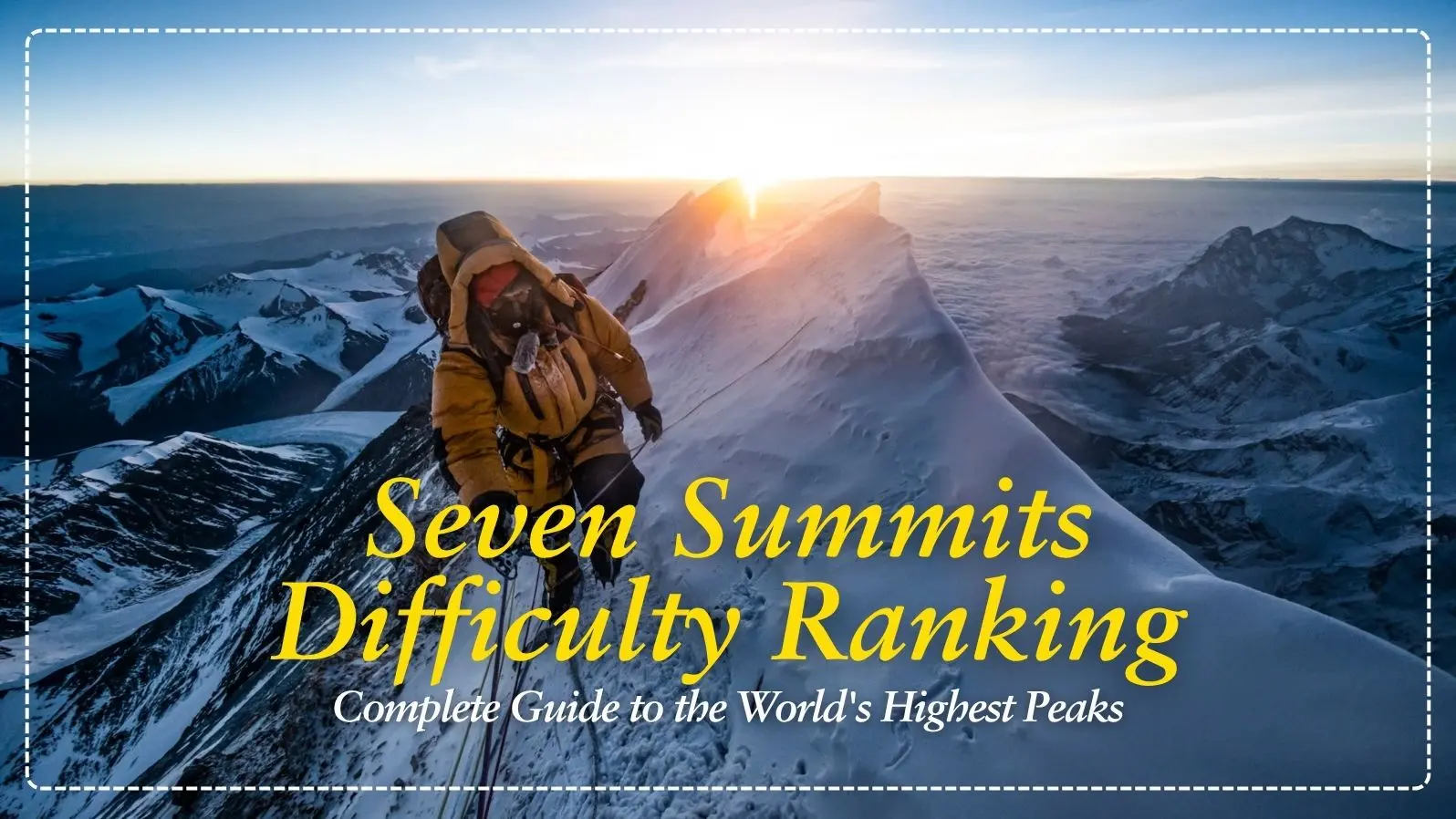
Dreaming of standing on top of the world? The Seven Summits the highest peaks on each of the seven continents represent the ultimate bucket list for serious mountaineers and adventurous travelers. But not all summits are created equal. The Seven Summits difficulty ranking varies wildly: one peak is a well-marked trekking route that fit amateurs can attempt; another demands oxygen bottles, extreme cold endurance and months of preparation. Understanding these differences before you plan your expedition could be the difference between summit success and a life threatening situation.
This comprehensive guide ranks all seven summits by difficulty, explains the key factors that make each one challenging and gives you the insider data you need whether you are a first time high altitude trekker or an experienced alpinist ticking off your continental list.
What Are the Seven Summits?
The Seven Summits concept was popularized by American businessman Dick Bass, who completed his list in 1985. The classic Bass List includes:
- Everest — Asia
- Aconcagua — South America
- Denali (Mt McKinley) — North America
- Kilimanjaro — Africa
- Elbrus — Europe
- Vinson Massif — Antarctica
- Kosciuszko — Australia/Oceania
A rival list the Messner List replaces Kosciuszko with Carstensz Pyramid (Puncak Jaya) in Papua, Indonesia, as the true high point of the Oceania continental plate. Most serious alpinists target the Messner variation because of its genuine technical challenge. This guide covers both options where relevant.
Seven Summits Difficulty Ranking — At a Glance
The table below ranks all seven summits from easiest to hardest, factoring in technical climbing skills required, altitude and acclimatization demands, remoteness and rescue access, weather windows and expedition length.
| Rank |
Mountain |
Continent |
Elevation |
Difficulty |
Typical Duration |
| 1 |
Aconcagua |
South America |
6,961 m / 22,838 ft |
Moderate–Hard |
18–22 days |
| 2 |
Denali (Mt McKinley) |
North America |
6,190 m / 20,310 ft |
Hard |
17–21 days |
| 3 |
Kilimanjaro |
Africa |
5,895 m / 19,341 ft |
Moderate |
6–9 days |
| 4 |
Mont Blanc / Elbrus |
Europe (debate) |
4,808 / 5,642 m |
Moderate |
7–12 days |
| 5 |
Vinson Massif |
Antarctica |
4,892 m / 16,050 ft |
Hard (logistics) |
14–21 days |
| 6 |
Puncak Jaya (Carstensz) |
Oceania |
4,884 m / 16,024 ft |
Hard (technical) |
10–14 days |
| 7 |
Everest |
Asia |
8,849 m / 29,032 ft |
Extreme |
60–70 days |
Note: Europe has two contested high points. Mont Blanc (France, 4,808 m) is higher in the Western Alps; Elbrus (Russia, 5,642 m) lies in the Caucasus. Most Seven Summits lists now use Elbrus as the European summit.
Detailed Difficulty Profile: Each Summit Explained
Elevation: 5,895 m / 19,341 ft. Kilimanjaro is the most accessible of the Seven Summits and is often the first high-altitude objective for aspiring adventurers. No ropes, no technical gear and no prior mountaineering experience are required it is a high-altitude trek, not a climb. The biggest challenge is acclimatization: altitude sickness affects a significant portion of all summiteers regardless of fitness level.
The Machame Route (7 days) and Lemosho Route (8 days) offer the best acclimatization profiles. Success rates on longer routes exceed 85%. Tanzania’s national park fees and a growing eco-tourism infrastructure make this a well-supported adventure.
✦ Pro Tips
→ Choose a 7–8 day route over a 5-day route; the extra acclimatization days dramatically improve summit success rates.
→ Go slow — pole pole (Swahili for ‘slowly, slowly’) is the guiding mantra of every good guide on Kili.
→ Best climbing windows: January–March and June–October.
Elevation: 5,642 m / 18,510 ft. Mount Elbrus in the Russian Caucasus is the highest point in Europe (per the Messner and most modern definitions). A cable car system takes climbers to 3,800 m, reducing the initial ascent significantly. The standard South Face route is non-technical, but extreme cold (down to −40°C), sudden storms and whiteouts make Elbrus deceptively dangerous. Frostbite and disorientation in bad weather claim lives every year.
Guided expeditions typically run 10–12 days, including acclimatization rotations on the mountain. Russian visa requirements and geopolitical considerations since 2022 have prompted many operators to offer alternative European summits.
✦ Pro Tips
→ Hire a reputable company like
Shikhar Travels: storms move in fast on Elbrus with little warning.
→ Acclimatize with day hikes to the Pastukhov Rocks (4,700 m) before summit day.
→ Best season: June to September.
Elevation: 6,961 m / 22,838 ft. At nearly 7,000 metres, Aconcagua is the highest mountain in both the Western and Southern Hemispheres. Yet it requires no technical climbing on the Normal Route (Northwest Ridge) no glaciers, no ropes, no ice axes on summit day. So why is it rated Moderate Hard? The altitude. At this elevation, even acclimatized climbers face severe hypoxia, and the notorious Viento Blanco (White Wind) can pin expeditions for days.
Success rates hover around 40% on the Normal Route, largely because climbers underestimate acclimatization time. Expeditions run 18–22 days with multiple carries to high camps. The 360° views from the summit encompass the entire southern Andes.
✦ Pro Tips
→ Spend at least 3 nights at base camp (4,370 m) before going higher.
→ The Polish Glacier Direct offers a technical alternative for experienced alpinists.
→ Permit fees apply; book in advance for peak season (December–February).
Elevation: 6,190 m / 20,310 ft. Denali in Alaska is widely regarded as one of the most demanding of the Seven Summits despite not being the highest. The reasons are multiple: its subarctic latitude means climbers experience conditions equivalent to 7,500 m elsewhere; the mountain sits only 3° south of the Arctic Circle; and the West Buttress the standard route involves glacier travel, crevasse crossings and steep snow slopes at altitude. Temperatures routinely hit −40°C with wind chill.
All climbers must carry their own gear via sled (pulk) up the Kahiltna Glacier for the first days. NPS rangers and mandatory registration add a layer of safety but the mountain demands self-sufficiency. Only around 50% of Denali expeditions succeed.
✦ Pro Tips
→ Prior glacier travel experience is strongly recommended this is not a first-mountain objective.
→ The weather window is tight: May to early July.
→ Build in buffer days; storms can pin teams at 14,200 ft camp for a week.
Elevation: 4,892 m / 16,050 ft. Vinson’s technical difficulty is moderate comparable to Denali’s lower slopes but the Seven Summits difficulty ranking places it firmly in the Hard category because of extreme remoteness and cost. Getting there requires a charter flight from Punta Arenas, Chile, to Union Glacier in Antarctica, costing USD 40,000–65,000 for the full expedition. Temperatures average −30°C and self-rescue is essentially impossible.
The mountain itself has fixed ropes on key sections. Climbers typically spend 14–21 days on the continent. Success rates are high (around 75%) because only well-prepared, guided climbers make the financial commitment to attempt it.
✦ Pro Tips
→ This is the most expensive of the Seven Summits budget accordingly and factor in weather delays.
→ Antarctic Heritage Trust regulations apply; respect leave no trace protocols strictly.
→ Season: November to January only.
Elevation: 4,884 m / 16,024 ft. Carstensz Pyramid in Papua, Indonesia, is the most technically demanding of the Seven Summits. Despite its relatively modest elevation, the standard route requires multi-pitch rock climbing at a Grade 5.10 level, abseiling, Tyrolean traverses and fixed-rope ascents on exposed limestone ridges. It is the only summit that demands genuine rock-climbing skills.
Access is complicated by Indonesian government permit restrictions, proximity to the Grasberg copper mine and the need to traverse through indigenous Dani territories. Many expeditions are cancelled due to permit denials. This unpredictability, combined with technical difficulty, puts Carstensz firmly in the hard category.
✦ Pro Tips
→ Rock climbing competency to at least 5.9 level is essential before attempting this peak.
→ Work only with operators who have strong relationships with local authorities.
→ Papua permit delays can add weeks to your planned expedition window.
Elevation: 8,849 m / 29,032 ft. Mount Everest is the unquestioned pinnacle of the Seven Summits difficulty ranking. The world’s highest peak demands extreme cold endurance, supplemental oxygen (virtually all summiteers use it above 7,500 m), Sherpa support, months of acclimatization and significant technical skills on the Khumbu Icefall, Lhotse Face and Hillary Step. Death Zone exposure above 8,000 m causes cellular deterioration regardless of fitness levels.
Commercial expeditions run 60–70 days and cost USD 35,000–130,000+. Nepal’s government has tightened permit regulations since 2019. Success rates on the South Col route are approximately 56%, but the number conceals significant survivor bias those who make it to base camp are already highly filtered. An average of 5–10 deaths occur on the mountain per year.
✦ Pro Tips
→ A 7,000 m+ peak (Aconcagua, Denali, or a Himalayan 7,000er) should precede any Everest attempt.
→ Choose April May or September October for the best weather windows.
→ Hire only UIAGM/IFMGA-certified guides and go with operators who have strong Sherpa networks.
Key Factors That Determine Seven Summits Difficulty
When assessing the Seven Summits difficulty ranking, experts consider five primary variables:
- Altitude and Hypoxia Risk: Above 5,500 m, oxygen levels are severely reduced. Every 1,000 m gain above base altitude doubles acclimatization time required.
- Technical Climbing Grade: Ranges from walk-up (Kilimanjaro) to rock climbing Grade 5.10+ (Carstensz) to mixed ice-rock-snow (Denali, Everest).
- Weather and Temperature: Subarctic conditions on Denali and Antarctic cold on Vinson create risk levels that exceed elevation-only assessments.
- Remoteness and Rescue Access: Vinson offers essentially zero rescue options; Kilimanjaro and Elbrus have helicopter rescue infrastructure.
- Permit and Access Complexity: Carstensz is notorious for permit denials; Everest requires significant lead time for Nepal/Tibet permits.
Frequently Asked Questions (FAQ)
Q. Which of the Seven Summits is the easiest to climb?
Ans. Kilimanjaro in Tanzania is widely considered the easiest of the Seven Summits. It requires no technical climbing equipment or prior mountaineering experience, making it accessible to fit trekkers willing to devote 7–9 days to proper acclimatization.
Q. Which of the Seven Summits is the hardest?
Ans. Mount Everest is the hardest summit by any metric altitude, technical difficulty, duration, cost and fatality risk. However, Denali and Carstensz Pyramid are considered harder than their elevation alone suggests, due to severe cold and technical rock climbing requirements respectively.
Q. Can a beginner attempt any of the Seven Summits?
Ans. Yes, Kilimanjaro is regularly completed by first-time high-altitude trekkers. Aconcagua via the Normal Route and Elbrus via the South Route are also considered beginner-friendly in terms of technical requirements, though altitude preparation is essential for all three.
Q. How long does it take to complete all Seven Summits?
Ans. The fastest completion on record (Matthias Giraud) took under 117 days. Realistically, most climbers take 7–10 years to complete all seven, factoring in permits, weather windows, expedition costs and recovery between major climbs.
Q. What is the Messner List vs the Bass List?
Ans. The Bass List (1985) includes Kosciuszko (2,228 m, Australia) as the Oceania summit. The Messner List replaces it with Carstensz Pyramid (4,884 m, Papua, Indonesia), the highest point of the Oceanian continental plate. Most modern mountaineers and record-tracking bodies prefer the Messner List for its greater alpinistic challenge.
Q. How much does it cost to climb all Seven Summits?
Ans. Total costs typically range from USD 100,000 to 250,000+ for the complete Seven Summits. Everest ($35,000–$130,000) and Vinson ($40,000–$65,000) are the most expensive due to permit fees, charter flights and guide costs. Kilimanjaro is the most budget-friendly at $3,000–$7,000.
Training Recommendations by Difficulty Level
A structured training plan should match the difficulty tier of your target summit:
- Moderate (Kili, Elbrus): 3–4 months of cardiovascular base training, trekking with loaded pack, altitude simulation if possible.
- Moderate–Hard (Aconcagua): 6–9 months of training including weekend mountaineering courses, crampon and ice axe skills and back-to-back long-day hikes.
- Hard (Denali, Vinson, Carstensz): Minimum 12–18 months of structured training with prior experience on 5,000–6,000 m peaks, glacier travel, crevasse rescue and rope work.
- Extreme (Everest): Multi-year preparation involving 7,000 m and 8,000 m summits, supplemental oxygen training and a prior Everest Base Camp season.
Final Thoughts: Planning Your Seven Summits Journey
The Seven Summits difficulty ranking is not just a list it is a roadmap for progressive mountaineering achievement. Whether you are planning your first expedition to Kilimanjaro or have Everest in your sights after ticking off six continents, understanding the unique challenges of each peak is the most important step you can take before booking your permit.
Adventure travel to high-altitude destinations is growing rapidly, especially from India and Southeast Asia. If you are planning a Seven Summits expedition or simply want to experience the magic of high altitude trekking, connect with experienced operators who understand both the technical demands and the cultural nuances of each destination.
Post Views: 2,372