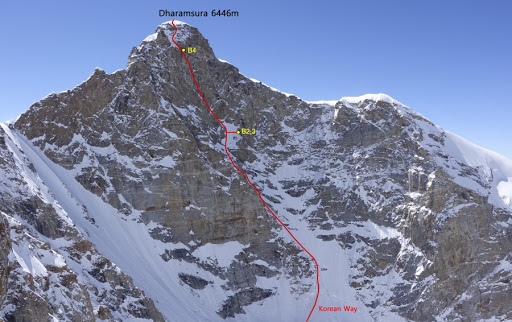
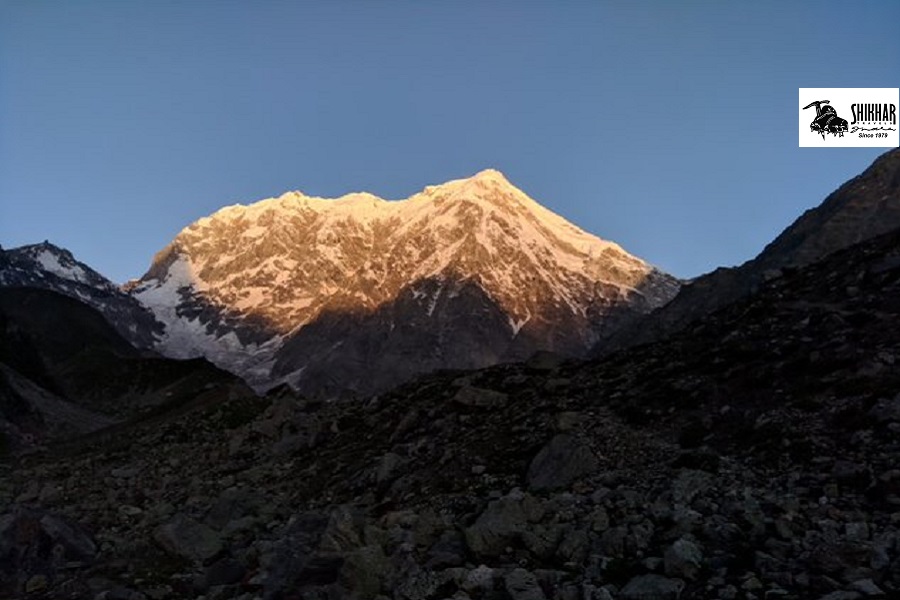
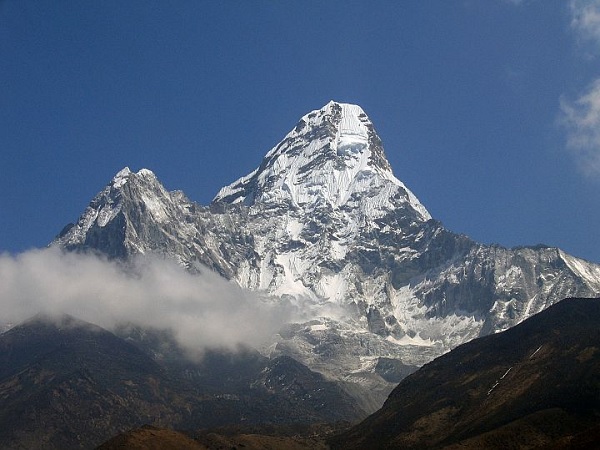
Mount Nun Climbing Expedition (7135 M | 23409 ft) itinerary
Mount Nun Expedition Day by Day Itinerary
DAY 1: ARRIVE DELHI (216 M)
Welcome to India- a country where hospitality is a way of life; to a culture steeped in tradition, a land where history lives in music and dance. Upon arrival at Indira Gandhi International Airport Delhi, You will meet our representative and warm welcome with traditional manner and garlands, followed by transfer to hotel for check in and overnight stay.
DAY 2: DELHI (IMF VISIT)
Morning after breakfast proceed to Indian mountaineering foundation (IMF) for briefing with the Director of IMF, Liaison Officer and complete some paperwork. You can also visit the museum and library of IMF to get more information about Indian Himalayas and your expedition, afternoon free for leisure.
Meal: Breakfast
DAY 3: DELHI - LEH (3,524 M)
Morning after an early breakfast, we will transfer you to the airport to board a flight to Leh. Maximum flight duration is 2 Hrs, and you will enjoy the fascinating view of Snow covered mountains of Himachal Pradesh and Ladakh during this journey.
Note: Arrive Leh airport you need to fill the Foreigner registration form to enter Ladakh union territory.
Upon arrival in Leh drive to hotel for check-in. Rest of the day for Acclimatisation. Later in the day meet and greet with Team Shikhar (Sherpa, Kitchen Staff, Guides), Shikhar Team leader will review your climbing gear. If you need something you can buy from Leh local market, overnight at hotel.
Meals: Breakfast + Lunch + Dinner
Day 04: LEH
Morning after breakfast you will have an acclimatization hike to Shanti Stupa and Leh Palace. Return to your hotel by the later part of the afternoon. Evening you can walk down to the nearest market on your own or spend some time at leisure. Overnight at the hotel.
Meals: Breakfast + Lunch + Dinner
DAY 5: LEH - KARGIL (2,676 M)
Morning After breakfast check out from hotel and drive to Kargil, approx 230kms drive. You will witness once again to the Barren Mountain and wilderness, lunch enroute. Overnight stay at hotel in Kargil.
Meals: Breakfast + Lunch + Dinner
Note: Kargil is a last place where you can get good mobile network and WIFI Internet connection.
DAY 6: KARGIL - TANGOL (3,700 M)
Morning after breakfast liaison officer along with Shikhar representative will complete remaining paperwork and formalities in the local administration offices.
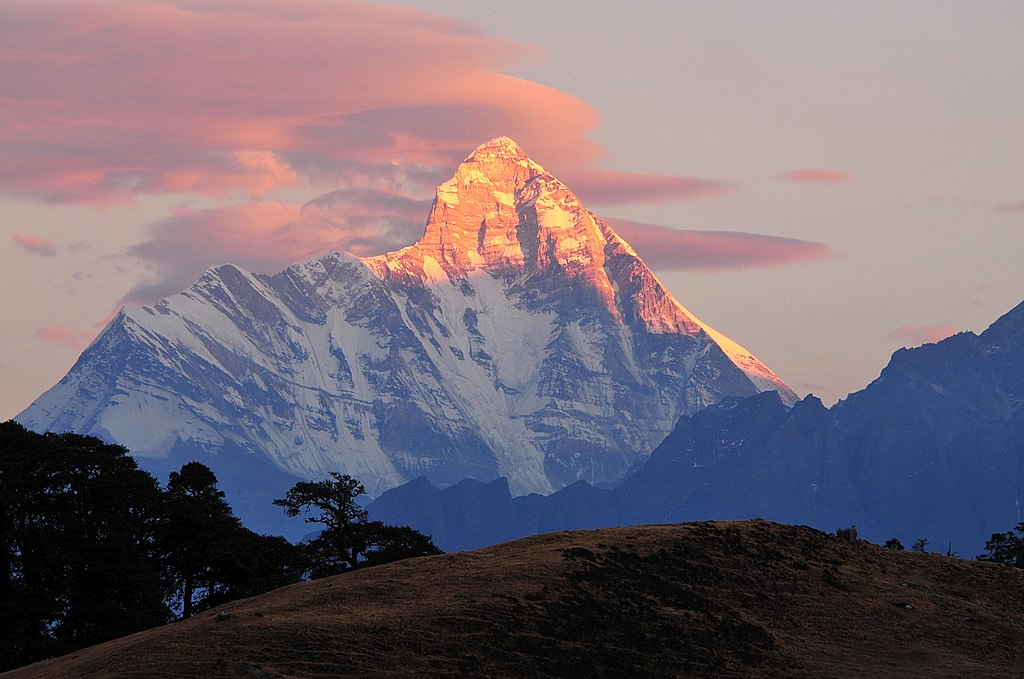
Later in the day, checkout from hotel and drive to Tangol village approximately 04 hrs drive, enroute you will see the first view of Mount Nun 7135, Mount Kun 7077 M, and Stop from taking picture and enjoy local masala tea. Afternoon reach at Tangol village, overnight stay in the tents, evening you can walk around the local village.
Meals: Breakfast + Lunch + Dinner
DAY 7: TANGOL - BASE CAMP (4,600 M)
Morning after breakfast handover your bags to the Porters, today we climb to moraine and continue to base camp. This involves 5-7 hrs trek. Upon arrival establish your base camp and overnight stay in tent.
Meals: Breakfast + Lunch + Dinner
DAY 8: ACCLIMATIZATION & TRAINING AT BASE CAMP
A full acclimatization and training day at Base Camp. The team conducts technical training on nearby ice slopes: crampon technique, ice axe self-arrest, fixed rope ascending/descending, knot practice, and harness fitting. The puja ceremony is performed in the morning with traditional offerings and prayer flags. Distribution of technical equipment. Evening briefing on the climbing strategy and rotation schedule.
Altitude: 4,600m | Meals: All meals | Stay: Tents
DAY 9: BASE CAMP TO CAMP 1 (Load Carry)
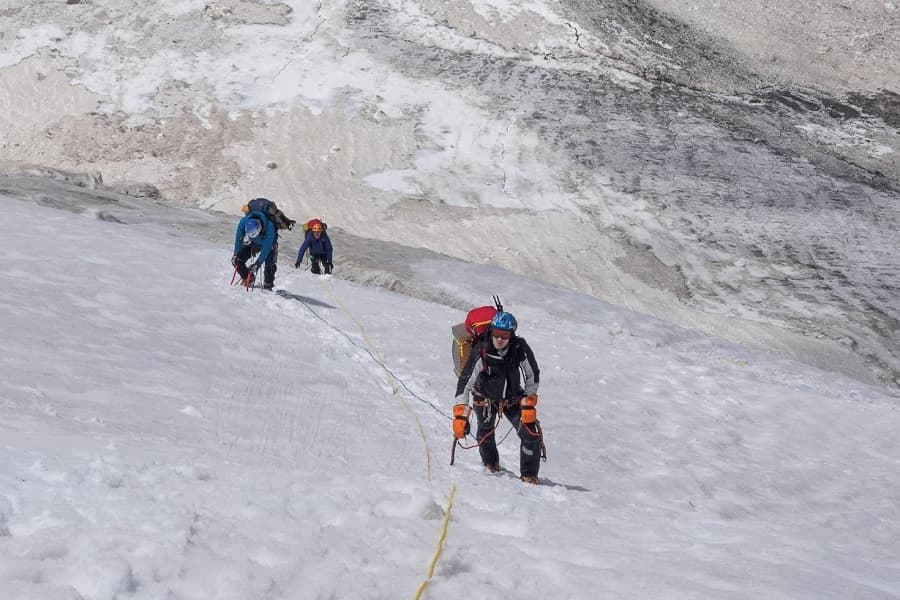
First rotation begins. Team carries loads to Camp 1 (5,400-5,500m), establishing the supply cache. This involves crossing the rocky slope, navigating the glacier, ascending the 75-degree ice wall using fixed ropes, and traversing the snowfield. After depositing loads, the team descends back to Base Camp for recovery.
Altitude: 4,600m to 5,500m and return | Trek: 5-6 hrs up | Meals: All meals
DAY 10: REST & RECOVERY AT BASE CAMP
Recovery day at Base Camp. Hydration, nutrition, and light movement. The body adapts to the altitude stress from the previous day's carry. Equipment check and repairs if needed.
DAY 11: BASE CAMP TO CAMP 1 (Overnight Stay)
Second rotation to Camp 1, this time staying overnight to further acclimatize. Climbing the same route but with overnight gear. This night at 5,500m is critical for the body's adaptation to sleeping at higher altitude.
Altitude: 5,500m | Trek: 5-6 hrs | Meals: All meals including high-altitude food | Stay: Tents
DAY 12: CAMP 1 TO CAMP 2 (Load Carry) — RETURN TO CAMP 1
Load carry from Camp 1 toward Camp 2 (6,100m). This steep, sustained climb on 60-70 degree slopes tests endurance and technique. After depositing loads, descend to Camp 1 for overnight rest.
DAY 13: CAMP 1 TO BASE CAMP (Recovery Descent)
Descend from Camp 1 back to Base Camp for recovery. The descent allows the body to recover from altitude stress while retaining the acclimatization gains. Rest, eat well, and prepare for the next rotation.
DAY 14: REST DAY AT BASE CAMP
Full rest day. Monitor weather forecasts and plan the summit push window. Team briefing on conditions above Camp 2.
DAY 15: BASE CAMP TO CAMP 1
Third rotation begins. Climb to Camp 1 with summit gear. The route should now feel familiar the ice wall less intimidating, the snowfield more navigable. Overnight at Camp 1.
DAY 16: CAMP 1 TO CAMP 2
Push from Camp 1 to Camp 2 (6,100m) with overnight gear. This is the challenging sustained ascent on steep slopes. Arrive at the dramatic ridge campsite of Camp 2 for overnight stay. First night above 6,000 metres.
Altitude: 6,100m | Trek: 8-9 hrs | Meals: Ready-to-eat high-altitude food | Stay: Tents (4-person sharing)
DAY 17: CAMP 2 TO CAMP 3 / SUMMIT CAMP (6,400m)
Move from Camp 2 to Summit Camp (6,400m). Relatively shorter climb compared to previous days but at extreme altitude where every movement is slower. Arrive at Camp 3, set up, eat, hydrate, and attempt to rest before the midnight summit push.
Altitude: 6,400m | Trek: 5-6 hrs | Stay: Tents
DAY 18: SUMMIT DAY — MOUNT NUN (7,135m)
Summit push begins at approximately 11 PM (Day 17 night). Climb through the night on the west ridge, navigating 40-60 degree ice slopes in darkness with headlamps. The final boulder section before the summit demands extreme focus despite fatigue. SUMMIT at 7,135 metres. Descend to Camp 3 or Camp 2 depending on conditions and team strength. Round trip: 14-16 hours.
Summit Altitude: 7,135m / 23,409 ft | Climb: 14-16 hrs round trip
NOTE: Summit day is weather-dependent. The expedition leader and Sherpas will make the final call on timing based on wind, visibility, snow conditions, and team fitness. Safety always takes priority over summit ambitions.
DAY 19: DESCENT FROM HIGH CAMPS TO BASE CAMP
Descend from high camps (Camp 2 or Camp 3) all the way back to Base Camp. This is a long, demanding day (8-10 hours) that requires full concentration despite fatigue and relief. Steep descents with crampons on tired legs demand care. Arrive at Base Camp for celebration and rest.
DAY 20: CAMP 2 – BASE CAMP
Today morning pack you gears and all belonging and trek back to Base Camp. Reach at base camp and celebrate the Success of summit. Overnight in tent.
Meals: Breakfast + Lunch + Dinner
DAY 21: BASE CAMP – TANGOL – KARGIL
Morning after breakfast handover your bags to the porters and trek down to Tangol village. Letter board in the vehicle and drive back to Kargil. Overnight stay in hotel.
Meals: Breakfast + Lunch + Dinner
DAY 22: KARGIL - LEH
Morning after relaxed breakfast drive to Leh. Overnight stay in the hotel.
Meals: Breakfast + Lunch + Dinner
DAY 23: LEH - DELHI
Morning drive to Leh Kushok Bakula Rinpoche airport to catch the flight for Delhi. Reach at Delhi airport and drive to IMF for De-briefing, you need to summit the expedition report and your experience (valuable feedbacks and inputs) in Indian Himalaya. The Liaison Officer's official duty will finish here. After De-briefing drive to hotel for overnight stay. Evening enjoy the farewell dinner in Delhi with Shikhar team.
Meals: Breakfast + Farewell Dinner
DAY 24: DELHI DEPART
Morning after breakfast check out from hotel, our airport transfer will drop you at Indira Gandhi Airport to Depart for onward destination. It was lovely to having you in India, See you soon.
Meal: Breakfast
WHY CHOOSE MOUNT NUN?
Highest Peak in the Zanskar Range
At 7,135 metres, Mount Nun is the undisputed highest summit in the entire Zanskar Range. Standing on its summit provides panoramic views across the Karakoram Range and the snow-covered wilderness of western Ladakh.
Ideal 7,000m Stepping Stone
Mount Nun is widely considered the best first 7,000-metre expedition for climbers who have completed peaks in the 6,000-6,500 metre range. The technical demands rope work, crampon technique, ice wall climbing, camp rotation mirror what larger Himalayan peaks require, making it the perfect preparation for future 8,000-metre objectives.
Technical Mountaineering, Not Just Trekking
Unlike walk-up trekking peaks, Mount Nun demands genuine mountaineering skills: front-point cramponing on 60-75 degree ice walls, fixed rope sections, glacier navigation across hidden crevasses, and sustained climbing at extreme altitude. The alpine grading of AD+ to D reflects this level of challenge.
Stunning Glacier & High Camp Experience
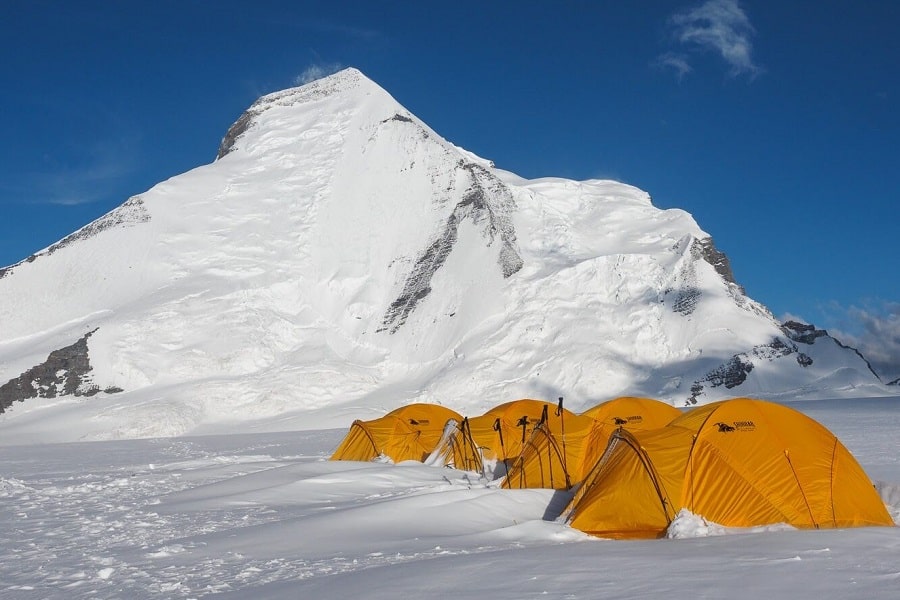
The expedition route passes through vast glacial formations, high-altitude snowfields, and dramatic ridge campsites. Camp 2, perched on a narrow ridge at 6,100 metres, offers some of the most spectacular high-altitude camping views anywhere in the Himalaya.
Cultural Immersion in Ladakh
Before reaching the mountain, participants experience Ladakh's rich Buddhist heritage through visits to Hemis Monastery, Thiksey Monastery, and Shey Palace. The drive through the Suru Valley offers glimpses of traditional Ladakhi village life against a backdrop of towering peaks.
Climbing in India's Rain Shadow
Mount Nun's climbing season (July-September) coincides with the Indian monsoon, but Ladakh lies in a rain-shadow zone. While other Himalayan regions receive heavy rainfall, the Zanskar Range typically enjoys clearer skies and more stable climbing conditions during these months.
PREREQUISITES & EXPERIENCE REQUIRED
Mount Nun is reserved for experienced mountaineers only. This is not a peak for first-time climbers or those with only trekking experience. The technical demands, extreme altitude, and unpredictable conditions require a specific skill set and proven high-altitude capability.
Minimum Experience Required
Successful summit of at least one peak above 6,000 metres (preferably 6,500m+). Examples include Stok Kangri, Kang Yatse II, Friendship Peak, Island Peak, Mera Peak, Lobuche Peak, or equivalent high-altitude climbing experience. Mountaineering certification from a recognised institute (Basic Mountaineering Course or equivalent) is highly recommended.
Technical Skills Needed
Familiarity with crampons and ice axe technique (front-pointing on steep ice). Experience with fixed rope climbing using ascenders (jumar) and descenders. Knowledge of basic rope work, knots, harness use, and carabiner systems. Ability to walk roped on a glacier and basic crevasse rescue awareness. Experience with high-altitude camping and operating in extreme cold.
Physical Fitness Benchmarks
Ability to jog 5 km in 25-30 minutes consistently. Ability to run 10 km in under 60 minutes. Strong leg and core strength (squats, lunges, planks). Experience hiking with a loaded backpack (15-20 kg) for 6-8 hours. A structured training programme of 6-9 months before the expedition is recommended.
Age Requirements
Minimum age: 16 years (minors aged 16-17 must be accompanied by a parent or guardian). Climbers above 60 years must provide a medical certificate from a qualified doctor confirming fitness for high-altitude mountaineering activities.
Medical Requirements
A signed medical certificate confirming fitness for high-altitude activities. No history of serious cardiac, respiratory, or neurological conditions. Disclosure of any ongoing medications or medical conditions to the expedition leader before departure.
ROUTE & CAMP DETAILS — BASE CAMP TO SUMMIT
The Mount Nun expedition follows a rotational acclimatization strategy. Climbers move between camps in stages carrying loads, descending for recovery, and progressively spending more time at altitude before the summit push. This section details each camp and the climbing challenges between them.
The Mount Nun expedition follows a rotational acclimatization strategy. Climbers move between camps in stages carrying loads, descending for recovery, and progressively spending more time at altitude before the summit push. This section details each camp and the climbing challenges between them.
Base Camp (4,600m)
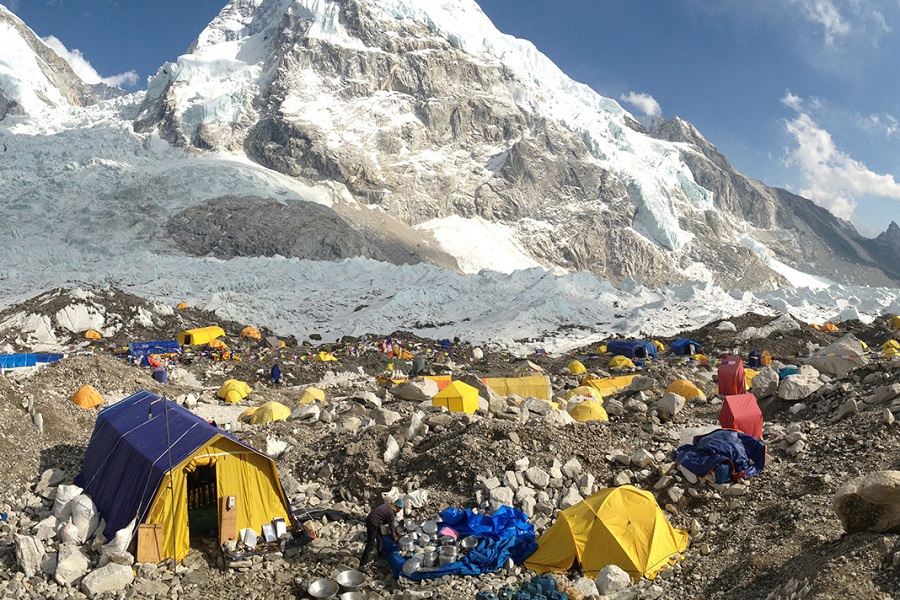
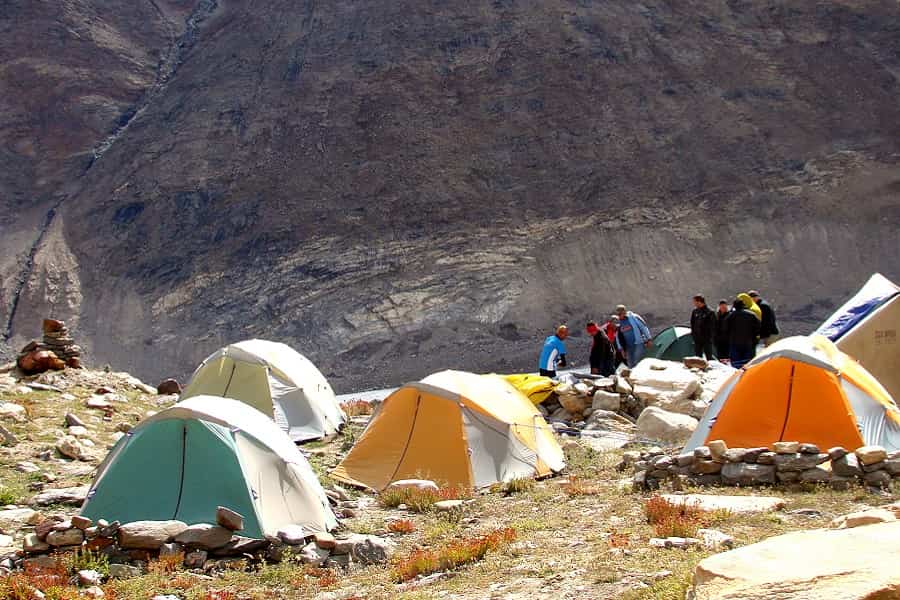
Base Camp is established after a 5-7 hour trek from Tangol village across moraine terrain, glacial streams, and steep scree slopes. The camp sits at the foot of the mountain with clear views of the Nun-Kun massif. A traditional puja ceremony is performed here, seeking blessings for a safe expedition. Base Camp serves as the logistics hub: equipment is distributed, technical training is conducted on nearby ice slopes, and the team prepares for the rotational climbing phase ahead.
Camp 1 (5,400-5,500m)
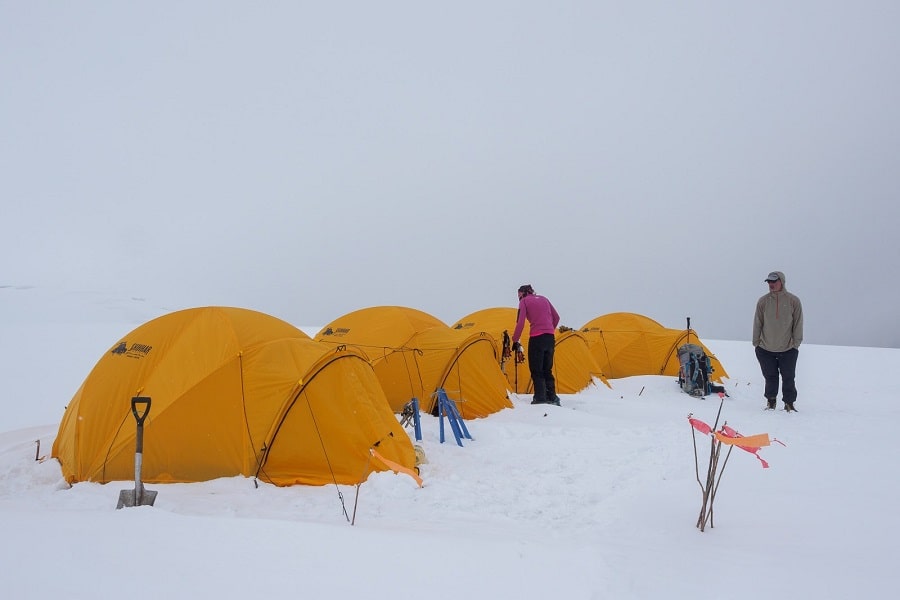
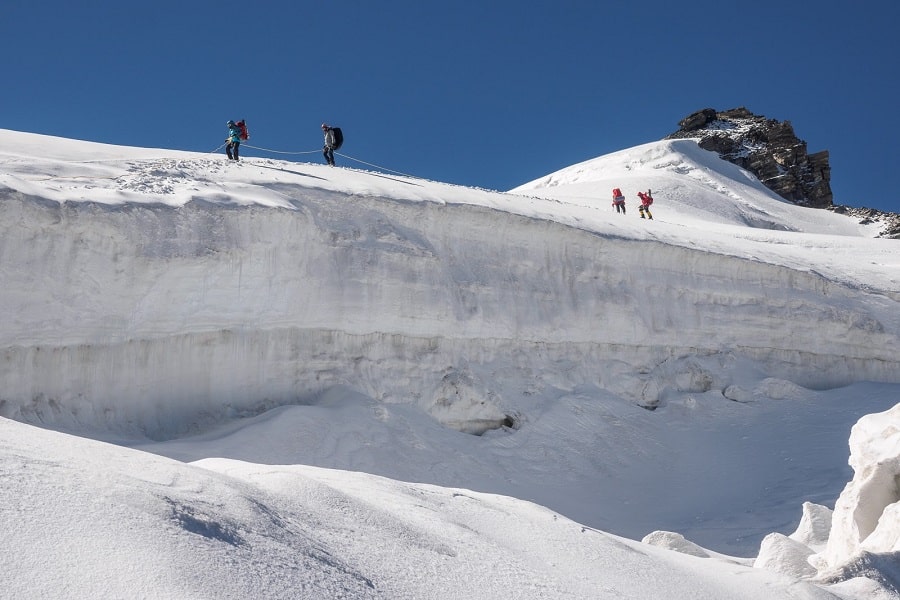
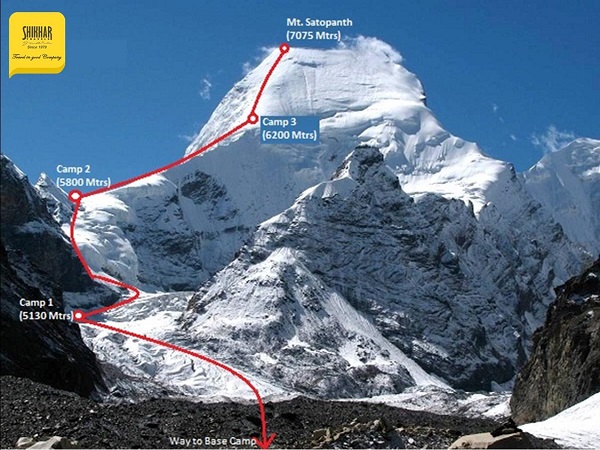
The route from Base Camp to Camp 1 begins with a two-hour climb up a steep rocky slope, followed by glacier travel on a well-established trail. The most challenging section is a 300-metre ice wall with gradients reaching 75 degrees this is where fixed ropes become essential. After clearing the ice wall and an additional steep ice patch, the gradient eases to around 30 degrees as you enter a vast 4-km wide snowfield. Camp 1 is established in the middle of this snowfield. Hidden crevasses are a constant concern in this zone. Estimated climbing time from Base Camp: 5-6 hours.
Camp 2 (6,000-6,100m)
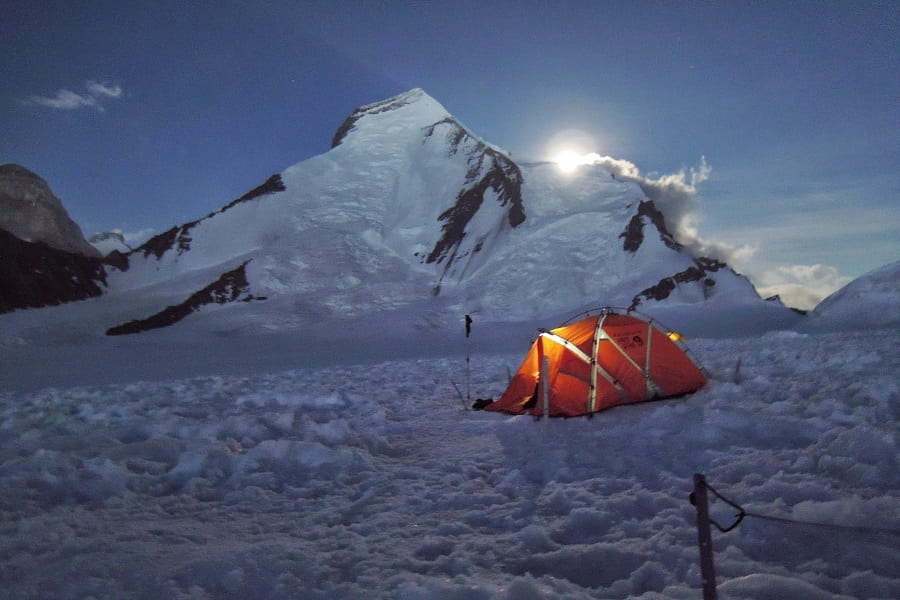
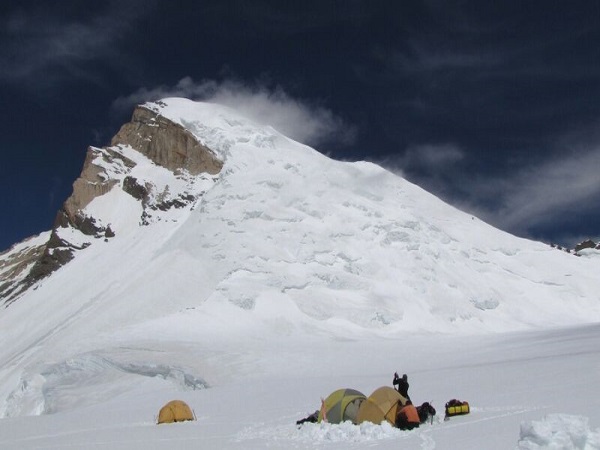
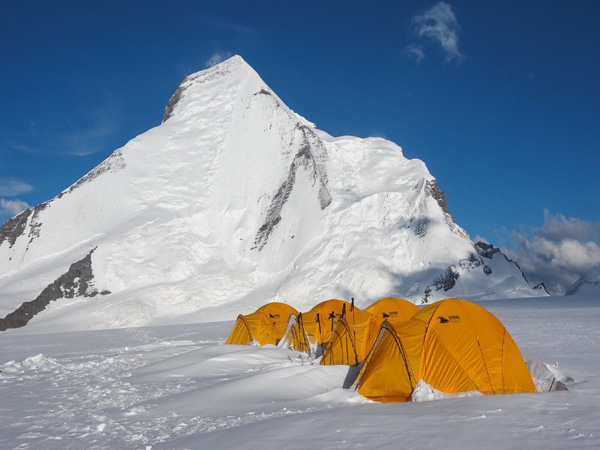
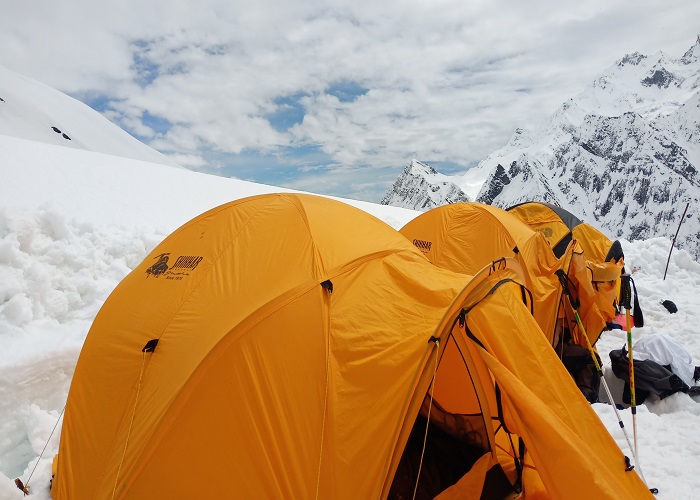
The ascent from Camp 1 to Camp 2 is the most physically demanding stretch of the expedition. The entire route is a straight, sustained climb on 60-70 degree slopes with a height gain of 600 metres. Front-point cramponing is required for much of the distance, and navigating boulder sections with crampons adds significant difficulty. Camp 2 is perched dramatically on a narrow, sloped ridge tents literally dangle on the edge with a steep slope on one side and an 800-metre drop on the other. Despite the exposure, Camp 2 offers the most spectacular views of the expedition: sunrise over the snow-covered landscape, the dance of cloud shadows across the glacier below, and an unobstructed panorama of the surrounding peaks. Estimated climbing time from Camp 1: 8-9 hours.
Camp 3 / Summit Camp (6,400m)
Camp 3 sits at 6,400 metres and serves as the launch point for the summit push. The route from Camp 2 involves an initial steep descent followed by relatively gentle snow dunes with gradients not exceeding 40 degrees. Camp 3 is stationed in the middle of a snowfield, similar to Camp 1. Estimated climbing time from Camp 2: 5-6 hours.
Summit Push (7,135m)
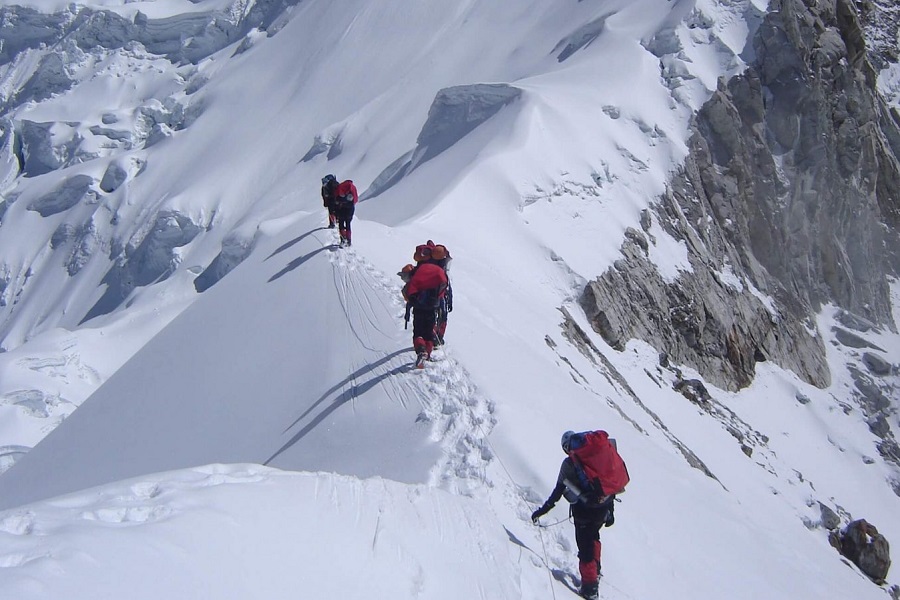
The summit attempt begins between 11 PM and midnight to take advantage of firm, stable ice conditions. Climbers access the west ridge from Summit Camp, traversing 40-60 degree ice slopes before the gradient reduces to 40-50 degrees on the upper sections. The final stretch involves navigating large boulders with crampons an exceptionally challenging task after hours of physical and mental exertion at extreme altitude. Once the boulders are cleared, approximately 50 metres of climbing remains to reach the summit of Mount Nun at 7,135 metres. The round trip from Summit Camp typically takes 14-16 hours. On a clear day, the summit provides views of the Karakoram Range and peaks across western Ladakh and Zanskar.
SAFETY, RISKS & MEDICAL SUPPORT
Known Risks on Mount Nun
Acute Mountain Sickness (AMS), High Altitude Pulmonary Edema (HAPE), and High Altitude Cerebral Edema (HACE) are the primary altitude-related risks. Symptoms can appear above 3,500 metres; Mount Nun's base camp is at 4,600 metres, well within the risk zone. Sudden weather changes including storms, whiteouts, extreme cold (below -20°C at summit), and violent winds on exposed ridges. Glacier hazards including hidden crevasses, unstable seracs, and shifting ice. Loose rock and scree on approach sections. Physical exhaustion from sustained high-altitude effort over multiple days.
Shikhar's Safety Measures
Experienced expedition leader and high-altitude Sherpas with a climber-to-guide ratio appropriate for the difficulty level. First aid medical kits carried at every camp. Oxygen cylinders available at higher camps for emergency use. Systematic acclimatization schedule with multiple rotation rounds to minimise altitude sickness risk. Daily health monitoring by the expedition leader. Communication equipment for emergency contact. All technical equipment (ropes, anchors, snow bars, ice pitons) inspected before every climb.
Emergency & Rescue
In case of a medical emergency, the team initiates descent to lower altitude as the primary response. Road rescue from Tangol village via vehicle to Kargil hospital. Helicopter evacuation can be arranged in extreme emergencies (weather permitting). All participants are strongly advised to carry personal insurance that covers high-altitude activities up to 7,500 metres, helicopter rescue/air evacuation, and emergency medical expenses with a minimum coverage of USD 6,000 for evacuation
.
IMPORTANT: Please ensure your insurance covers you for the heights you are likely to attain and for helicopter rescue. Provide Shikhar Travels with your insurer's name, 24-hour emergency telephone number, and policy number before departure.
GEAR & EQUIPMENT
What Shikhar Provides
All technical climbing equipment: fixed ropes, climbing ropes, high-altitude tents, carabiners, snow bars, ice pitons, high-altitude gas cartridges. Complete kitchen and camp equipment up to Base Camp. First aid kits and oxygen cylinders at higher camps. Accommodation in tents during the approach and at Base Camp (twin sharing). Transportation of member luggage up to 40 kg per person by porters from road head to Base Camp and return.
What You Need to Bring (Personal Gear)
Clothing: Layering system with moisture-wicking base layer, insulating mid layer (fleece/down), waterproof outer shell (jacket and pants). Thermal body warmer (upper and lower). Warm waterproof gloves (2 pairs recommended). Balaclava and sun-shielding hat. UV-protection sunglasses or snow goggles.
Footwear: High-ankle waterproof trekking boots for approach trek. Camp slippers/sandals for rest days.
Essentials: Rucksack (50-60 litres) with rain cover. Headlamp with spare batteries. Water bottles (2 x 1 litre) plus thermos flask. Small lunch box. Personal toiletries, sunscreen (SPF 50+), lip balm. Personal medical kit (consult your doctor). Energy bars, dry fruits, electrolyte sachets.
NOTE: Satellite phones and certain Garmin GPS devices are prohibited in India. Do not carry these items. Mobile connectivity (BSNL postpaid recommended) is available in Leh and Kargil but not beyond.
HOW TO REACH MOUNT NUN
By Air (Recommended)
Fly to Kushok Bakula Rimpochee Airport, Leh (IXL), located 4 km from Leh city. Direct flights operate from Delhi (1.5-2 hours), with connections from Mumbai, Srinagar, Jammu, and Chandigarh. Shikhar's expedition package includes Delhi-Leh-Delhi airfare.
By Road
Two highway routes reach Leh: Manali to Leh via Baralacha La, Lachalung La, and Tanglang La (500 km, open June-September). Srinagar to Leh via Zoji La, Lamayuru, and Kargil (450 km, open May-October). Road travel is scenic but long (2 days minimum).
Important Note for Foreign Nationals
Upon arrival at Leh Airport, foreign nationals must fill out a Foreigner Registration Form to enter Ladakh Union Territory. Carry passport, valid visa, and 2 photocopies of each.
From Leh to Base Camp
Leh to Kargil: 230 km, approximately 6-7 hours drive through barren mountain landscapes. Kargil is the last town with reliable mobile network, ATMs, and market access.
Kargil to Tangol Village: 75 km, approximately 4 hours drive through the Suru Valley. En route, you will see the first dramatic views of the Nun-Kun massif. Tangol is the trailhead for the trek to Base Camp.
Tangol to Base Camp: 8-9 km trek, 5-7 hours, crossing villages, moraine terrain, glacial streams, and steep scree slopes.
FAQ
How difficult is the Mount Nun expedition?
Mount Nun is rated as a challenging, technical expedition with an alpine grading of AD+ to D. It is one of the most demanding 7,000 metre peaks in the Indian Himalaya. The climb involves navigating crevassed glaciers, ascending ice walls with gradients up to 75 degrees, sustained front-point cramponing on 60-70 degree slopes, and a summit push of 14-16 hours from the highest camp. Unpredictable weather, extreme cold (below -20°C at the summit), and the physiological effects of altitude where oxygen drops to roughly 50% of sea level add to the challenge. This expedition requires prior mountaineering experience and is not suitable for beginners.
What experience do I need to climb Mount Nun?
You must have successfully summited at least one peak above 6,000 metres. Recommended prior peaks include Stok Kangri (6,153m), Kang Yatse II (6,250m), Island Peak (6,189m), Mera Peak (6,476m), or equivalent. You should be comfortable with crampons, ice axe, fixed rope climbing (jumar/descender), and roped glacier travel. A Basic Mountaineering Course certification from a recognised institute is strongly recommended. Mount Nun is not suitable for first time high altitude climbers.
How long does the Mount Nun expedition take?
Shikhar's Mount Nun expedition is a 24 day programme from Delhi to Delhi. This includes 2 days in Delhi (IMF briefing and de-briefing), 2 acclimatization days in Leh, travel days to Kargil and Tangol, 12 days for the climbing phase (base camp setup, rotational acclimatization, and summit attempt), and return travel. The climbing phase includes buffer days for weather delays, which are standard on all 7,000 metre expeditions.
Where is Mount Nun located?
Mount Nun is located in the Suru Valley of the Kargil district in Ladakh, India. It is part of the Zanskar Range and sits within the Nun Kun massif, approximately 250 km east of Srinagar. The peak rises to 7,135 metres (23,409 feet) and is the highest summit in the entire Zanskar Range. The nearest town is Kargil (230 km from Leh), and the trailhead is at Tangol village in the upper Suru Valley.
What is the best time to climb Mount Nun?
The best climbing season is July through September. August is generally considered the peak month with the most stable weather windows. This period coincides with the Indian monsoon, but Ladakh lies in a rain-shadow zone and typically experiences clearer conditions while other Himalayan regions receive heavy rainfall. Shikhar offers 5 fixed departures between July and August 2026.
How much does the Mount Nun expedition cost in 2026?
Shikhar's Mount Nun expedition costs USD 5,148 per person (inclusive of 5% GST). This is an all-inclusive Delhi-to-Delhi price that covers domestic airfare (Delhi-Leh-Delhi), hotel accommodation in Delhi, Leh, and Kargil, all transportation, meals including high altitude food, expedition permits and IMF booking fees, liaison officer services, mountain guide and Sherpa team, all technical climbing equipment, porter service, first aid kits, and oxygen cylinders.
What gear and equipment do I need to bring?
Shikhar provides all technical climbing equipment (ropes, high-altitude tents, carabiners, snow bars, ice pitons, gas cartridges) and camp equipment up to Base Camp. You need to bring personal clothing (layering system with base layer, fleece/down mid layer, waterproof outer shell), high-ankle trekking boots, thermal inners, warm gloves, balaclava, UV sunglasses, headlamp with spare batteries, rucksack with rain cover, water bottles, personal toiletries, sunscreen SPF 50+, and a personal medical kit. Note: Satellite phones and certain Garmin devices are prohibited in India.
Is Mount Nun harder than Stok Kangri?
Yes, significantly. Stok Kangri (6,153m) is a trekking peak that requires no technical climbing skills. Mount Nun (7,135m) is nearly 1,000 metres higher and demands technical ice climbing, fixed rope work, and sustained effort at extreme altitude. The jump from 6,000m to 7,000m represents a major physiological step oxygen levels drop further, recovery slows dramatically, and weather windows become much narrower. Climbers typically complete Stok Kangri or a similar 6,000m peak first, then progress to Mount Nun as their first 7,000-metre objective.
What fitness level is required for Mount Nun?
You need excellent cardiovascular endurance and leg strength. As benchmarks: you should be able to jog 5 km in 25-30 minutes and run 10 km in under 60 minutes. Strength training should focus on legs (squats, lunges), core (planks, deadlifts), and back. Practice hiking with a loaded backpack (15-20 kg) for 6-8 hours. A structured training programme of 6-9 months before the expedition is strongly recommended. Mental resilience is equally important the expedition involves sustained physical effort over 2-3 weeks in isolated, demanding conditions.
How do I reach the Mount Nun base camp?
The journey starts from Leh, which is accessible by air from Delhi (1.5-2 hours flight to Kushok Bakula Rimpochee Airport). From Leh, you drive to Kargil (230 km, 6-7 hours) and then to Tangol village (75 km, 4 hours) in the Suru Valley. From Tangol, a 5-7 hour trek (8-9 km) across moraine terrain and glacial streams takes you to Base Camp at 4,600 metres. Shikhar's package includes all transportation from Delhi to Delhi, including the Delhi-Leh airfare.
What permits are required for the Mount Nun expedition?
A climbing permit from the Indian Mountaineering Foundation (IMF) is mandatory. For foreign nationals, an additional permit fee of approximately USD 300 applies. A Liaison Officer is assigned by the IMF to accompany the expedition. Shikhar Travels handles all permit processing, IMF coordination, liaison officer arrangements, and local administrative formalities in Kargil all included in the expedition cost.
What are the main risks on Mount Nun?
The primary risks include Acute Mountain Sickness (AMS), High Altitude Pulmonary Edema (HAPE), and High Altitude Cerebral Edema (HACE). Sudden weather changes can bring storms, whiteouts, and violent winds at higher camps. The glacier terrain includes hidden crevasses, ice walls, and unstable snow conditions. Physical exhaustion from sustained high-altitude effort over multiple days is a significant factor. Shikhar mitigates these risks through systematic acclimatization, experienced leadership, daily health monitoring, communication equipment, and first aid/oxygen availability at camps.
What is the summit success rate on Mount Nun?
Summit success on Mount Nun depends heavily on weather conditions, snow stability, and the team's acclimatization and fitness levels. Like most 7,000-metre peaks, success is weather window dependent. Flexibility in scheduling and patience during weather delays significantly improve summit chances. Shikhar builds buffer days into every expedition schedule to maximise the window for a safe summit attempt.
Do you provide technical climbing equipment?
Yes. Shikhar provides all technical and group climbing equipment including fixed ropes, climbing ropes, high altitude tents for upper camps, carabiners, snow bars, ice pitons, and high altitude gas cartridges. Personal climbing equipment (crampons, ice axe, harness, helmet) may need to be arranged by the climber check with our team for the latest gear list and rental options available in Leh.
Is insurance required for the Mount Nun expedition?
Insurance is not included in the expedition cost but is very strongly recommended. Your policy should cover high-altitude mountaineering activities up to at least 7,500 metres, helicopter rescue and air evacuation (minimum USD 6,000 coverage), and emergency medical expenses. Provide Shikhar with your insurer's name, 24 hour emergency number, and policy number before departure. Without insurance, any rescue or evacuation costs must be borne by the participant.
Can beginners attempt Mount Nun?
No. Mount Nun requires prior high-altitude mountaineering experience at minimum, a successful summit above 6,000 metres. The technical demands (ice wall climbing, fixed rope sections, glacier navigation) and the physiological challenges above 7,000 metres make it unsuitable for first time climbers. If you are new to mountaineering, we recommend starting with peaks like Friendship Peak (5,289m) or Kang Yatse II (6,250m) before progressing to Mount Nun.
What is the acclimatization schedule?
Shikhar's acclimatization strategy follows a "climb high, sleep low" principle with multiple rotation rounds. Day 1-2 in Leh (3,500m) for initial altitude adjustment. Day 3-4 in Kargil and Tangol (2,676m-3,700m) with an acclimatization walk. Day 6-7 at Base Camp (4,600m) with training and rest. Days 9-14 involve rotational climbs: ascending to Camp 1 (5,500m) with load carries, returning to Base Camp for recovery, then sleeping at Camp 1 before moving higher. This systematic approach minimises altitude sickness risk.
What food is provided during the expedition?
Shikhar provides all meals throughout the expedition. In hotels (Delhi, Leh, Kargil), breakfast is included with select meals. During the trek and at Base Camp, three full meals (breakfast, lunch, dinner) are prepared by our cook team with a focus on nutrition, variety, and calorie-dense food for energy. Above Base Camp, ready to eat high-altitude meals are provided. Special dietary requirements can be accommodated with advance notice. Carry personal snacks (energy bars, dry fruits, chocolate, electrolyte sachets) for supplementary energy during climbs.
What mobile connectivity is available during the expedition?
BSNL (postpaid) has the best connectivity in Ladakh, followed by Airtel. Prepaid connections stop working once you enter the Ladakh region only postpaid SIM cards function here. Mobile network is available in Leh and Kargil. After leaving Kargil toward Tangol and beyond, there is no reliable mobile or internet connectivity until you return to Kargil. Plan your communication needs accordingly.
What accommodation is provided during the expedition?
Hotel accommodation (twin/double sharing) is provided in Delhi, Leh, and Kargil on designated days. During the approach trek and at Base Camp, accommodation is in tents on twin-sharing basis. At higher camps (Camp 1, Camp 2, Summit Camp), high-altitude tents are used, typically on 4 person sharing basis due to limited space for pitching. High-altitude tents are sturdier, more spacious, and designed for extreme weather conditions.
What documents do foreign nationals need for the Mount Nun expedition?
Foreign nationals must carry a valid passport, Indian visa, and 2 photocopies of each. A Foreigner Registration Form must be filled at Leh Airport upon arrival. A signed medical certificate from a qualified doctor is mandatory. High-altitude insurance purchased from your home country (covering helicopter evacuation and activities up to 7,500m) is required. 2 passport-size photographs. All original documents must be carried on person during the expedition. The expedition permit fee for foreign nationals includes an additional charge of approximately USD 300 above the Indian national rate.
NOTE: Satellite phones and certain Garmin devices are prohibited in India.